Out of the Mire
…because thriving is the goal
An Introduction to Personal Inertia and Taking Action
I can usually write a blog post in an hour or two but not this time. For some reason I could not put this post together no matter how hard I tried. I sat down in December to write a post on personal inertia. We were on the cusp of 2019. I was taking stock of 2018. Did 2018 have a personal theme? What could be gleaned from the experiences of 2018 in order to make 2019 even better? You know, I was being contemplative.
And then I was in a car accident. My daughter and I were rear-ended quite hard so much so that the insurance company totaled out my car. The car of the driver who hit us was towed from the scene. I really started thinking about my own personal inertia at that point.
What is inertia?
There are two definitions for inertia: 1) indisposition to motion, exertion, or change (“I don’t like or fear change.”) and 2) a property of matter by which it remains at rest or in uniform motion in the same straight line unless acted upon by some external force. Generally speaking, people tend to be inert. We develop habits, and we stick to them. It doesn’t matter if the habits are good or bad. We like predictability (“I like my car and would like to keep it.”). We don’t want to be confronted on how we do things, what we think, or how we interact with others. If it’s always been done a certain way, then most people will continue in this customary fashion from the smallest habit to the grandest cultural traditions. In terms of inertia, this is called uniform motion. For the most part, we like to remain in a state of uniform motion and/or rest, and this is not necessarily bad. Society needs structure and uniformity to function from the nuclear family all the way to level of government.
In terms of health, this is called homeostasis. The human body requires a certain amount of sleep. We require vital nutrients, daylight, human interaction, physical touch, exercise, and clean air and water in order to maintain homeostasis. All of this is part of uniform motion. When an outside force acts upon this homeostatic inertia, that usually means a stressor has occurred like a virus, toxin, physical injury, genetic mutation, car accident, or the like, and homeostasis has been disrupted. We are no longer inert.
The same comparison can be made to the emotional self–the mind. Emotional homeostasis in terms of wellness and looking after our mental health is a priority , and there are any number of factors that affect this from hormones, diet, and genetics to relationships, jobs, and family history–and, of course, trauma. How we structure our lives in order to maintain our emotional and mental homeostasis is where inertia becomes a factor in either propelling us forward or sabotaging us.
Why is a discussion of inertia worth having? Well, from what I’ve experienced in life personal inertia is often the primary reason we do not take action to make changes that will actually better our lives and set us up for success in the future. There is another name for personal inertia, and that name is fear. Let me define this particular sort of fear:
Somewhere between our internal experiences of our lives and our external perceptions lies the reality of the consequences of whatever action was actually taken–the choices we made. And, this is what I want to talk about because that nagging fear of living in that place–the land of consequences--is often what keeps us locked into our circumstances, thusly, preventing us from ever making the most necessary changes which ultimately gets us where we want to go.
Inertia and Fear of Negative Consequences
In my experience, there are two things that sabotage us when we are presented with the opportunity to take action. We become anxious because we don’t know what will happen (but we’re quite sure that it will be bad), and this anxiety/cognitive distortion exacerbates our personal inertia, thusly, thwarting our innate resiliency and ability to change; and we can’t overcome our own inertia long enough to implement the desired and likely necessary changes in ways that count.
What does this look like in real life terms?
An example:
Jane is a talented, intelligent woman with two college degrees who has traveled extensively and lived abroad. She runs a non-profit. She is multi-lingual and has a large social and professional network, She is kind, generous, and strives to make everyone around her feel comfortable and welcome in her presence. She volunteers at her kids’ school and teaches Sunday school classes. She is well-liked by her neighbors and her community at large, and she is beloved by her many friends. She met Tom, her husband, in college. Tom is a charismatic, extraverted man who aims to be the center of attention wherever he is. He thrives on admiration. He gave up his successful law practice to become a political consultant, and he excels at this occupation. He is highly paid and enjoys advertising his wealth and status by driving expensive cars, wearing expensive brand name clothing, and paying for everything in cash. He is loud, boisterous, and obsequious, but people seem to be drawn to him–particularly women. He has strongly narcissistic tendencies and a mercurial temperament behind closed doors to the point of being verbally and emotionally abusive to Jane and their three children. Male colleagues like him because he mirrors back to them their own positive perceptions of masculinity, and female colleagues like him because he is flirtatious but not excessively so giving them a sense of importance. Tom had one extramarital affair within the first three years of their marriage. They have been married for 18 years. Both Jane and Tom are from conservative Christian families who do not support divorce believing that “God hates divorce”. While Jane doesn’t believe that women should stay in abusive relationships, she will not label her relationship as abusive even though she is verbally/emotionally abused as well as pressured to stay married by both her family of origin and her in-laws in order to keep up appearances and “be obedient” to what the Bible teaches. During the last two years, Jane is experiencing symptoms of an undiagnosed autoimmune disease and chronic fatigue symptoms. She is also experiencing depression symptoms. She argues with Tom daily. Jane and Tom have verbally violent fights at least once a week in front of their children, and their oldest son is beginning to model some of Tom’s negative personality traits.
Where is the inertia in Jane’s situation?
- Her belief system: She is highly influenced by the promotion of an idea that God hates divorce even though God does not. This idea is pervasive within some Christian doctrine, however, and has kept many people in very bad situations. (Further reading: Does God Hate Divorce?) To leave, she would have to overcome this belief herself and likely tolerate a great deal of judgment from her family which could lead to long-term conflict. She would have to confront her family’s beliefs, her husband’s family’s beliefs, and her friends’ beliefs that she is sinning against God by leaving as well as her larger Christian community who also believe that divorce is a sin. The potential loss of support and community represent a huge inertial obstacle to overcome. For many people, this alone is a giant hurdle that is too daunting to overcome without proper supports in place.
- The dynamics of her family system and structure: When a family member with abusive tendencies is admired and beloved within and without the family system, victims of their abuse are robbed of their voice and empowerment simply because no one believes that the abuser is capable of perpetrating acts of violence. It is the “But s/he was so nice!” phenomenon. This often leads to victim-blaming (“What did s/he do to cause such a nice person to act that way?”) Also, there are families who view divorce to be stigmatizing and shameful and try to influence family members to stay married in order to prevent loss of social standing. This might sound absurd but fear of social injury through shame and rejection is a legitimate fear. Projecting that fear onto a victim of abuse, while inappropriate and wrong, is very common in family systems.
- Fear of the narcissist’s ego-driven response: When one defies a clinically narcissistic person causing a narcissistic injury, there is almost always a negative consequence. Leaving and divorcing a narcissist can be very difficult to the point of feeling impossible. Fear of retaliation often overrides the desire to leave. One often feels that it is better to stay rather than attempt to face off with the talionic rage of the injured narcissist, and that is legitimate particularly if there was physical abuse or threats of a custody battle if there were children in the relationship. (Further reading: Divorcing a Narcissist)
- Impoverished sense of self: Years of living in an abusive marriage and the larger family system impoverished Jane’s sense of identity. When one’s sense of self is eroded through increased exposure to unresolved conflict, it becomes harder to define the self in terms of the positive. Over time, the self becomes determined based upon the negative as an image is determined by its negative space rather than its true contents. This can act as its own inertia as well as it changes one’s narrative. Constant criticism, a consistent minimization of one’s emotional and intellectual repertoire, an increase in shame and hypervigilance, and mental distortions that skew perceptions of reality all come together to misrepresent the truth of circumstances as well as the whole self and its ultimate capabilities and future possibilities. Once a narrative becomes edited by distortions, a person’s uniform motion, as it were, is derailed and almost thrust in a different direction. The distortion of an impoverished sense of self resulting from abuse leading to this particular kind of inertia is hard to overcome. Certainly not impossible. Just painful. And that isn’t a small thing.
How do we begin to overcome our own personal inertia and take action?
Desire.
Put simply, we can begin to take meaningful and effective action in our lives when our desire for change is greater than our fear of change and the potential consequences that our actions could bring. In terms of inertia, our desire becomes the outside force acting upon our uniform motion which changes our direction or propulsion.
Desire can be an unwanted emotional experience for some particularly if it’s strong because it seems that fear and desire go together in a sometimes awkward and toxic dance. The stronger the desire the more powerful the fear, and it often depends on how desire manifests. Desire can feel like ambition or intense focus on a goal. It can feel like a consistent attraction to specific daydreams or fantasizing. It can also feel like longing or yearning unearthing a profound sense that you are not living a life meant for you. You may feel like something is missing drawing you into a sort of quest or search. In its more helpful form, desire can be an ontological state that motivates an awakening which drives the self to deeper self-actualization–desire freed from fear. Desire mingling with fear often manifests as envy, jealousy, toxic competitiveness, judgmentalism, and comparisons with others. Desire can be highly disruptive to the self.
What is very interesting to note is that there is a neurochemical connection between desire and fear, and it is found in dopamine:
“The chemical dopamine induces both desire and dread, according to new animal research in the July 9 issue of The Journal of Neuroscience. Although dopamine is well known to motivate animals and people to seek positive rewards, the study indicates that it also can promote negative feelings like fear. The finding may help explain why dopamine dysfunction is implicated not only in drug addiction, which involves excessive desire, but in schizophrenia and some phobias, which involve excessive fear.” (Society for Neuroscience. “Brain Chemical Shown To Induce Both Desire And Dread.” ScienceDaily. ScienceDaily, 9 July 2008. )
How do we take this information and make it work for us? The things that we often fear are quite valid–the loss of community, fear of retaliation and violence, social injury and rejection, fear of God, loss of occupation, inability to survive, and loss of social standing. This is about survival. Staying “stuck” and in predictable circumstances–even if we hate them or they’re hurting us–may often seem like the best choice when faced with potential outcomes that we fear should we allow desire to influence us. Our own neurochemistry can bolster this mindset. Desire or dread. What should influence us?
The question of influence, to me, is one of the most important issues we can consider. When we are influenced more by a fear of potential negative outcomes our natural response will be an inertial one which is to maintain. Stay put. Stay the course. Refuse change. Do what you know even if what you know is making you miserable and sick or even making your loved ones miserable and sick. It is an internal battle that must be fought. Where there is desire, there will be fear particularly when the potential for change is present. In theory, this might sound all well and good, but what comes after desire?
I like this list:
- Needs–Your Propulsion System: “When our emotional needs are fulfilled by loving parents and a supportive environment, we have a propulsion system that initially pushes us along a positive trajectory. In contrast, if our needs have not been adequately met in childhood, for example, if we grew up in an emotionally chaotic family, then our need for love and security becomes a propulsion system that drives us powerfully, but down the wrong path. We will need to let go of our unhealthy needs and reconnect with our healthy ones, so that we can finally power our life inertia with a propulsion system of our own choosing.” (Four Forces of Life Inertia, Jim Taylor PhD)
- Self-Esteem–The Pilot: “If you are driven to gain love, a feeling of security, and a sense of competence from other people because you need their approval to feel good about yourself, then others are controlling your life path. An essential part of piloting your spaceship will require that you learn how to trust in your inherent value and capabilities, so that you can be in control of your own self-esteem. This shift will relieve the immense and unrelenting pressure to gain self-esteem from others and put you on a trajectory to gain your own feelings of love, security, and competence, which is the only true way to feel good about yourself. With this genuine self-esteem, you will have the capabilities to take full command and pilot the spaceship that is your life.” (Four Forces of Life Inertia, Jim Taylor PhD_
- Ownership–The Guidance System: “If you have spent most of your life doing what others wanted you to do instead of asking yourself what you wanted to do, you may never have felt that you were responsible for your life. Ownership means that you are an independent being who has a cause-and-effect relationship with the world in which your actions matter, your actions have consequences. With ownership, you do have to accept responsibility for your mistakes and failures, but you also get to accept responsibility for your successes and achievements. Additionally, you now have the power to change your life. Once you accept ownership of your life, you will be able to direct your life trajectory with your vision of who you are, what you value, and where you want to go.” (Four Forces of Life Inertia, Jim Taylor PhD)
- Emotions–The Fuel: “Children who are raised in families where there is a lot of emotional turmoil will often develop internal lives that are dominated by negative emotions. If your life is controlled by negative emotions, it’s really hard for you to be happy. It’s as if you’re trying to run your spaceship on contaminated fuel.When parents who believe that “bad” emotions will hurt their children and try to prevent their kids from experiencing, for example, frustration, anger, or sadness, the children will end up emotionally undernourished, deprived of the chance to understand and gain mastery over the full range of what they are capable of feeling. That lack of emotional mastery results in an empty fuel tank, leaving your spaceship drifting through life without a means of propelling it, and vulnerable to outside forces that will dictate your life inertia. When you gain mastery of your emotions — when you are capable of identifying, understanding, and expressing your emotions in a healthy way — you produce a fuel that pumps directly from your soul, burns reliably, and can power your life inertia efficiently in whatever direction you choose.” (Four Forces of Life Inertia, Jim Taylor PhD)
Why endeavor to engage in this? I’ll let Dr. Jim Taylor answer this:
“When we change our life inertia, we liberate ourselves from those forces that have, until now, propelled us in a direction we would not have chosen. With control of the spaceship that is our lives, we will have freedom from debilitating fear, doubt, anger, shame, and despair. It also means we will have the freedom to hope, feel, accept, engage, and strive. When you are in command of your spaceship you are on track to live a life that will bring you meaning, fulfillment, and well-being. And you can be sure that you will not have to experience the most frustrating of all emotions – regret. Once you have gained command of your life you will not have to ask, “I wonder what could have been?” (Four Forces of Life Inertia, Jim Taylor PhD)
May 2019 be a year of daring to desire and taking action.
Keep going.
Stopping the Holiday Madness
The Iceman hath indeed cometh to my neighborhood. I woke up in the wee hours of the morning to the sound of snowplows clearing snow and scraping concrete. I had grand plans to “get shit done” yesterday until my car got stuck in the alley in a mound of snow. Well, three inches of snow that had somehow become a mound that my totally hip minivan couldn’t overcome. I see now why all the locals drive SUVs. Nothing seems to stop them. Not snow, ice, flash floods. Pedestrians.
Hanukkah begins tonight, and I have a To Do list that needs attention before that first candle is lit. This weekend, however, feels a million times less stressful than last weekend. You know, Thanksgiving weekend–the first Thanksgiving weekend my mother and stepfather have come to my house in years.
About 11 years ago I had an epiphany. Our family holiday get-togethers had become so emotionally tumultuous and stressful that I wondered why we even bothered to celebrate them. What was the point? I tried taking Xanax once just to get through Thanksgiving, and that was a mistake! I took one Xanax in the morning and fell asleep standing up while cooking. Suddenly, I woke up on the kitchen floor an hour and half later with no memory of how I got there.
The thought occurred to me to just tell my mother, “No, you cannot come over on Thanksgiving. Celebrate with your husband’s family,” but my mother has borderline personality disorder. The last time I told her ‘no’ I was a small child. She slapped me so hard across the face that I nearly sustained a whiplash injury. Over the years, I’d seen people tell my mother ‘no’. It never went well for them. Violence always ensued in one way or another, but eleven years ago I was willing to take that risk. Either give up celebrating altogether or tell my mother ‘no’.
So, I found some courage, and I told her that we wanted to celebrate Thanksgiving by ourselves in a way that was meaningful to us. She had in-laws. Celebrate with them (I wasn’t that blunt). That was probably one of the reasons my mother stopped speaking to me. For five years.
So, last weekend, my mother and stepfather drove in from out-of-state to join us for Thanksgiving, and I had a feeling that it would be a less than pleasurable evening. Over the years, we’ve crafted a certain kind of holiday. We eat in the evening. We stay at the table. We enjoy drinks and desserts. And then the games come out. Sometimes we’ve played until early into the next morning, but my mother doesn’t know how to have fun. She doesn’t have great social skills, and part of that is due to how she was raised. My mother has also spent far too much time alone as she has aged, and her ability to socialize has slipped. As her daughter, I observed this, and, as a host, I kept this in mind.
By six o’clock in the evening on Thanksgiving, I knew it was just going to be about getting through the night. It wasn’t fun. It felt like playing a social game of Tetris. People around the table were, at times, acting inappropriately, and I, as the host, had to somehow make the remarks and behaviors fit together to keep the evening flowing smoothly. I was glad when it ended. As I cleaned up, I distinctly remembered why I disliked holiday celebrations.
Why do we do it? I ask it honestly. Why do we put ourselves through the meat grinder that is Holiday Celebrations with Friends and Family if we feel so drained afterwards?

Ah yes, tradition. How many awful things have been tolerated in the name of Tradition? Sure, sure, we get to eat some great traditional food like Great Aunt Vera’s dessert bars and Auntie Esther’s bread, but then three of your cousins show up two hours late completely shit-faced and high, your sister-in-law starts talking politics during dinner and refuses to change the subject, your brother starts discussing religion and offends a co-worker you invited, your father is passive-aggressive and upsets your mother-in-law, and then a family argument ensues in the middle of dinner about that thing that happened that one time. Just like last year. And the year before that! It’s like a holiday template that must be followed every year, or it isn’t the holidays.
I’m not suggesting that my idea to un-invite my mother to Thanksgiving was the “right” thing to do, but it was a different thing to do. I wondered what life during the holiday season might feel like if I said, “No one can come over until they stop acting badly. You want to come over? Then deal with your issues. I’m not having bad holidays anymore. Can we please start a new tradition?” You know that you have a real problem on your hands when you start dreading December in June, and that was me. I wanted to know what an honestly pleasant celebration free of drama, enabling codependency, crippling anxiety, and pandering to pathologically self-centered people felt like.
What does it feel like? It feels wonderful. There are no more obligatory visits with family members who actually don’t approve of us and actively look down on us for not thinking like they do. I can spend the month of December making positive plans rather than making plans to decompress from excessive stress. I don’t have to come up with strategies to avoid my cousin’s husband who likes to secretly grope me when he hugs me, and I don’t have to think of ways to sidestep political and religious discussions that always end in fiery judgment and unkindness.
One key thing I learned from this Thanksgiving is that I don’t have the distress tolerance for “misbehaviors” when the circumstances are already stressful, and this I would suggest is likely true for many people.
This is the most important takeaway. Somatic complaints are very common during the holidays for this very reason. Our bodies cannot adequately process the overload of stress which comes in the form of a cortisol assault on your body. Cortisol is a hormone produced by your adrenal glands. When you are stressed, your body produces it. One of the key things that cortisol does is suppress your immune system’s response. Have you ever had a very stressful week at work or school like completing a big presentation or studying for exams? You’re doing fine and then once the project or exams are over, you suddenly get sick. Or, if you get migraines, you are migraine-free during the stressful work week, but come Saturday, you’re down with a terrible migraine event. Why is this?
The symptoms of illness like a runny nose, sore throat, body aches, or nausea are not caused by a virus. Those are signs of inflammation which are caused by your immune system engaging in a response to fight off a pathogen. In other words, that’s how you know that you caught a bug. In the stressful days prior to your symptoms when you were neck-deep in exam prep (or Holiday Apocalypse Family Fun Time), you were already infected with a virus. Your body’s stress-induced production of cortisol, however, was suppressing your immune system’s response to that pathogen. So, you had no symptoms of the infection, but you had an infection. You merely experienced the symptoms of the infection after your stress decreased along with your cortisol production. The stress causes the spike in cortisol production, but it is likely the lifestyle changes that puts you at risk for viral infection like poor dietary habits and sleep deprivation. We all eat more poorly and get less sleep during “crunch time”, and that is what invites viral infection. We simply stop taking care of ourselves particularly when we feel like something is on the line like our jobs, grades, or our sense of self. And the holidays certainly have a way of doing that to us.
Not managing our stress contributes to cortisol dysregulation which can result in a number of health problems and negatively impact your immune system. Bottom line: take care of yourself and invest in your own level of happiness and well-being even if it proves to be very difficult. Why? Because you’re worth it and you deserve a meaningful holiday experience–even if you have a family who disagrees with you.
With that, I bid you a meaningful and healthy December.
Life Is A Highway
Have you ever been in the middle of a particularly major life transition and wondered if you were doing the right thing? Or, perhaps you were quite certain that you were headed in the right direction; you, however, weren’t sure that some of the lesser but still impactful decisions you had to make were correctly decided.
That’s descriptive of me right now. I’m in the middle of a huge life transition–I’m planning a move to the West Coast next summer. Were it just me it wouldn’t be such a big deal, but I’ve got my daughters’ quality of life to consider. We are all in the mix. I’ve got to sell my house, put the finishing touches on moving to a different post-graduate program, find housing in the Bay Area (yeah, that’ll keep you up at night), minimize all my possessions, and…and…and…
It’s a colossal effort, and yet I know it will come together. But…
There are those moments of quiet when I take in the magnitude of it all, and I ask, “Am I doing the right thing for everyone?” It’s not often, but it’s not an unimportant question. When there are children depending upon us to care for them and build a foundation under them, we need to ask such a question. As a Jew, I pose that question to God as I and my ancestors have come to understand him both personally and corporately. And, I sincerely expect an answer although answers don’t always come on my preferred timeline.
The late Brennan Manning once told a story of a Jewish Bubbe out with her grandson at the shore. She was delighting in watching him play with his new shovel and bucket until a large wave unexpectedly washed ashore and swept his toys out to sea soaking her young grandchild in salty water. Running to her grandson as he sat crying on the sand, Bubbe called out, “Bring back my grandson’s shovel and bucket! It makes him so happy to play with them, and, if it makes him happy, then I am happy!” A few moments passed, and suddenly a wave spit out her grandson’s bucket and shovel right at their feet. Smiling and clapping, her grandson resumed playing as if nothing had ever happened. Bubbe, however, frowned and said, “He had a hat!”
Some would say that Bubbe is ungrateful. Look at the miraculous quality of what just happened! The sea returned the shovel and bucket! So what that his hat wasn’t returned to him. I say that Bubbe is expectant, and this boldness and sense of anticipation in believing God, as she understands him, is what informs how she interacts with him.
So, what does this have to do with my moving out West? Well, I think that regardless of one’s understanding of who God might be–even in terms of agnosticism, interacting with God (or if you want to call the Divine “the Universe”) can be a highly rewarding and reassuring process. It can remove a sense of ontological loneliness that plagues so many of us and guide us through incredibly difficult circumstances. In my case, on the day I decided that we were going to move West, I asked for a reassurance that it was the right decision–something I rarely do, but it was such a big, life-altering decision. I wanted the strongest sense that it was right. So, I drove my car along a stretch of highway pondering what a “good reassurance” might be. Something that I could look back on when circumstances got rough and remind myself, “Oh, you’re on the right track. Remember? You saw that sign.”
Suddenly, I had it! I love bald eagles, and we have a few of them in my neck of the woods. I decided that I wanted to see a bald eagle in a tree right by the road as I was driving–something I never see. It didn’t have to be that day. Just…soon. I’ll confess that I felt silly. Asking for a sign. P’shaw! as my grandfather would say. As soon as I asked God to give me a sign, I almost took it back. I don’t do things like that. But then, in the middle of my embarrassed rumination, I saw it. I slowed down my car to take it in. A beautiful bald eagle perched majestically on a branch overhanging the highway’s shoulder at 7 AM. I was shocked. “Did that just happen?” I thought. It did indeed.
My mind has returned to that moment during times of high stress and anxiety, and it has caused to me to wonder what signs really are. What is a sign?

When we drive, we see signs all the time, or at least we should see them if we are paying attention. We’ve probably all encountered people who don’t pay attention to the road signs. Those are the people driving the opposite direction on a one-way street or doing a U-ey when they should not. How about those folks who run stop signs for lack of paying attention, thusly, causing an accident? Signs serve a very good purpose. They let you know where you are, what you should do, how fast you should drive, where to go, and where not to go. The most important thing to note about signs is that one has to see them in order for them to be effective.
Well, if Tom Cochrane’s song is correct and life is a highway, then it stands to reason that we need signs, too. We need to know when we are on the right road. We need to know where the next rest area is. We need to know where we should not turn and where we should. What does a Do Not Enter sign look like in terms of our own lives? What does a Be Alert For Bears sign or an Avalanche Warning sign look like metaphorically speaking? More important, what does a Dead End sign look like? How do you know when you can’t go any further?
For me, this is why I asked for a sign. I needed to know that the road I had just turned onto was the right one since the journey was going to be so long and, frankly, fraught with hurdles.
So, how does one recognize a sign?
- Many signs directing us are dismissed as coincidences, but the longer I’m alive the more I’ve come to believe that there are few coincidences in life.
- Stay present to your circumstances and surroundings. Pay attention to the interactions you have with people. Just as in driving, when we fail to see crucial signage we often miss exits we intended to take, get stuck in traffic, or get lost. This is analogous to our lives and our journeys.
- Learn to trust your intuition and insights. For example, a few weeks ago I was at a crossroads. I needed to decide if I was going to continue taking classes next trimester in my medical program. I have the support of everyone around me to discontinue at my current school and continue at the program in the Bay Area, but I still feel anxious about it. I woke up last week wondering if I should just enroll in classes next trimester even though I don’t really want to do it. Then, the mail came. The Department of Education’s Office of Civil Rights (OCR) found my college guilty of discrimination based on sex–a violation of Title IX. I read through all the provided documentation and the OCR’s mandated corrective actions which will cost the school thousands of dollars into six figures. I knew then that I could not enroll again. My original decision not to continue my medical education with this college was the right one. The documentation and guilty verdict were a sign or sign post, if you will, that I was on the right road.
- Don’t feel afraid to ask for a sign. Why? Well, traveling outside of the spaces in which you feel safe requires taking risks, and humans don’t like uncertainty. We like to know where we are going and what to expect. While it’s not possible to know the outcomes of everything, it is possible to get into the driver’s seat of your own life and gain a sense of personal empowerment. There is paradox in here. The people who do their best to avoid risks are generally the ones who are bound by anxiety. There is a strong link between risk aversion and anxiety and depression. Leading a narrow life never lessens the anxiety. It just forces one to become an emotional and physical shut-in preventing one from experiencing the happiness and fulfillment so desperately desired.
- Cultivate trust in yourself: “How do we leap and trust that it will all be okay? By cultivating a practice of self-trust, which connects us to the well of our deepest knowing where the answers to the unanswerable questions live. And these aren’t answers so much signposts or hints at the paths we want to walk, the decisions we want to make, the risks we’re willing to take. Because death exists life cannot be anything other than risk. Because loss exists relationships are the ultimate risk to our hearts and how can we do anything other than forgive our ego – that part of us that desperately attempts to safeguard against pain – for trying to protect us in the only way it knows how?
But risk we must if we’re to live a full life (like our cat). People who take risks are happier because they live their lives more fully, without fear at the helm of their ship charting the course (which means they venture out to open seas). They not only jump out of airplanes and off mountaintops – as my son is itching to do – but they dive into the murky waters of the greatest emotional risk of all: relationships of all kinds. They risk their hearts (which do not heal as easily as a broken bone). And they do so from a platform of self-trust, which is the launching pad for all of life’s decisions, big and small.” (Risk Aversion and Anxiety)
Further Reading:
What Happy People Do Differently
One of life’s sharpest paradoxes is that the key to satisfaction is doing things that feel risky, uncomfortable, and occasionally bad.
Becoming an Agent of Goodness
I am seldom on Facebook, but, as I was up bright and early this morning, I indulged my urge and took a peek. This is what I found:
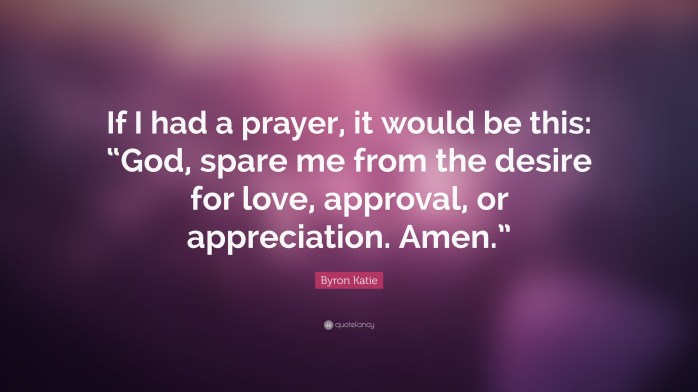
My knee-jerk reaction was, “What the fu…” Was I more shocked by the original “prayer” or with my Facebook friend’s additional commentary? And, why did these words strike a nerve in me?
I must turn back the clock to 2014, when I wrote my most highly viewed blog post “Affective Deprivation Disorder and Alexithymia in Marriage”. In that post, I described the emotional experiences of my former marriage:
“If I could remove all emotional desire from myself, then I would be able to do this (stay married). I actually asked God to make me like Spock. That has to be one of the weirder prayers to ascend. Like some warped psalm:
“Oh God, make me like Spock. Purge me of emotion. Oh my soul, shut the hell up so that only my brain will speak and my heart will sleep a thousand years.”
Oddly these two entreaties, if you will, have a similar tone. I longed to be purged while Byron Katie desires to be absolved as elucidated by the use of the word “spare” which means “to be released, acquitted, exculpated, or pardoned”. The end result would be the same–a kind of subjective idealism that could take a person all the way to solipsism. What does that mean? Allow me to explain.
Firstly, it should be stated that nothing that Byron Katie teaches is new or ground-breaking. She is combining the Narrative Approach in psychology with certain Buddhist principles to craft a teaching that has been used in Dialectical Behavior Therapy (DBT), EMDR, and cognitive behavioral therapy (CBT) for years. Her Four Questions are well-stated. She has made solid therapeutic guidance highly accessible to many people. With Oprah’s stamp of approval, people who have perhaps disregarded therapy as ineffective or stigmatizing will now have a chance to experience what solid therapy is all about. That being said, her Four Questions are straight out of CBT and Narrative Psychology.
So, what of this philosophy of subjective idealism? Simply stating it, subjective idealism states that your reality and how you perceive it is contingent upon how you experience it; Reality is contingent upon The Knower–to be is to be perceived. The extreme form of subjective idealism is solipsism which states that “I alone exist”. British Idealist F.H. Bradley explained solipsism as such:
“I cannot transcend experience, and experience must be my experience. From this it follows that nothing beyond my self exists; for what is experience is its [the self’s] states.” (online source)
Bradley’s explanation almost defines 21st century human interaction. You stay in your experiential bubble. I’ll stay in mine. Nothing beyond my experience exists. Nothing beyond your experience–if that is valid–exists or is germane to mine. We are but ships passing in the ether in anonymous, quick interactions either on social media, in consumeristic interactions online or at retail outlets be they malls, indy stores, or cafés big and small. Disconnection.
This brings me to Maslow’s hierarchy of needs:
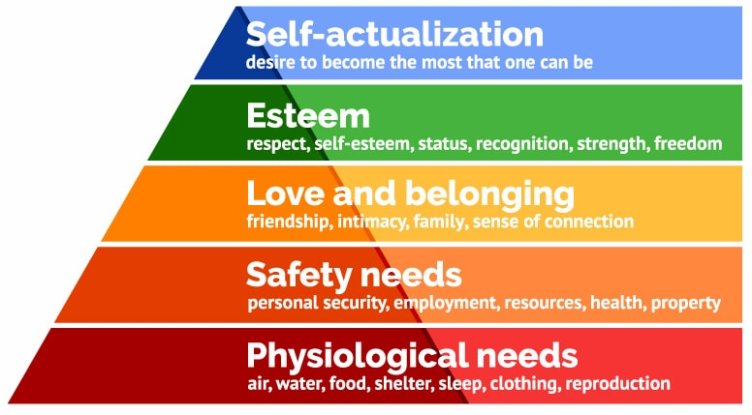
Directly above our two most basic needs in terms of our humanity–Physiological and Safety–lies Love and Belonging. Putting it as simply as possible, one of the reasons why people require therapeutic interventions and outside help for prolonged periods of their lives is because they have to figure out how to acquire and develop Esteem and Self-Actualization without Love and Belonging. Or worse, if a person experienced hardships and traumas in which their Physiological and Safety needs were threatened or unmet, then certainly their needs for Love and Belonging would go unmet as well. In that case then, how would one go about developing Esteem and Self-Actualization in a coherent way? How do we build bridges over deficiencies in order to continue maturing until we can increase our capacities for those needs to be met? Is it possible for everyone?
What Katie and my friend are suggesting is that we simply obliterate the need and desire. We resort to emotional subjective idealism–particularly my friend. If God is meeting my desire for love, approval, and appreciation, then I no longer need it from humans. Well, that contradicts the teaching of Jesus and the rest of the New Testament, and I only say this because my friend is a Christian. So much of the New Testament and the Gospel are concerned with relationships and community and how people are to treat one another. Why then post something that essentially advocates extricating oneself from reciprocal relational experiences and responsibilities, thusly, retreating into a self-created pseudo-solipsistic model?
This I know all about. To counteract pain and grief.
Human beings are social creatures. We are mammals after all. There is a scene in the film “The Horse Whisperer” in which Robert Redford’s character, Tom, stands in a field for hours near a traumatized stallion, Pilgrim. Pilgrim, appearing fatigued from standing in the same spot for such a long stretch, finally approaches Tom reluctantly. Tom gently leads him back to the stables. When asked why the skittish horse allowed Tom to touch him, he answered that horses were social creatures and would eventually have a need to join their herd; or, a herd of some kind.
Humans are no different, but we have very clever ways to convince ourselves otherwise. We build bridges inside ourselves over the empty and dark crevasses of unmet needs that have morphed into unnamed pain and call it Stoicism, Enlightenment, or Individualism. We will say that we are absolving ourselves of our needs or desires for love, approval, and appreciation, and it sure does sound like something…worthy. In my mind, however, it is a form of bargaining in order to avoid grieving that which has been lost or never experienced, and I say this because I used to believe these things, too.
The problem herein is that absolving yourself of your desires to be loved, approved of, and appreciated also pardons you from giving these things, and this is, in a more profound sense, what is causing people to pray for this sort of absolution to begin with. The world we have today is in no way more evil, chaotic, corrupt, or violent than it was 100 years ago–or 1,000 years ago. History seems to always repeat itself, and humans still struggle to learn from the past. What the world continues to lack is goodness in the forms of love, approval, appreciation, generosity, courtesy, and neighborly concern.
What might our cultures look like if more people were appreciated, loved, and approved of? How would you feel day-to-day if you felt truly appreciated by your friends, children, co-workers, and partner? If you felt approved of–truly liked–by the people in your life? Well-developed and self-actualized people do not require other people’s permission to make their life choices or hard decisions, but it is much easier to achieve self-actualization if you have a foundation of Love and Belonging beneath you rather than a foundation of grief for never having had it.
The healthy and ultimately most healing “prayer” that I think one could offer up instead of the aforementioned is:
God, help me grieve the times and experiences in my life wherein I did not receive the love, approval, and appreciation that were meant to develop me for Esteem and Self-Actualization. Introduce me to healthy people who know how to love, approve of, and appreciate me and others properly so that I may become a fully-developed, healthy person who can not only fully internalize and experience the spectrum of loving experiences but also go on to love, approve of, and appreciate others in order to become an agent of Goodness in the world. Amen.
Gaslight Nation
I have made a point to keep my blog free of all political discussion purposefully because I don’t run a political blog. 21st c. political discourse tends to be characterized by fear mongering, polarizing and pedantic language, a lack of civility, ad hominem attacks and other logical fallacies, and a ferocious but presently normalized invective that was not culturally familiar or acceptable twenty or even ten years ago. I am most likely the millionth person to observe that something has shifted in the last five years in the United States in terms of what Americans accept as ‘normal’ behavior from our local, state, and national leaders. Where we were once scandalized by a sitting president engaging in oral sex with an intern in the Oval Office, we now condone (in the form of electing him to office) a father’s brazen admissions of sexual attraction towards his daughter as well as permit a known sexual harasser and batterer to occupy the highest office of power in our country. This is where the culture wars, political partisanship, ideology substituting itself for good politics, and excessive corporate campaign contributions led us.
They led us to the great disaster of Judge Brett Kavanaugh’s confirmation hearing before the Senate Judiciary Committee Friday, September 28. The nation was on pins and needles because this was not just another hearing. Something about this hearing felt nauseatingly familiar to many men and women tuned into C-Span, and I’m not talking about politics. Something else was afoot.
Judge Kavanaugh was nominated by Mr. Trump in July 2018 to replace Supreme Court Justice Anthony Kennedy. While I’m very interested in the political reasons for Mr. Trump’s choice not the least of which is Kavanaugh’s view that a sitting president cannot be indicted, I am far more inclined to examine Sen. Lindsey Graham’s (R-SC) outburst during the hearing in which he explodes in anger towards the Democrats questioning Kavanaugh:
“What you want to do is destroy this guy’s life, hold this seat open, and hope you win in 2020.”
The Republican from South Carolina then turned his attention back to Kavanaugh and asked: “Are you a gang rapist?” Kavanaugh replied: “No.”
The Republican senator also asked Kavanaugh, “Would you say you’ve been through hell?” Kavanaugh responded, “I’ve been through hell and then some.”Graham expressed sympathy for the Supreme Court nominee and his family, saying, “I cannot imagine what you and your family have gone through.” He added, “I hope the American people can see through this sham…”Earlier in the day, Graham compared the judge’s treatment to Ford’s experience, the woman who came forward to accuse him of sexual assault.“I’m not going to reward people for playing a political game, I think, with her life,” Graham said. “She is just as much a victim of this as I think Brett Kavanaugh (is). Because somebody betrayed her trust, and we know who she gave the letter to.” (CNN)
Certainly, this outburst has a political context, but there is a wide stream of that something else flowing through this dialogue; and it should not to be missed. I want to break it down, but before I do I want to note that Sen. Graham spoke with Chris Wallace on “FOX News Sunday” prior to the hearing. Here’s what he said:
“What am I supposed to do, go ahead and ruin this guy’s life based on an accusation? I’m just being honest. Unless there’s something more, no, I’m not going to ruin Judge Kavanaugh’s life over this. But she should come forward. She should have her say. She will be respectfully treated…I will listen, but I’m not going to play a game here and tell you this will wipe out his entire life,” Graham noted. “‘Cause if nothing changes, it won’t with me.” (CNN)
There it is again–that idea that Kavanaugh’s life will be ruined somehow were Dr. Blasey Ford’s allegations found to be credible, and Graham is…what? The harbinger of Kavanaugh’s downfall should he hold him to account with rigorous questioning or further investigation? As CNN’s Editor-at-Large says, “If the very people who hold in their hands — and votes — the power to make or break Kavanaugh’s nomination are admitting publicly that almost nothing Ford says will change their mind(s), isn’t that the sort of rank partisanship that has gotten us into this morass in the first place?” Logically speaking, if Kavanaugh sexually assaulted a young woman in high school, then isn’t he the cause of his own ruin? Of course, a young man can hardly conceive that one day he might be a Supreme Court Justice nominee, but that is neither here nor there. Young men shouldn’t be drunkenly sexually assaulting young women and expecting to win a gold medal in ‘Character and Ethics’ a few decades later when past bad acts come to light. The Senate Judiciary Committee’s job is to sniff this sort of thing out and make certain that Supreme Court Justice nominees are fit for the role: beyond reproach. Sen. Graham and the entire committee lost sight of that role in the midst of their pursuit of power:
“A judge must be a person with strong character. A judge who has strong character has the ability to apply broad, general law to a narrow, specific set of facts without abusing the court’s authority, letting his or her personal views get in the way, or overlooking important facts and law…a judge should be a visionary. The judiciary is responsible for making sure our laws serve justice and uphold the Constitution. When our laws fail to do so, a judge should search for a way, within the confines of the law, to right a wrong and see that justice is done, even in the face of a disapproving majority. Finally, a judge should be a patriotic American. By this, I mean that a judge must be concerned for the country and the people the law serves more than his or her personal agenda or self-interest. Justices must have intellectual integrity. Supreme Court justices ordinarily are accountable only to their own consciences. Justices must be able to build consensus. The court’s opinions only have force when a majority agrees; fractured decisions leave people struggling to understand what the law means.” (What Makes a Great Supreme Court Justice?)
Alas, Sen. Graham indicates that holding Kavanaugh to account is akin to ruining his life, but this is not something that jibes with Graham’s past actions or his ambitions.
“Graham, who was first elected to Congress in 1994, came to national attention in 1998. He was a member of the House Judiciary Committee during the impeachment of former President Bill Clinton. Graham then served as a “manager” of Clinton’s Senate impeachment trial.
The irony of his demonstration is that Graham, who wants to chair the Judiciary Committee someday, sought to use a sex scandal to take out a president at that time. Now, two decades later, Graham is defending a Republican Supreme Court nominee from accusations of sexual misconduct.” (Politico)
Moving on, the first question that Graham asks of Kavanaugh is whether he is a gang rapist. That would be a legitimate question if Judge Kavanaugh were accused of gang rape, but Dr. Blasey Ford never alleged that Brett Kavanaugh gang raped her. She never declared, “Brett Kavanaugh is a gang rapist.” So, why ask such an absurd question? Well, this question is a logical fallacy called argumentum ad absurdum in which someone appeals to the extremes in an attempt to disprove something. Notice that Sen. Graham did not ask Kavanaugh whether he had engaged in forced sexual touching with Dr. Blasey Ford. That would have been a legitimate question. No, Graham comes up with some absurd caricature that offends the imagination, triggers victims of rape, and strikes skeptics as ridiculous: “Judge Kavanaugh as high school gang rapist?” P’shaw! No, he’s not a gang rapist! Well, if that’s not right, then the whole allegation must be false; and therein lies the deception and utter brilliance of argumentum ad absurdum. Brett Kavanaugh, however, can be innocent of gang rape and still be guilty of sexually assaulting Dr. Blasey Ford. It was, well, an absurd question.
Sen. Graham’s next question makes Brett Kavanaugh look pitiable, and it is a brilliant juxtaposition considering the public just watched a prosecutor take Christine Blasey Ford apart for four hours under high pressure questioning in front of the Senate Judiciary Committee. Who looks like a victim now? The victim of sexual assault or the alleged perpetrator? It was a clever redirect.
Sen. Graham then goes on to offer sympathy for Kavanaugh’s “suffering” going so far as to call the hearing “a sham”. He then takes it further by comparing Kavanaugh’s present circumstances–being heavily scrutinized, questioned, and potentially investigated–to Dr. Blasey’s high school sexual assault at Kavanaugh’s own hands. Yet this is the purpose of a hearing! A Supreme Court Justice nominee is supposed to be heavily scrutinized and questioned. If I, as a citizen, am supposed to abide by the laws this man interprets, then I want to know that he isn’t guilty of breaking any himself particularly in the realm of sexual violence.
So, what is all this then? What is the “something else” that we are witnessing aside from obvious partisan politics and sniping? This is gaslighting. Perceptual manipulation and minimizing in the public forum.
Why is it gaslighting? This is where I have to speak politically for a moment. This hearing was indeed a sham largely because the GOP is trying very hard to confirm Kavanaugh before the midterm elections. I understand their zeal and impatience. They have an agenda, and they want to see it through. This hearing was a formality for the conservatives. Sen. Graham’s irate posturing and belligerent bloviating accusing the DFL of a sham was manipulative. The entire hearing was a sham from the beginning. The GOP did not seem interested in the true quality of the contents of Judge Kavanaugh’s character or past actions that might reveal his deeper nature. If they were, then Sen. Graham would have been open-minded and quietly considered every word Dr. Blasey Ford spoke last Thursday during her four hours before him and his colleagues. The Senate Judiciary Committee would have called for an FBI Investigation right away and postponed all proceedings. Some things just matter more than a political agenda.
Had this been the DFL pushing through a favored nominee with little opposition due to lack of votes, then it would have likely played the same way. Their hearing would have been a formality, too. Each party has its own idea of who should occupy this most coveted seat on The Bench. That being said, what is more important? The next two to six years of the GOP political agenda, or the next forty to fifty years of judiciary competence, ethics, and rigor? I know that POTUS has openly boasted about: grabbing women by the p*ssy (2015 “Access Hollywood” Interview), treating women like sh*t (New York Magazine), calling women who breastfeed disgusting, and going so far as to find 12 year-old girls attractive among so many other offensive and misogynistic misdeeds (Telegraph), but Mr. Trump’s anomalous, abnormal, and likely personality-driven behavior should never be normalized because it is not, in fact, normal or something to be modeled. In fact, America’s elected officials should raise the bar–or, sadly, return the bar to its previous height–and demand excellence from each other in conduct, behavior, speech, personal and professional ethics, and character regardless of their party affiliation.
The issue at hand should not be: “There wasn’t a problem with Kavanaugh until you pointed it out; therefore, you must be the problem, ____________.” (insert Dr. Blasey Ford, another accuser, or DFL) . In my mind, the most pressing issue is the possibility that a Supreme Court Justice nominee may very well have sexually assaulted at least one woman, and the majority of the GOP does not seem to care about that. This reeks of cronyism, elitism, and that old institution that must crumble: The Boys’ Club (well, you know, generally for privileged white boys and men).
For many people, this “something else” feels so familiar because it is familiar. For survivors of sexual violence, we’ve seen our perpetrators defended while being blamed ourselves because we “looked” like we wanted it. Our perpetrator didn’t understand; we should feel sorry for him/her. S/he sure is going through hell now being held accountable. Besides, they have such a bright future. Why make a big deal out of a misunderstanding? (That’s minimizing or trivializing, and that’s a form of gaslighting)
Perhaps we were told that we didn’t remember it like it happened (This is called countering, and this is a form of gaslighting). The following ever-popular accusation is often made and was made by Trump himself: “If it really happened, then why didn’t you come forward?” You need only look at the four-hour ordeal Dr. Blasey Ford has been subjected to not to mention everything else she is currently enduring to understand why men and women don’t come forward after sexual violence. I was raped when I was 22 years-old on a date, and I never told anyone. My refusal to disclose doesn’t mean a rape never happened. It only means that I didn’t talk about it. Period.
Gaslighting is pervasive, and one can encounter it in myriad environments both professional and personal–and political it seems. Be savvy. Pay attention. When you begin to feel crazy, like you’re the only sane one around, start really listening to what is being said to you or around you. Educate yourself on perceptual manipulation aka gaslighting. Learn about logical fallacies. Logical fallacies are commonly used in political arguments and rhetoric. The culture of our political system can change. It changes when we vote and get involved.
So, get out and vote in the people who line up with your values and ethics, and vote out the people who do not. Also, pay attention to how your current political favorites behave when they are politicking. Do they rely on gaslighting and logical fallacies to push their points and agendas? Do they often align themselves with those who do? Carefully consider that. It matters. A lot.
Further Reading:
Nine Things I’ve Learned
I used to write a lot about trauma and the nature of it largely because I was in the middle of dealing with it. For me, I would try to get outside of my own traumas and inspect them as if I were looking at a car I might buy.

That works for a while–the distancing. It restores to you a sense of control, and for people who have been traumatized feeling in control is meaningful. It brings a sense of empowerment, and that makes a huge difference when you’re doing “trauma work”. But, what about those things called “triggers”? What happens then? Honestly, it feels a bit like this:

Eventually, however, we have to take a meaningful look at what traumatized us. That is what many of my trauma-related posts are about–trying to live a meaningful life while also stuck in the “glass box of emotion”.
But, what about life after the trauma work? What do I mean by that? Well, I can tell you what I did during the trauma work. I shut my life down because I had no energy to power it. Metaphorically, I had a small generator, and that only kept necessary systems online. I withdrew from almost everything that involved socializing because I did not have the emotional energy to interface with other people. I was too sensitive at that time to deal with the normal flaws and foibles that characterize the human race. I could barely reach out to my friends. I was just trying to stay afloat. We are talking about surviving here. Getting out of a serious domestic abuse situation is not easy. It was one of the hardest things I’ve ever done.
I lost friends in the process. There are people who will not understand, not believe you, or who who will shame you for taking the actions you did. It all contributes to a very rocky healing process and extenuates the grieving. Alas, after the initial shock, the therapy, the fallow period in which you feel utterly broken, and the slow ascent out of the pit of despair and pain, you can and do emerge. You will be “remodeled”. You aren’t the same, but you are still you. So, what now? Three years after my ex-husband moved out, what have I learned?
- If you commit to a process of therapy, you will heal faster. I was in therapy for two years. It contributed to the healing process for me post-divorce in ways I couldn’t have accomplished on my own. I am a die-hard believer in therapy although you need the right therapist. A bad therapist will create more obstacles, but you will leave his/her office with interesting stories.
- There will be moments when you will feel discouraged about your life, and that’s normal. When you are living in an abusive environment, almost all your energy is spent trying to adapt to it. You are focusing entirely on your abuser or negative circumstances in order to anticipate what s/he will do next or what will happen. If you have children, you will also be trying to protect them. Your health and emotions matter little. If you sustained physical injury as well, you may try to brush it off as quickly as possible while pretending it never happened. That was my M.O. When the perpetrator of abuse is no longer present and the circumstances change, the first thing you feel is a wonderful sense of relief and joy. I was elated. My therapist warned me that the years of trauma that I had packed away in my body and psyche would come forward as soon as I felt safe. I said, “Nah…no way.” I was so wrong. I spent over a year processing that pain, and it was extraordinary. Basically, I was ugly crying in my bedroom every night wishing I would just die. Eventually, that stopped, but it won’t stop until you finish the process. So, commit to it with all you’ve got. Then, move forward feeling much lighter.
- You might be afraid to meet new people, or you might feel the opposite–stoked to get out there and meet everyone. Initially, I felt so raw that I struggled to socialize. I was also blamed by more than a few people for being abused with very typical victim-blaming statements (ex. “I can’t believe a person as smart as you would let something like that happen.”). I simply didn’t feel like trying to make new connections. I also didn’t want new people meeting me in the context of such a transition. I felt defective somehow, and I think that feeling is normal considering how often people imply it however wrong they are. This does fade as you heal, but it is okay to stay in the relative safety of your safe space until you’re ready to get out there again as long as it doesn’t become a prolonged exercise in avoidance. Then, you’ll have new things to discuss in your therapist’s Hot Seat.
- There comes a point when you come alive again. At some point in your healing process, you reignite. I do not know if any singular factor acts as a catalyst, but I do know that an energy returns that wasn’t there prior. For me, it was when I went back to school. That was an external manifestation of a shift in my beliefs. I reached a point where I believed that I could start over. I wanted to build a life that mattered, and I wanted my daughters to see what a woman was capable of–what it looked like to get up again. I found my worth again and believed that what I wanted mattered. I started to acquire hope. This is a very good sign. Go with it and see where it takes you.
- You will love and be loved again. This was something that only resided in the realm of fantasy for me–even when I was married. I felt so overlooked and worthless during the last years of my marriage. Everything revolved around what my ex-husband would and would not do. I deleted so many parts of my emotional and intellectual repertoire to stay that I hardly knew who I was anymore when the marriage ended. I couldn’t answer basic questions like, “What is your favorite kind of music?” or “If you could go on a vacation, then where would it be?” We could only listen to his preferred music, and we never talked about vacations. I never had an iota of privacy, and he mocked almost everything that I liked. So, I lost myself. Meeting someone new was a glorious surprise, and I’m still surprised by it daily. I did not think that it was possible for me. I know that it is common to say, “If it is possible for me, then it’s possible for you.” It is true though. It is possible for you.
- Let yourself be happier than you believe you deserve. This is still very hard for me, but I try. I, therefore, anticipate that it may feel difficult for you at times. There have been moments in the past three years when I have felt a limitless sort of happiness. When I feel it, I want to dampen it because fear is on its heels. I have never experienced sustained goodness in my life. Ever. This is often the case for people from abusive or dysfunctional families and/or circumstances. When you begin to believe that your environment is safe or you begin to trust those around you, circumstances and people often turn against you. You can’t relax. You can’t trust. You can’t believe. You can’t rest. You must always be on edge, read the people in your midst so that you know how to react, and be ready to fight or flee. Happiness or joy can never become something you truly want. Surviving is the goal. This is the reality of a trauma survivor, but it need not be your reality for the rest of your life. So, I suggest allowing yourself to feel happiness and/or joy when it comes and then allow it to stay within you longer than you are comfortable with it. The anxious thoughts will no doubt partner with your happiness–“What if _______ happens?”, “What if _________ dies?”, “What if _________ turns out to be just like _________ and hurts me?” There are myriad distorted anxieties that the brain throws at you when you begin to relax into happiness. That’s okay. Allow yourself to feel happier than you believe you deserve to be in little bits. Eventually, you can sustain it for longer periods of time, and that state of being will normalize itself.
- Getting triggered isn’t as bad as it used to be. I experienced a triggering event yesterday, and it came out of nowhere as triggering events often do. Initially, I didn’t even know why I was upset. I thought I was overly sensitive and felt foolish. When I finally came to the reason, I felt oddly grateful and somewhat annoyed. I realized that I still had emotional work to do around some of the emotional abuse in my former marriage, and, admittedly, I’m tired of the subject. But, the recovery was relatively fast, and I could see it more objectively than I once did. I didn’t get sucked in and stay triggered for hours upon hours. This is progress! Triggering events are still painful, but they are now more representative of data points. I can use them to gain traction now rather than sink to the bottom of the emotional Laurentian Abyss. It does get better and easier, and you come to see yourself not as a victim of something but simply as yourself. That change in self-definition is a huge turning point.
- You will eventually become more interested in your future than your past. This can be a hard thing to grasp, but it’s akin to a paradigm shift. When you endure a lot of therapy, you are naturally past/present oriented because you spend all your time sleuthing for past problems and traumas that affected you in the present. This is useful to a point. Eventually, we must begin to see our lives as present/future oriented, and that can be extremely difficult for people who have endured trauma largely due to the little talked about symptom of PTSD called a foreshortened future. What is a sense of a foreshortened future? Essentially, it means that you cannot plan for yourself because you cannot imagine your own future. You simply can’t see it. Some therapists define it as a person believing that their life will be cut short and define the symptom as an avoidance symptom in PTSD. I think that they’re wrong. I rely on neuroscience for this one. The brain relies on our past experiences and narratives to construct future narratives and make plans for us. An extreme example of this is an amnesiac patient. Patients with amnesia cannot make plans for their future. Why? They have no memories of past experiences so their brains cannot tap into past experiences to project possible narrative outcomes when planning for the future. So, people with traumatic experiences and PTSD have narrative experiences characterized by traumatic experiences. If all a person has done in their lives is adapt to trauma, then all of their time and energy is spent focusing on and adapting to someone else (a perpetrator) or to traumatic circumstances (poverty, war, highly dysfunctional or abusive circumstances). Never have they learned to plan. They have only learned to adapt on the fly usually around someone else’s behaviors or circumstances. Planning is a skill. Learning to “dream” about a future where good things can and do happen to and for you is also a skill particularly if you have never once experienced that. It must be learned in a safe place where one can be taught how, and where once can learn to practice it. The future doesn’t exist yet. We help to create it, but this idea is elusive at best when you perceive the past to have ruined your present. You must embrace the idea that your future is yours even if you can’t feel it or see it yet. It is yours as surely as your past is behind you. This one takes time, but it is possible to learn this skill.
- You will recover your resiliency. This is a big deal. We are all resilient creatures. Humans can survive almost anything, but we can also reach breaking points. The point here is that you can come back from that. There are days when it will feel like you won’t or can’t. Don’t believe everything you think or feel. That is folly. Getting up again after setbacks, no matter how bad, is what resiliency is all about. Developing grit and shifting your self-definition from one of a victim to a person who can and will get up again is where the rubber meets the road. Changing how you view yourself in relation to the people who hurt you matters the most right here. For me, my personal statement has been: “I will not let people of that quality take the best out of me. I will get up again.” Remembering this has given me the fuel I have needed to keep going when I have felt truly overwhelmed. At some point, you will turn around and look back taking in how far you’ve traveled. You will see that you did indeed get up again and walk miles. No one said that the healing process was easy or felt good. I will tell you that it hurts profoundly, but it does not hurt forever. There comes a point when you something shifts. You will begin to feel more peaceful than you feel anxious. You will discover joy and feel that more often than you feel fear. Fear and anxiety can become habitual states of being. They are familiar, and we know how to feel like that. Joy and peace? Not so much. Those must be cultivated and invested in. And…fought for. The culture we live in does not value joy, peace, civility, and kindness. If you want that in your life, you have to cultivate it, fight for it, and stand guard over it.
At this point on the road, this is where I’m at. I’m sure in a year I’ll be somewhere else, but it is reassuring to know that we don’t have to stay where we are now. We can get up and move. As always, I wish you all great peace and…
Keep going.
Could You Give Most of It Away?
I just started reading Goodbye, Things: The New Japanese Minimalism by Fumio Sasaki.
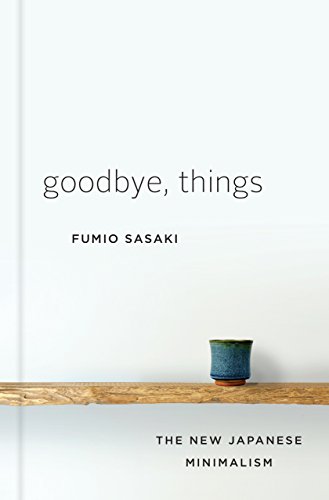
Maria Kondo struck a nerve in America with her runaway hit The Life-Changing Magic of Tidying Up. I, however, need to do more than just tidy up. I need to purge. Do you know what I mean?
I’ve lived in my house for 19 years. That’s a long time to live in a singular space, and, while I make it a point to donate gently used items quarterly (or we would have nowhere to hang our hats), it’s nowhere near enough. I have four daughters. Children seem to amass large quantities of things. People give them things. They collect things. They want to keep them forever. I understand that. I feel sentimental about certain things. Children, however, seem to feel sentimental about almost everything–even that used napkin from last Tuesday when their friend came over and used it to wipe dirt off the floor. It’s actually a testament to their wonder, I think, and capacity to be 100% present.
And if you have a basement?! God have mercy on you.
Another round of donating is not what I’m about to embark on. In ten months, I am moving house. Three years ago, I announced on this blog that my marriage was ending after years of back-and-forthing and writing about domestic violence and emotional abuse and, “Is it really that bad?” A year-and-half ago, I went back to graduate school, and next summer three of my daughters and I are headed West–to the Bay Area. To live in a very small space no doubt. It’s the beginning of another new adventure.
So, I have to examine every single thing I own and decide: Do I need this or not? And, I wasn’t sure how to go about doing that. That’s why I picked up Sasaki’s book. I figured, hey, there must be some good advice in here. At a minimum, maybe I’ll feel inspired or mentored. Sasaki, thusly, defines minimalism as:
“Minimalism is a lifestyle in which you reduce your possessions to the absolute minimum you need. Living as a minimalist with the bare essentials has not only provided superficial benefits like the pleasure of a tidy room or the simple ease of cleaning, it has also led to a more fundamental shift. It’s given me a chance to think about what it really means to be happy.” (pp. 20-25).
Here is an example of a minimalist bedroom:

A minimalist kitchen:

A minimalist bathroom:

A minimalist living room:

I have noticed that all of these images are super posh, and, in my opinion, this should be more accessible. What does a middle-of-the-road minimalistic apartment or house look like? You know, where ordinary people reside. Of note, this is not a movement aimed at people living in poverty. First-world countries are heavily affected by consumerism and capitalistic expenditures, and the USA tops that list with China and Japan featuring second and third. Americans are awash in stuff:
The USA features the highest levels of per household disposable income and expenditure. High income levels boost the capacity for discretionary spending of US households, although the country’s income gap remains large and continues to rise. (Euromonitor International)
I wonder what sort of impact those of us with too much stuff would have on our communities if we donated the items we truly don’t need and seldom if ever used and stopped using our income to acquire more goods, thusly, changing how we “consume”? Furthermore, what sort of impact would this have on our time–an invaluable resource? I imagine that owning less means having more time, too, because we have to dedicate time to caring for our stuff. How might we spend our resources if we moved in a minimalistic direction with intention? Over the next 10 months, I intend to find this out. I can tell you right now what my two biggest problems are going to be–whittling down the book collection, my kitchen implements because I am a cook, and tea accoutrements. I have an unusually large number of really beautiful teacups most of which were gifted to me, and I can’t take them all with me.
Perhaps I ought to do a giveaway! One teacup a week…
Anyone like teacups? English teacups? And then there are the Yixing teapots…
Oy vey…
God have mercy indeed (I’m actually sort of excited to see how this experiment turns out).

Further Reading:
Living with Intention
I receive many emails asking how to fix a loved one. It might be a mother with a personality disorder or a partner or family member with alexithymia. In both cases, I have been that self-same person on the search for solutions. I have asked the same questions: What can I do to fix this? Is it me? Can I fix myself so that they will love me? Can I fix them by giving them books to read or directing them to resources? Maybe they had bad modeling as children and just need to be loved better, and I’m the one to do it!
I have loved someone with a disordered personality that kept them out of reach, distant from me, isolating me on a loveless and lonely island. For years, I dove into the treacherous sea of uncertainty and swam to distant coastlines in an attempt to rescue my own mother from her mental illness. I came bearing recommendations and suggestions that I swore would help her. I only roused her inner demons and exacerbated her illness causing her to throw me back into the black waters which promptly washed me back onto the rocky shores of my tiny island.
I loved another person who seemed to thrive on isolation and personal inertia. From the moment we returned from the weekend in a hotel we called our honeymoon, he holed up in a room and rarely ventured forth into the outside world. He preferred fantasy over reality. He disdained my presence and cultivated an impoverished sense of love and relationships while also developing a deluded and grandiose sense of self. It did not matter how hard I tried to enter into his personal poverty or what riches I offered him. He rejected everything. He preferred his own distorted interpretation of the world. He chose himself even over his children. Whether he lacked the capacity or the will, it did not matter for he simply did not act. He remained as he ever was.
What then? The heart wants what it wants and loves whom it loves, but then what? When the truth becomes apparent, and when will it become apparent? When you ask for it. When you want it. And, what is this truth? It is not your job to change people. It is not your job to fix people.
It is your job to change and heal yourself.
It is our job to develop our personalities and our character so that we are continually becoming the kind of people with whom we would like to partner either platonically or romantically. This is no small task. It is so much easier and, honestly, far more fun to look at other people and pick them apart. It’s vastly entertaining to scrutinize and judge our acquaintances and even our partners. That smug feeling we experience when we climb onto our high horses is like taking a hit of heroine. It’s addictive. Why? Here is an interesting take on judgment:
“At some point in our life, usually in childhood, some external event causes us to separate from that true nature. That separation from love creates in us feelings of specialness or inadequacy, leading to loneliness and as a result, fear. So we project it outward in the form of judgment.
We know we are loving, interconnected beings, but in our separation we live in a dream state, shutting off our connection to our loving truth. This separation establishes the ego’s perception of a false self based on judgment. We grow to believe deeply in the false perception of ourselves in order to feel safe in the world of separation.
Deep down, and without realizing it, we judge ourselves for separating from our truth, leading us to feel ashamed and guilty. That unconscious guilt is so painful that we have no choice but project it outward in an effort to end our suffering. By projecting judgment onto others, we deny and repress our feelings of guilt. Subconsciously, this makes us feel even more guilty because we know this judgment is not who we really are. The guilt we feel from judging others is then projected right back onto ourselves, and the vicious cycle beings again. This the judgment cycle.
I cannot overstate this: Judgement is the number one reason we feel blocked, sad and alone. Our popular culture and media place enormous value on social status, looks, racial and religious separation, and material wealth. We are made to feel less than, separate, and not good enough, so we use judgment to insulate ourselves from the pain of feeling inadequate, insecure, or unworthy. It’s easier to make fun of, write off, or judge someone for a perceived weakness of theirs than it is to examine our own sense of lack.
Judgment is an addictive pattern.
Judgement is an addiction response to deep-rooted trauma. The first trauma is the separation from love. From a spiritual perspective, choosing fear and separation over love dissociates us from our truth. We become fragmented in this state of separation and lose our connection to our inner being. In this disconnected state, we inadvertently turn our back on our inner being and become obsessed with an outward projection of who we think we are. Feelings of guilt and sadness wash over us, because deep down, we know we’ve turned our back on love. But we can’t fully understand our guilt, so we do whatever we can to avoid feeling it. This is how the cycle of judgment becomes and addictive pattern.
When we avoid our guilt and suffering by projecting it onto others, it’s a way of numbing out. Like any good drug, judgment will anesthetize our pain and redirect our focus. It can even get us high. Gossip is a great example. Whenever you get together with friends to talk about another person in a judgmental way, you’re avoiding your own core wounds. You’re using judgment as a drug to numb your own pain and get high on someone else’s. Gossip is especially nasty because it gives us the illusion that we’re bonding with others, when instead we’re just banding together to heap all our pain onto another person.
Gossiping can give us a buzz because it provides temporary relief from self-judgment and attack. We repeat a self-judgmental story on a loop all day long: I’m not good enough. Why did I make that mistake? I’m ugly. I’m not smart enough. And so on. All these self-inflicted behaviors are just another form of addiction. We unconsciously choose to judge rather than feel the pain beneath our wounds.
But notice I said that our self-judgmental story is played on a loop. That’s because it leads nowhere! Getting on the path to healing requires us to feel the discomfort—but we’re way too scared to go there, so instead we gossip or judge ourselves as the victim feels safer than facing our wounds. This I show self-judgment becomes an addiction.
The addictive pattern is further fueled by our denial. We long to feel better but deny that judgement is the problem. In fact, we see judgment as the solution, as a way of protecting ourselves. Our unconscious belief system keeps us stuck in the judgment cycle because we’re terrified of facing our own pain and suffering. We use judgment to protect ourselves from exposing our deepest wounds.
The repetition of judgment is habit-forming. If you repeat a behavior over and over, you strengthen your neural pathways. In time that behavior becomes second nature. The more you repeat the pattern of judgment, the more you believe in it. You create your reality with the thoughts you repeat and the beliefs that you align with. When judgment is your belief system, you’ll always feel unsafe, under attack and defensive. If you’re going to change the habit of judgment you need to change your core belief system. Our aim is to find our way back home—to find our way back to love.” (From Judgment Detox by Gabrielle Bernstein)
Stopping any self-destructive cycle and engaging in a truly honest personal inventory with the intention of self-betterment is difficult but virtuous. Asking the question: What do I really want from a friend and partner and then committing to developing those very qualities in oneself is, in my experience, the path to actually ending destructive relationships and beginning healthy ones.
Why? Well, as you begin to grow into healthy behaviors and ways of relating to yourself and other people, you will organically grow out of unhealthy patterns of behavior. Self-destructive behaviors will ebb, and the people in your life who were attracted to those qualities in you will migrate away from you because you will naturally also move away from them. Simply put, your orbits will change. This kind of growth is a process, and processes take time. It is not something that happens immediately, but it does happen when you commit to your own process of improvement and growth. After a time, you will see that destructive people have left your life. You may also be forced to make difficult decisions like ending relationships that were always bad for you or have become so over a period of time, but this is part of growing up and into living life with intention.
When you live your life with intention, you discover that you cannot make another person meet your needs; you cannot force another person to stop hurting you. You can only move away from them and choose to live your life among different people who share your values. And, this is essentially what people are emailing me about: How can I make my loved one share my values? How can I make the person I love stop valuing neglect or gaslighting or exploitation or selfishness or their own personal inertia? How can I make them see that what I value is better? You can’t. If you don’t share the same values now, then you likely never will. Take the temporary hit, gather your momentum, and keep going. You will find other people in the world who do share your values and will love you, and you will love them, too. You really will.
I don’t say any of this flippantly or without compassion. I have done everything that I’m suggesting, and I know all too well just how hard it is. I also know what life looks like “on the other side”. It is worth it.
Keep going…
Circumstantial Alchemy
I like to write useful posts, and I’m going to try to spin this “leaden” topic into gold as it were. I think I can do it.
I am certainly getting many opportunities to engage in circumstantial alchemy at my college. I have to confess something. I had a rather disheartening interaction with a fellow student yesterday, and, because I process through writing, I thought I would write about it.
I’ve not written a lot about my health issues (at least I don’t think I have). My personal view of my health journey has always been that I’m a healthy person fighting off illness rather than I’m a sick person fighting to be well. That paradigm has kept me optimistic and positive. Sometimes, however, when you’re dealing with an unrelenting, chronic condition or many unrelenting, chronic conditions, there are trying days, and the illness(es) wins a few rounds. Truth be told, I’ve been a healthy person fighting off illness since early childhood. I’ve spent months that probably add up to a few years of my life in hospitals, and I carry multiple diagnoses and see four specialists outside of my primary care physician just to manage all of these diagnoses. Frankly, I became a bit discouraged because I wondered if I actually had one unknown condition that was the umbrella diagnosis manifesting as all these other health problems.
Last year, I ended up in yet another specialist’s office seeking more help because I suspected I had stumbled upon the X factor–the unknown umbrella diagnosis. I was, thusly, diagnosed with Mast Cell Activation Disorder/Mast Cell Activation Syndrome, and it could very well be the foundational problem underlying every other health issue I have. It is also a giant pain in the ass. My doctor moved quickly to get the right protocols in place so that I would stop experiencing anaphylactoid reactions every few weeks, and she connected the dots between her diagnosis and the other specialists’ diagnoses. That was a huge relief. She indicated that it was indeed quite possible that I didn’t actually have all these other conditions; it may all be a mast cell disease at play. I was both shocked and awe-struck. I left her office with an Anaphylaxis Action Plan in place. I now wear my Medic Alert bracelet all the time. Everyone close to me knows how to administer an Epi-Pen, and my very long list of allergens is up to date. I get monoclonal antibodies infused at the hospital every four weeks, take Gen 1 and Gen 2 antihistamines daily in addition to mast cell stabilizers. I follow a low histamine diet. I do my best every day. And yet, as most of us know, sometimes your best is not good enough.
Sometimes things still happen like stress or viral infections or food contaminants. Or, a nurse doesn’t administer an infusion correctly, and a mast cell activation event occurs that leaves you in bed for 10 days sending you to the ER for fluids, Zofran, and steroids. I didn’t know that could happen!
(Actually, two nurses mistakenly injected Xolair directly into my abdomen intramuscularly! Like they were rabies shots!!!)

It was while I was lying in bed last week feeling like I was run over by a truck and working myself into a nice, foamy lather over missing a week and half of classes that I comforted myself–“Your friends at school will get your notes for you. It’ll be okay. Your teachers know you. No, you’re not a slacker. You won’t fail out of grad school…”
So, finally, here is my confession. Here is the lead. When I was finally able to return to school, I greeted the people I knew and thanked them for putting notes in my mailbox. I approached a friend I’ve spent time getting to know, and her affect clearly indicated that she wasn’t interested in talking. I thought that she could be distracted, but then I realized that she was not interested in talking to me. I moved to end the conversation; my final remark was a movie recommendation and she almost scoffed, “Well, at least you did something positive last week.” Whoa.
Did you catch that? That’s shame right there. Whether she knows it or not, she was condemning me for being sick last week. For not meeting her criteria of engaging in “positive actions”, and embedded within that sharp retort was blame: “It’s your fault that you’re sick.” She then went on to ignore me–to distance herself from me–a perceived sick person. And, from an anthropological perspective, this is very mammalian–unless, of course, you’re an elephant.
“Some scientists studying wild elephants have argued that, in addition to cooperating for survival’s sake, the creatures are capable of genuine empathy. Poole recalls, for example, one elephant flinching as another stretched her trunk towards an electric fence; it was fortunately inactive at the time but had been live in the past. Elephants often refuse to leave their sick and injured behind, even if the ailing animal is not a direct relative. [Joyce Poole, one of the world’s foremost elephant experts and co-founder of the charity ElephantVoices] once observed three young male elephants struggle to revive a dying matriarch, lifting her body with their tusks to get her back on her feet.” (Scientific American)
I felt as if a stone were in my stomach for the rest of my class. Like my heart had dropped low down into me. I was disheartened and disappointed. I did not understand this social interaction at all until just moments ago as I was trying to write this out, but I see it now. There was no compassion, and I don’t say this because I feel entitled to it. I merely observe it.
Living with a chronic illness is…weird. It’s too easy to say that it’s hard. For me, it’s not hard exactly. I find it strange. There are days in which I feel perfectly fine. I don’t have any pain, and I’m almost not fatigued at all. Of course, my diet is very limited. I’m practically a vegan because I can’t tolerate most animal proteins particularly bovine meat and milk. I have celiac disease so that means no gluten, and I’m deathly allergic to quite a few fruits and nuts. And now what with the MCAS diagnosis, I have to pay attention to foods that are “histamine liberators”. There are days that it feels very complicated, but, for the most part, I don’t really mind. Every day that I don’t literally almost die from anaphylaxis, I’m truly grateful. I’m not one to think in terms of fairness or justice because that smacks of a victimization. Illness is part of the human experience. Is it fair? Well, I cannot answer that. Suffering is part of life.
What I have gleaned from my experiences with long-term, chronic health issues is empathy and compassion for people who suffer from, well, just about anything. To quote John Mulaney, adult life is so goddamned weird. We do not have the privilege of foresight. We don’t know what lies ahead of us, but we do have the opportunity to cultivate a better personality with a richer substance and character that allows us to meet the unknown with courage and resiliency. And, what of this unknown? You may never get sick and stay sick a day in your life, but someone you love might. What’s more, they may do everything right and still never heal properly. Then what? Will you blame them? Tell them that they aren’t positive enough? Good enough? Strong enough? Dedicated enough? X enough? Will those well-meaning judgments most likely intended to spur them on to try harder actually help them? No. Why? If a person with a chronic illness could heal from trying harder to heal, then they would already be better. Trust me.
We are all human in the end and will shuffle off this mortal coil. Where then is the gold from this lead? I think that it is to be found in the how. How we live. How we treat others. How we view others. Even how we go about experiencing our diseases and disorders if we have a chronic condition. The one thing we are guaranteed is that we will all come to be intimately acquainted with suffering in either ourselves or other people. What then? Compassion. It is the only legitimate response. It validates, legitimizes, heals, and grows connections. Compassion mends the broken places and bridges the divides.
What of the people who blame, shame, judge, alienate, invalidate, and ostracize us for things that are no fault of our own? Well, sometimes we learn how to be better humans by observing others make mistakes.
If I wasn’t fully present to the reality of compassion and its utter necessity in the world before, I am now. I don’t feel angry at my fellow student. Oddly, I feel grateful. Her impoverished response acted as a mirror for me. For those of us who do deal with chronic conditions whatever they may be, we need to have compassion for ourselves because sometimes it’s in short supply. For me personally, I want to continue to develop compassion in my character and be mindful to exercise it. Unfortunately, you can count on other people to judge what they do not understand, and many people do not understand chronic illnesses particularly people who have been healthy for most of their lives. It is a lonely place when you are your most frequent and best advocate, but sometimes that is the road set before you until you find your tribe.
And, so, I will raise my voice today to join the other voices of compassion. There is absolutely no shame or reason to accept judgment if you have a chronic illness. Regardless of the overflowing fount of opinions in your life and the world at large, you deserve compassion, kindness, empathy, and a safe place to land where good friends will love you today. Just as you are.
Keep going, MJ
“Love and compassion are necessities, not luxuries. Without them, humanity cannot survive.”
― Dalai Lama XIV, The Art of Happiness
Currently on the Nightstand
Share this blog

RSS


thrivingisthegoal.com
is licensed under a
Creative Commons Attribution-No Derivative Works 3.0 United States License.

 Out of the Mire