Out of the Mire
…because thriving is the goal
Permission Granted
I have been on a bit of a blogging binge these past few days. I suspect the reason is that I am housebound. I had an arthroscopic surgical repair on my hip and must do a lot of sitting around. I feel compelled to say that it was a young person’s injury. Yeah, yeah, let me just wipe any images of me creeping along with a walker out of your minds tout de suite! I must retain some ounce of dignity after a month on crutches or at least believe that I have.
I also finally have time to contemplate because everyone is back in school! There’s some quiet around here. Sort of. So, ideas have room to move. One idea that percolates often is the notion that Christians don’t need therapy. I have bumped up against this idea many, many times. I didn’t realize that it was so pervasive until I met other Christians who had to see their therapists clandestinely. Apparently, in certain religious circles, psychology and psychiatry are thought to be forms of quackery. Like chiropractic care. My father once told me that my seeing a chiropractor was stupid because they were all quacks. My nature is to question such views so I attempted to build a case. He wasn’t having it. Chiropractors are all quacks. Case closed.
I’ve met people who insist that they don’t need to see a therapist and they certainly will never take medication for their mood issues because God will heal them. Years later, they are still waiting for God to heal them. I was told with great zeal by a woman I did not know in a church setting that God would punish and judge me if I had surgery because this represented my choosing man’s way over God’s will for me. If it was God’s will for me to bleed to death, then so be it. I knew a Christian addiction counselor who prayed for a man with addiction issues one evening. When she was finished, she declared that he was healed and was in no further need of counsel, accountability, retraining in thinking, or help. I know a family who refused to send their son to AA claiming that he simply needed to walk in victory. He didn’t need to follow some twelve step program. They were angry that the 12 steps in AA weren’t specific enough in naming God as Jesus so they refused to have anything to do with it.
I could continue to tell stories like this, but I think it’s clear that there are some odd views out there. Do they exist outside Christian circles? Well, of course, they do, but I’m interested in the attitudes I see and have experienced in the Church today. Why? Because there is a better way. Also, these views don’t line up with any biblical account so why are we behaving like this? Truthfully? I think most of these attitudes go all the way back to one verse in Genesis:
“As for you, be fruitful and multiply; Populate the earth abundantly and multiply in it.” Genesis 9:7
This verse is a horribly misunderstood verse because it’s so poorly translated. The Hebrew is bursting with dimensions of meaning that can in no way be conveyed in one sentence. What does it really mean? First, what do people think it means? From what I’ve encountered over the years, I observe that people believe this verse to mean, “Go out and try and find a mate so that you can have a lot of babies.” That’s it. That’s what everyone seems to think this verse means. I’m not sure that I want to worship or believe in a god that would command something like that. Why go to all the trouble to create humans if that’s all we’re good for?
The Hebrew word used for ‘fruitful’ in this verse is פָּרָה (parah), and it does mean fruitful; but it means fruitful in the sense of prospering, flourishing, and increasing as one increases in a physical sense. I am fruitful in my labor or my work. I see results from my effort. It has a very concrete implication and sense about it. The next word ‘multiply’ is an odd choice. Why choose ‘multiply’ here when the next command in this verse is almost a reiteration of this word? What does this really mean? The Hebrew word used in this text for ‘multiply’ is רָבָה (rabah), and it does mean ‘multiply’ but how? How are we to multiply? This is where it matters. What is implied in the Hebrew in this word is not just having children. There are many definitions for this word. They are:
- to multiply in greatness or become great
- to multiply in things or become great of things
- to become great of wisdom or noble thoughts
- to become a great person with great knowledge
- to set a high price
- to enlarge one’s army
- to multiply one’s wealth
- to increase one’s animals
- to do much greatly and often
- to pray a long time
- to increase in glory
- to make another person great
- to make God great
- to enlarge or increase one’s borders
- to bring in abundance
- to have children
Of the sixteen definitions that I could find for rabah, only one concerns having children. The others define our role as humans. We were to go out and increase in knowledge, greatness, wisdom, nobility, and character. We were to make the world better. We were released to do that. We were commanded to live our lives. Go out and learn. Go out and think. Go out and work. This verse isn’t about marrying and having children. It’s about God pointing to the great unknown and saying, “Well, get out there! Go make something of yourselves! Try! And make sure to make others great while you’re pursuing greatness, too! ” We were given autonomy. God did not mean for us to be little children, quaking and wondering if every choice we make is okay with Him. Clearly, this verse depicts something different. This verse is empowering. This verse speaks of collaboration and permissions and a wide open playing field.
So, what does this have to do with therapy?
- “I’ll just wait for God to heal me.” vs. become a person with great knowledge
- “I know I have anxiety but God will do something about that, I’m sure.” vs. become great of wisdom or noble thoughts
- “I don’t need some 12-step program. I’m fine.” vs. do much greatly and often
- “I know I struggle with my anger. I know I’m depressed sometimes. I read my Bible. I go to church. I’m sure God will help me.” vs. enlarge or increase one’s borders
- “That therapy business is just a bunch of BS. I’m fine. I don’t need some stranger to tell me what to do. I go to church.” vs. increase in glory
These are really just victim statements. There is nothing empowered about them. God has already given us permission, commanded us even, to get our acts together. If something isn’t working in our lives, then we are already permitted to fix it! Does God work miracles today? Yes, but, more often than not, He is going to set you on a path that will take you through a journey that will multiply you so that you will increase in nobility, wisdom, knowledge, greatness, and, finally, learn what flourishing looks like. That is what God looks like. We are His children, and children look like their parents. God does not “fix” our health problems for us if we can engage in a process that will, over the long term, heal us in some way. How many diabetics do you know who get treatment for their disease by waiting for God? God has already provided treatment through diet, exercise, and proper medical care. The diabetic, however, has to engage their will to seek out that treatment. There is a process there.
We can all recognize that diabetes involves the pancreas. When will the Church recognize that mental illness involves another internal organ–the brain? There are highly trained clinicians who treat the brain as well, and pursuing care with a trusted clinician combined with whatever forms of faith practice that are meaningful to you in order to overcome what is hindering your mental health and well-being are what it means to learn to flourish and multiply. You don’t need permission from a pastor, small group, or best friend to seek help. You don’t need to wonder if it’s okay to see a therapist, psychologist, or psychiatrist. Will God be angry with you because you didn’t wait long enough for Him to intervene?
You’ve already been told to go out there and do something. Pursue something. Enlarge your borders. Increase your knowledge. Become a great person.
Do. Increase. Enlarge. Become. Go.
Permission granted.
A Plea
Somewhere in the annals of this blog I’m sure I’ve posted on the difference between forgiveness and reconciliation. I feel quite certain that most people who know me have heard me yammer on about that, and yet a plethora of Christians and even non-Christians shame and judge fellow humans for their perception on how so-and-so is handling his or her relationships as if they have a right to do that. So, I’m going to discuss this topic again because it really can’t be talked about enough. And I’m going to get down and dirty with the Greek this time. That’s right. We’re breakin’ out the koine.
Before I start parsing, let’s just suppose something. Suppose my daughters were all murdered by a serial killer. That’s a horrible supposition, but, for the sake of the discussion, it’s relevant albeit horrifying. Suppose said psychopath is captured, tried, and found guilty. Let’s suppose some more. What if I were to live in a state where capital punishment were legal? Mr. Spree Killer was gettin’ a lethal injection, and I was invited to a front row viewing along with all the other families who lost loved ones at this murderer’s hands.
As a theist, am I obligated to forgive this guy? He killed my daughters.
Let’s define forgiveness. There are three definitions for ‘forgive’. Two have to do with our emotions:
- to give up resentment of or claim to requital for <forgive an insult>
- to cease to feel resentment against (an offender)
The third definition refers to a transaction:
- to grant relief from payment of <forgive a debt>
I don’t care how the dictionary defines forgiveness. In the context of this discussion, I want to know what forgiveness means in the biblical context. What does it really mean? This matters because so many people are bludgeoned emotionally by others for not being forgiving enough, and, when asked what they mean, they don’t really define themselves very well. So, let’s do it! Let’s define the terms.
Two Greek words are used to delineate ‘forgiveness’ in every verse discussing forgiveness in the New Testament. Those Greek words are ἀφίημι (aphiémi) meaning ‘I send away, release, remit, forgive, permit’ or ἀπολύω (apoluó) meaning ‘I release, let go, send away, divorce’. The pertinent meaning used depends upon the context. Note, however, that these words contain legal meanings. In terms of forgiveness, these words treat sin as debts. To forgive, in the biblical sense, is to release someone else from a debt owed. There is nothing within either of these words that pertains to emotions. It’s strictly legal. It is a transaction. That’s it.
So, that very awkward question should be answered then, right? Am I obligated to forgive someone who violates me even if it is technically unforgivable? Well, let’s talk about that. What makes something unforgivable? If we are speaking in terms of transactions, I would think that an unforgivable action might be something that is irreparable. Something so wrong or heinous that no matter what that person tries to do in their lifetime, they can never pay you back. They are truly indebted to you because they can never, ever, ever restore to you what they stole. So, what’s the point in demanding that they pay you back if they can’t? Could a serial killer ever restore to me my daughters if he murdered them? Well, obviously, no! Why would I want to hold onto him then? Why would I want anything to do with him? Of course, I would just say, “You can’t pay me back. In fact, you owe me nothing. Go the way laid before you now and get as far away from me as possible.” This is a cold-blooded act of the will. This kind of forgiveness is not motivated by mercy, kindness, love, or goodness. It’s merely an act done to free oneself from evil deeds perpetrated by another, and the world is full of evil deeds.
Incest, sexual abuse in all its forms, trauma, verbal and emotional abuse, spousal abuse of all kinds, living with domestic violence and substance abuse, spiritual abuse…the list goes on and on. We don’t enter into the forgiveness transaction because it feels good. We do it for our own peace of mind, to cut ties with acts of violence done to us, and to change our focus. Emotional healing comes later. Sometimes years later. No one has the right to judge that.
Forgiveness, however, has never meant that a relationship has been restored. It simply means that the debtor has been released from debts owed. That’s it. In the biblical sense, it doesn’t mean that the one granting forgiveness has ceased to feel resentment. It doesn’t mean that the one releasing the debtor isn’t still hurting tremendously. It doesn’t mean that trust is restored. It just means that what the debtor owed the person whom they hurt has been cancelled.
Many Christians seem to confuse forgiveness with reconciliation. They are in no way the same thing. I can forgive someone for hurting me, but I am allowed to choose not to be in a relationship with that person. Why? Because relationships are founded upon trust. Without trust, it is impossible to have a truly sound and rewarding relationship. Both people in a relationship must trust each other. If one person has a history of violating the other, then there will be a power differential in that relationship that will erode trust. Forgiveness is possible, but true reconciliation may not be.
The Bible discusses reconciliation in the New Testament. One of the words used is καταλλαγή (katallagé) meaning ‘restoration to favor’. This sort of reconciliation is talking about humanity’s restoration to divine favor because of the expiatory death of Jesus. It’s an exchange of one position for another. Another word used for reconciliation in the New Testament is ἀποκαταλλάσσω (apokatallassó) meaning ‘change from one state of feeling to another’. There is a sense in this word that the act of reconciliation is bringing something back to a former state of harmony. Then there is καταλλάσσω (katallassó) which means ‘decisively change, as when two parties reconcile when coming (“changing”) to the same position’. This term was originally used by money-changers when exchanging coins but also implies changing from enmity to friendship. It’s clear that the term ‘reconciliation’ can communicate different things to us. It’s also clear that it doesn’t mean forgiveness.
Why am I discussing this again? Choosing friendship over enmity is easy if there are small offenses. It’s not that hard to forgive minor things. That’s life after all. People will offend us, and we will offend others. It’s only right and virtuous to forgive.
Real abuse though? Families that perpetuate true damage? Incest? Violence? Alcoholism? Domestic violence? Untreated mental illness that parentifies children? Sometimes the only thing an adult child of these abusive families can do is leave and never look back. Forgive? Yes, eventually. Reconcile? Never. That would be tantamount to suicide. Some families hide their abuse with great skill.
I grew up in a nice, religious family. We went to church every Sunday. We went to Sunday brunch at the country club. My stepsisters and I were confirmed and wore our cross necklaces with pride. My stepfather played golf with his buddies. My mother quilted. My father and his wife taught Sunday school and were visible at every church gathering. One of my family members is a celebrated Christian author. On the surface, we were all smiling and happy. Never be surprised by what happens behind closed doors. Do you suppose anyone knew that my smiling mother had Borderline Personality Disorder and was terrorizing the family? Do you suppose anyone knew that I lived with a pedophile who was really a sexual sadist? Did anyone suspect that my stepsisters were being beaten? Do you suppose people guessed that my mother kept a bottle of narcotics and a revolver in her closet?
Families have their secrets. Human beings are capable of wondrous things, and they are also capable of horrors that surpass anything we might imagine. Never underestimate someone else’s suffering. If you meet another person who is not in contact with their family, don’t preach forgiveness. Don’t ‘should’ on them, tell them what you think they need to do, and then cloak it in some treacly Christianese platitude. It is unbelievably hard to walk away from your family–even if they’ve abused you. It goes against every instinct a human being has. So, the next time you meet a person who has made the choice to make their journey without their family, please be kind to them. Withhold your judgment. Don’t tell them to forgive. They already know that. I can tell you from personal experience that it’s very hard to forgive a parent for sexual abuse. It’s hard to forgive a parent for destroying a family. It’s not impossible, but it’s…hard. Survivors of familial abuse need love, support, and hope. They don’t need judgment simply because the landscape of their life looks different from yours. It is always a temptation to judge others whom you perceived to have “sinned” differently than you, but it is still wrong.
Lastly, learn the difference between forgiveness and reconciliation. Forgiveness is a process. It’s possible. Sometimes reconciliation is not. Why? Because oftentimes the very people with whom everyone keeps telling us to reconcile are the ones that are the most dangerous–our family members. To many, it is shocking and impossible, and it should be. Family should never abuse family, but it happens more often than you might guess. If you cannot in any way relate to my story or the stories of others who grew up in abusive families, then you are blessed extravagantly. Don’t hold someone else’s life experiences against them particularly if they were made victims by the very people who were called to nurture and love them. Don’t hold these things against them because their life makes you uncomfortable. We were never called to be comfortable. We were called to be comforters.
Would you invite the serial killer that you just forgave to your house for Thanksgiving dinner?
No? Well, there are a lot of people who grew up with emotional serial killers, and they would like to live a good life and learn to pursue happiness, too. Forgiveness? Sure. Reconciliation? Probably not.
And that’s completely acceptable and good. This is why the ministry of reconciliation belongs to the Holy Spirit, and He bestows it upon people. Not all of us will reconcile with our abusers. Not all of us were ever meant to. Our journey in life has been about surviving our abusers, climbing out of the abyss, and realizing that life can be richly rewarding and good. Even if we have to build a family from scratch.
There is room for all of us in the House of God–all of us.
“Because salvation is by grace through faith, I believe that among the countless number of people standing in front of the throne and in front of the Lamb, dressed in white robes and holding palms in their hands (see Revelation 7:9), I shall see the prostitute from the Kit-Kat Ranch in Carson City, Nevada, who tearfully told me that she could find no other employment to support her two-year-old son. I shall see the woman who had an abortion and is haunted by guilt and remorse but did the best she could faced with grueling alternatives; the businessman besieged with debt who sold his integrity in a series of desperate transactions; the insecure clergyman addicted to being liked, who never challenged his people from the pulpit and longed for unconditional love; the sexually abused teen molested by his father and now selling his body on the street, who, as he falls asleep each night after his last ‘trick’, whispers the name of the unknown God he learned about in Sunday school.
‘But how?’ we ask.
Then the voice says, ‘They have washed their robes and have made them white in the blood of the Lamb.’
There they are. There *we* are – the multitude who so wanted to be faithful, who at times got defeated, soiled by life, and bested by trials, wearing the bloodied garments of life’s tribulations, but through it all clung to faith.
My friends, if this is not good news to you, you have never understood the gospel of grace.”
― Brennan Manning, The Ragamuffin Gospel: Good News for the Bedraggled, Beat-Up, and Burnt Out
Clicker Training and Formula Faith
What I have wanted to discuss is the idea of feeling abandoned by God. I have certainly felt this way. For many people of faith, when something goes wrong in their lives, the first response is, “Why? Why did God let this happen? Where is He now? I feel so forsaken.” I think that’s a very natural response. People want to know why. Then there is the next question: “What kind of God would let something like this happen?” We move from asking to judging. That’s also a very human response. It doesn’t help us suffer well, does it? It doesn’t empower us. We don’t actually rise above circumstances or learn anything from these questions. We just spin our wheels, get mired down in our pain, and stop moving forward.
What if there were a better way?
I started thinking about behaviorism while I was thinking about how people experience God and their faith. Having grown up in a religious environment exposed to many different denominations, I’ve observed that most denominations teach essentially the same thing–be a good person by following the rules and perform good deeds. If you do this faithfully, then your devotion to God as displayed through your faithfulness should protect you from suffering. It’s “formula faith”. If I do x and y with as much commitment as I can, then God has to do z.
I see this when people tithe. I know a woman who faithfully tithes (gives 10% of her gross income). She lost her job, but she continued to tithe even though she couldn’t pay her mortgage. She began tithing out of her 401K. She tithed from her children’s savings accounts. She said in desperation to me one evening, “I don’t understand it. I tithe, and yet God won’t provide for me. Isn’t He supposed to do that? I have next to nothing. My children’s bank accounts are almost empty.” She tithed–performed x. Wasn’t God obligated then to do His part? He had to fill in the other variable. This is what we’re taught. I’ve heard that message at almost every church I’ve ever attended. What happens if you don’t tithe? Uh…no one knows. People are too afraid not to! And there’s your clue that something is not right–the fear.
Let me talk about my dog to illustrate my point. I had an Australian Shepherd, Rally. Rally died from a brain tumor almost two years ago. She was incredibly intelligent. I could train her to do just about anything. Before she died I was training her to play dead. When I wanted to teach Rally a new skill, I used a clicker. And Rally was bonded to me. She went everywhere that I went. Aussies are not like retrievers. They don’t live to please. They are working dogs. They work for something in return. Rally worked for food and affection from me. People aren’t so different from Aussies. We are smart, resourceful, willful, stubborn, and want it our own way. So do Aussies. We also need companionship and something to do lest we become destructive. So do Aussies. When it came time for training it was key that I know her disposition. Rally may have been stubborn and willful, but she was terribly sensitive. She would never have responded well to negative reinforcement so I could only use positive reinforcement.
What does this look like?
When you teach a dog a new skill, it’s best to let them figure it out. When I stood in front of Rally, my hands in front of me, clicker in hand, she knew it was time to work. As a working dog, she got excited. She would, therefore, show me all her skills right away hoping to get a treat. She would sit, lie down, wave her paw in the air in preparation to be shaken, bark to speak, and jump in the air because she was trained in agility, and then return to a sitting position. Those were old skills, however, so I would tell her that I wanted something new. When I was training her to play dead, I had to get her to lie down. As soon as she moved to lie down, I would click the clicker and give her a treat. It would take a few tries, but eventually she would figure out that I wanted her to lie down. Eventually, she would turn her body to the side as if she were about to roll over. Click-treat. Every motion that she made that was close to rolling over was rewarded with a click-treat. Does positive reinforcement take longer? Yes. Why? It takes longer because the dog is making the connection for themselves. The dog has to figure out what I want. I’m right there in front of the dog. I offer the reward when the dog gets it right. I simply ignore the dog when she gives me something I don’t want. Does it mean I’m ignoring her? No. I am just not interested in old tricks. I don’t want to see her shake. I don’t want to see her sit. I am teaching her something new so I’m focused on the new thing that I can already imagine her doing in my head. I will only interact with her when she gives me something that moves her closer to doing what I’m looking for. Then, she gets a click-treat. In simple terms, this is how you train a dog with positive reinforcement. It works beautifully particularly when the dog and the trainer have a relationship. Rally would work very hard for me. In fact, due to her brain tumor, I had to euthanize her. I had been working tirelessly with her on the ‘playing dead’ trick. She loved working with me, but she was having a hard time learning the trick. Right before the vet called us into the room, she got up, looked at me, and performed her new trick flawlessly. Click-treat, Rally.
So, why all this talk about behaviorism? I think it pertains to humans and God. Is God clicker training us? No, but I do think that God views us differently than we view ourselves, and I think that because of His view of us He interacts with us differently than we might expect. This difference is interpreted as abandonment and rejection by us when it’s actually the opposite.
When I was training Rally, her first instinct was to show me what she already knew. She gave me what she thought I wanted. This is key. This is what we do with God. We cast God in our image, and then we give Him what we think that He would want were we Him. So, in our making, God becomes angry, frustrated, impatient, and very judgmental. He then requires performance from us to appease Him. This is not the core belief system of modern Christianity, but this is what seems to be most culturally visible. It might be dipped in something sweet and wonderful, but it’s still there:
- You are a sinner who’s been saved.
- God stooped down to save you.
- If you aren’t ministering and following the Great Commission, then you don’t have faith.
- If you aren’t at church every Sunday, then you aren’t really a Christian.
- Giving tithes and offerings is a sign that you are a true Christian.
- No person who has a tattoo can possibly be a Christian.
- Gay people are going to hell.
- You will have a terrible marriage if you have premarital sex.
This is why so many Western Christians are shocked when they suffer. There is a tremendous lack of resiliency in the Western Church because of this formula faith. They did their part. They filled in the variables. Why didn’t God do His part? They waited until they were married to have sex. They tithe. They volunteer. They go to church on Sunday and fellowship with Christians on Wednesday. In fact, they only have Christian friends. They are not in the world at all. They have never seen an R rated movie. They don’t listen to secular music. They make a point not to enjoy sex or have sexual thoughts. They give Bibles to “heathens”. Why did their husband get laid off? And why can’t they get pregnant?
I’m not mocking anyone here. I’m not being sarcastic. I grew up in this culture. A good portion of my family is just like this. There is tremendous sincerity and true goodness in people who live under this religious burden. This is not what God is like. What I’ve described here is human beings giving to God what they know like Rally showing me her tricks. They are trying to please God with tremendous sincerity in hopes that they will be rewarded and protected from suffering and catastrophe. Click-treat.
Guess what? There is no reward or protection from bad events for this just like there was no reward for Rally. Why? Because what I’ve described isn’t what God is looking for.
I want you to show love, not offer sacrifices. I want you to know me more than I want burnt offerings. Hosea 6:6
Relationship. I have stressed this in almost every post I’ve ever written about humans and God. How is it that we can reduce God and ourselves to a formula? Would we do that to our children? Would we demand good deeds, penance, and sacrifice from the people that we love the most in order that we don’t punish them cruelly? I will let Rabbi Kushner elaborate:
Man depends on God for all things; God depends on Man for one. Without Man’s love, God does not exist as God, only as Creator, and love is the one thing that no one, not even God, can command….Acceptance of God’s will is not enough. Love, love of life, love of the world, love of God, love in spite of everything is the only possible answer to the ancient human cry against injustice.” (The Book of Job, Harold S. Kushner)
Those times in our lives when all feels silent, when we feel alone and forsaken by God, I believe that God is present. I believe that He is closer to us in those times than when He is coming in loud and clear. Those are the times when we are learning something new–a new way to live, a new way to communicate, a new way to experience God, a new way to overcome a difficult situation. We have given all that we’ve known or thought to be expected of us. We’ve given everything within ourselves to everyone around us, and we’ve certainly done everything possible to show God that we’re committed to our process. This time, however, all those great things that we know are being ignored. They don’t matter right now because God wants to do something new, and He wants to develop something better in us. Just like I was directly in front of Rally, waiting for her to give me something else, something new, something that was just a little bit closer to what I was looking for, God is, too. He’s right in front of us, face to face, influencing us, encouraging us to keep going. It’s those times that matter most when it comes to endurance. We mustn’t believe that we’ve been abandoned or forgotten. Not at all. God isn’t silent. He’s just not interested, I believe, in what we already know. He’s interested in moving us forward because He already sees us as whole, complete humans just like I could imagine Rally doing her trick perfectly, and I knew every step that she had to take to get there. I just needed her to cooperate with me.
We aren’t so different. Religious effort isn’t what’s desired because fear doesn’t transform anyone. Relational intimacy, on the other hand, founded upon love has the power to bring about lasting change and a momentum that can move us from one point in life to another. 1 John 4:18 states that love and fear cannot coexist, and 1 John 4:8 states that God Himself is love, therefore, you’ll know that you’re partaking of formula faith when fear is your motivation.
I’ll let the words of Isaiah close us out:
“Forget the former things;
do not dwell on the past.
See, I am doing a new thing!
Now it springs up; do you not perceive it?
I am making a way in the wilderness
and streams in the wasteland. Isaiah 43
Self-Validation and Recovery of the Self
Circumstances never wait for us to be ready. Some circumstances happen suddenly, and some, looking back, have been simmering for a long time. It’s not a surprise when they boil over and make a mess. Why do we then feel surprised? Is it denial? Is it avoidance behavior? Were we hoping that the situation would resolve on its own? Were we like one of those parents who assumes that their young child will grow out of their apparently autistic symptoms?
- “Oh, just leave it. She’ll grow out of it. She’s just young.”
- “Oh, I know he can’t read now, but he’ll catch up.”
- “Sure, he flaps when he’s anxious. All kids flap.”
I have learned that every circumstance provides an opportunity for personal development. It is one of the best ways to move through a situation that may be fraught with pain and actually get something out of it. I don’t want to feel helpless. I don’t want to feel like life is happening to me, and that’s often how I feel when I feel out of control. I can’t control anyone else even if I try to do so. I’ll only find myself manipulating them and violating my own code of relational ethics.
So, what are we supposed to do? Isn’t that a great question. I suppose that question needs a context. I’ll use my marriage as an illustration.
I’ve never had a great marriage. I can admit that now. I have a strong tendency to play the caretaker, and I am intimidated by strong displays of anger. Just read my blog and you’ll figure out why that is. I am by nature nurturing. I am hospitable. I enjoy serving people in my home. I do not like to see people suffer. I will go the extra ten miles to make sure people have what they need. Pair me with a spouse who is the least bit entitled and what might you get? Well, it ain’t good. It’s just that it was so much better in comparison to the relationships in my family of origin that I didn’t know that it wasn’t good enough. In retrospect, I should have done more than ask for more. I should have pushed harder sooner. Alas, I can only learn from the past now.
Passive aggressive behavior is toxic. Compare passive aggressive behavior to a raging, violent mother, and that passive aggressive spouse starts to look like Mr. Emerson of Room with a View. I simply didn’t recognize it for what it was until…
I began attending longterm therapy. I simply woke up one morning and realized that my head wasn’t screwed on properly. I needed a brain pan overhaul. Four extraordinary years later, I had new eyes. I was a completely different person. I wanted more, and I began to see that there were dynamics present in my marriage that were harmful. Seven years later? It’s worse, but I can see even more clearly than I could before. I also see that I am part of the problem.
Because I grew up with a borderline personality, I know that I left home with codependent tendencies. I am no longer codependent, but I do have caretaking habits. They are alive and well in my marriage. Reading this book has been eye-opening, and I recommend it to anyone who lives with a “high maintenance” spouse be it passive aggressive, emotionally unavailable, highly anxious, overly attached, not attached enough, or even high-functioning autistic. Recognizing where and how we caretake is the beginning of recovering ourselves. Learning how to stop is another step closer, and, boy, is that uncomfortable.
The other issue that I see in my life and the broader life experience is the notion of validation. I read this earlier today:
“Be faithful on the playing field God has given you, no matter how small, and let God validate you in His time and in His way.”
How many women have heard statements like these from well-meaning people? It inadvertently promotes feelings of helplessness and disempowerment. I propose that we are not meant to sit in painful circumstances and wait around for validation. We have brains. We can learn to validate ourselves.
Before we learn to do that, it’s important to discuss validation. What is it? Validation means “telling someone that what they feel, think, believe, and experience is real, logical, and understandable…it helps our relationships go better, and it calms intense situations so that we can problem solve. Validation is like relationship glue. Validating someone brings you closer.”
How do you validate? Well, the first thing to understand is that validating someone does not mean that you agree or approve of their behavior. Validation is a non-judgmental way of communicating that you understand their point of view. Here are some validation techniques:
- Focus on the inherent worth of the person, whether it is yourself or someone else.
- Observe by listening carefully to what is said with words, expression, and body. Listen with intention. Be of one mind in that moment. If you are self-validating, then honor your experience by sitting quietly with it, knowing it for at least a few moments. IF you are validating someone else, use good eye contact, nod, and focus on them. Don’t focus on what you are going to say next.
- Describe by non-judgmentally stating the facts of the situation.
- State the unstated by noting the presence of feelings, beliefs, etc. that have not been voiced: “You seem to feel angry but also hurt by what that person said to you.” If validating yourself, then identify your primary emotions. If anger is obvious, then explore your feelings of hurt, disappointment, or shame that may be hiding underneath.
- Search for what is valid and true about the experience and note it. Without feeling that you have to agree or approve of the experience, find a piece of it that makes perfect sense, and validate this. If validating yourself, then perhaps you realize that the thoughts you are having might be irrational; however, you validate that they exist and are powerful in the moment. If validating someone else, even if you disagree with their behavior, find something with which you can empathize: “When you get that angry, I can see that you want to strike out at someone. Your emotions are very powerful for you.”
Self-validation is vital because it tells us that all feelings are informational. Self-validation occurs when we are able to quietly reassure ourselves that what we feel inside is real, important, and makes sense. Emotions, thoughts, and sensations are all experiences that we sometimes doubt in ourselves so we ask:
- DO I really feel this?
- SHOULD I feel this way? (Does this emotion match the situation, even if it inconveniences someone else?)
Learning to self-validate quiets defensive and fearful emotions so that we can problem solve. It allows us to let go of the pain and exhaustion that constant self-justification and self-doubt require.
This part is important: Many of us may have grown up or grown accustomed to invalidating environments so we may habitually look around us and try to guess what other people in the same situation feel or what others expect us to feel. When we are told that we should not trust our inner experiences, we have been invalidated. We learn to trust other people more than ourselves. We have learned to self-in-validate. We spend a lot of time and energy trying to prove to others and ourselves that our experience is real and makes sense. This often results in conflict or crisis.
Learning to self-validate then becomes an exercise and practice in recovering yourself because self-validation teaches you to trust your inner knowing rather than making others your authority for what is right or wrong for you. You will regain your empowerment. You will learn to attend to your feelings and validate the information that your feelings give you which will give you a deeper sense of self-worth and self-esteem. Why? Because you are no longer beholden to others in the sense that others have to validate you. You can do this for yourself. Validating yourself is like glue for the fragmented parts of your identity because it teaches you to accept and understand who you are which leads to a stronger sense of self and better skills at managing intense emotions.
Self-validation puts us in our own metaphorical boat so that we can begin choosing which direction to take rather than being tied to someone else’s boat, which may or may not be sinking.
Is it easy? Hell, no, it’s not. It feels foreign and weird. We are made to receive validation from others because we are social beings. We are supposed to receive acceptance, understanding, and approval from the people in our pack, but we should not be held back in life and disempowered when we do not. That’s the point. Furthermore, I do not believe for one second that we were designed to sit and wait around for a visitation from God so that He could validate us. He is a creative force. He creates opportunities. If we are made in His image, then we were made to do the same thing. Self-validation does the same. It creates opportunities for us to move forward even if the very people that we love…won’t.
**Some of the material in this post was taken from handouts given in DBT Skills Group, but there are not source citations on the handouts.
Abandoning the Self
I live in Minnesota. I overheard someone say once that we work for our seasons. That’s an oddly funny thing to say, but, if you live here, then you’ll understand the meaning in that sentiment.
As a seasonal change approaches, the current weather patterns seem to want to hold on almost as if they have a personality. Summer just won’t leave! It’s sticking around in October like a bad guest! And yet the warm temperatures seem to loiter in the atmosphere in spite of midnight frosts. We all begin to assume that this year Old Man Winter will stay in his cave. This will be the year that Minnesota tricks winter. Halloween approaches and the kids are wearing short sleeves! We’ve done it!
And then it happens. The cold suddenly appears and refuses to go. Just like that. Where did all the lovely warmth go? No transition? No warning shot across the bow? Darkness at 5:30 and frigid mornings? I guess winter didn’t forget us after all. Shoot..
This is how I’ve experienced relational changes as well. Everything seems to be fine. It’s all going along smoothly, and then suddenly it’s not. One person becomes emotionally distant or cold or angry or withdrawn, and there was no warning; or if there was, then the warning was missed. You’re left wandering around in the desert of abandonment wondering what happened? Where did all that lovely relational warmth go? Why is it suddenly cold?
The only conclusion? I must have done something wrong.
But what happens when the other person has left the relationship be it through the Silent Treatment, functional dissociation, emotional neglect, or actual physical abandonment? What does one do then?
That’s a damn good question.
I am in this situation at present. In my marriage. My husband has severed the emotional and physical connections between us by way of what looks like functional dissociation, emotional neglect, and certain passive aggressive behaviors. At this point, he hardly speaks to me.
I have no control over his behavior. What can I control? Myself. What has become fascinating to me is my internal world and thought life during this very uncomfortable and painful season. Initially, I felt adrift and confused. I felt like everything was my fault although I couldn’t figure out what I’d done wrong. I found myself saying, “This feels so familiar. I don’t like this.” I observed latent PTSD responses quicken and come to the surface. I began startling easily again. I was very anxious and edgy. I was not sleeping well. I started having nightmares. I would retreat into the bathroom to cry.
Clearly, what was happening in this relationship reminded me of something I had experienced prior. Something traumatic. I hated to admit it to myself, but I knew exactly what felt familiar. My husband was reminding me of my father. I could scarcely accept it.
What I am describing here is called an emotional flashback. A few days ago, I went looking for any shred of information to help me understand the machinations of an emotional flashback in the context of PTSD, and I discovered a treasure trove. A therapist specializing in treating PTSD and C+PTSD has written numerous articles on this dynamic as well as other aspects of C+PTSD. I have spent that last few days reading through them, and I want to refer you to them.
According to Mr. Walker in his article Emotional Neglect and Complex PTSD, emotional neglect is the core wound of C+PTSD:
Minimization about the debilitating consequences of a childhood
rife with emotional neglect is at the core of the PTSD denial onion. Our recovery efforts are impeded until we understand how much of our suffering constellates around early emotional abandonment around the great emptiness that springs from the dearth of parental loving interest and engagement, and around the harrowing experience of being small and powerless while growing up in a world where there is no-one who’s got your back. Many survivors never get to discover and work through the wounds that correlate with this level, because they over-assign their suffering to overt abuse and never get to the core issue of emotional abandonment. As stated above, this is especially true when they dismissively compare their trauma to those who were abused more noticeably and more dramatically. [This is particularly ironic in light of the fact that some individuals can suffer a modicum of active abuse without developing PTSD, if there is one caretaker who does not emotionally neglect them]. (Walker, Emotional Neglect and Complex PTSD)
If his thesis is true, then repeated exposure to emotional neglect could trigger emotional flashbacks. I have seen this in other people. Why have I not seen this in myself as it pertains to one of my core relationships?
It is this statement that I want to share almost more than any other:
Emotional neglect, alone, causes children to abandon themselves, and to give up on the formation of a self. They do so to preserve an illusion of connection with the parent and to protect themselves from the danger of losing that tenuous connection. This typically requires a great deal of self-abdication, i.e., the forfeiture of self- esteem, self-confidence, self-care, self-interest, self-protection. (Walker, Emotional Neglect and Complex PTSD)
This is a stunning statement because it doesn’t just apply to children. This applies to adults as well. I sent this article to a friend last night who has worked with survivors of myriad forms of abuse. I asked her, “How many survivors do you know who can’t spend money on themselves? How many don’t take care of themselves? How many have poor boundaries? How many don’t make decisions in their best interest? How many have little to no self-esteem?” Her answer? “Almost all.” And, of course, how many were abused as children in some way even through emotional neglect which is perhaps the weightiest of all forms of abuse albeit covert.
I was once listening to two survivors talk about how they never spend money on themselves. They feel terribly guilty about it. Everyone else came first. They were laughing about it and declaring this as if it were a badge of pride.
“I don’t spend a dime on myself!”
“Oh, well, neither do I!”
“Well, I only go to Goodwill to get my clothes!”
“Oh, well, I just patch mine up!”
The idea that self-esteem, self-protection, self-care, self-interest, and self-confidence as values that are relevant and appropriate because they cultivate dignity were foreign and even dismissed. Perhaps even shunned! Why? Because you can’t have a developed sense of self if you believe that your identity has to be sacrificed for a relationship to succeed. That is exactly what happens when you live in an abusive relationship, and emotional neglect is abuse as is longterm exposure to passive aggressive behavior because that is another form of emotional neglect. So what is done in an attempt to stay in and preserve such a relationship? The self is abandoned.
The result of this self-abandonment?
Emotional intelligence and its cohort, relational intelligence, never get to develop, and children never learn that a relationship with a healthy person can become an irreplaceable source of comfort and enrichment. Moreover, the appropriate management of the normal emotions that recurrently arise in significant relationships is never modeled for them. Emotional intelligence about the healthy and functional aspects of anger, sadness, and fear lies fallow.
Moreover the receptor sites for receiving love and caring from others often lay dormant and undeveloped. Emotionally abandoned children often devolve into experiencing all people as dangerous, no matter how benign or generous they may in fact be. Anyone can automatically trigger the grown-up child into the deeply grooved patterns of perfectionism and endangerment engendered by their parents. Love coming their way reverberates threateningly on a subliminal level. If, from their perspective, they momentarily “trick” someone into seeing them as loveable, they fear that this forbidden prize will surely be taken away the minute their social perfectionism fails and unmasks some normal flaw or foible. (Walker, Emotional Neglect and Complex PTSD)
What is to be done about it?
It is important to emphasize here that real intimacy, and the healing comfort it alone can bestow, depends on showing up in times of vulnerability –and eventually, and most especially, in the flashbacked-times of feeling trapped in the fear, shame and depression of the abandonment melange. In this vein, I had to painstakingly practice for years showing up in my pain and abstaining from my childhood default positions of running or hiding or camouflaging with substances whenever I was in the grips of the fear, shame or depression of the abandonment melange. How else would I ever have learned that I was loveable and acceptable in all aspects of my experience, not just in the social perfectionism of my people-pleasing codependence?
And of course, like most survivors, I was ignorant at first that I was experiencing the emotional pain of the abandonment melange; how could I help but conceal it? Yet, even after considerable de-minimization of my childhood abuse/neglect picture, I still remained convinced for a long time that everyone but my therapist [who in deep flashbacks, I also recurrently distrusted] would find me abhorrent if I presented myself authentically in such condition…Effective recovery does typically involve working at various levels at the same time. De-minimization is a lifetime process, and remembering a crucial instance of being abused or neglected may occasionally impact us even more deeply on subsequent remembering as we more fully apprehend the hurt of particularly destructive parental betrayals. (Walker, Emotional Neglect and Complex PTSD)
There is a phrase for this in DBT–distress tolerance. We have to dedicate ourselves to learning to tolerate emotional distress so that we can consistently show up in our lives while feeling our pain without, as Walker said, defaulting to maladaptive coping strategies. Personally, I like to use functional dissociation. It works, but it is a form of resisting the pain which only leads to prolonged suffering. We need to follow the breadcrumbs of pain in order to find the source so that we can ultimately deal with it.
Ultimately, Walker asserts that it is possible to recover from Complex PTSD:
There is also growing evidence that recovery from Complex PTSD is reflected in the narrative a person tells about her life. The degree of recovery matches the degree to which a survivor’s story is complete, coherent , emotionally congruent and told from a self- sympathetic perspective. In my experience, deep level recovery is often reflected in a narrative that places emotional neglect at the core of the understanding of what one has suffered and what one continues to deal with. It is a very empowering accomplishment to really get the profound significance of childhood emotional neglect – to realize in the moment how a flashback into bewilderment, panic, toxic shame, helplessness, and hopelessness is an emotional reliving of the dominant emotional tone of one’s childhood reality. Like nothing else, this can generate self-compassion for one’s child-self and one’s present-time self, kick-starting the process of resolving any given flashback. This also assuages emotional neglect by providing the self with the essential missed childhood experience of receiving empathy in painful emotional states instead of contempt or abandonment. This, in turn, proves that there has been significant deconstruction of the learned, unconscious habit of pervasive self-abandonment. (Walker, Emotional Neglect and Complex PTSD)
Validation, validation, validation with a huge dose of self-validation. In this context, it is vital that we begin to see where we are living with crazymaking, accusations, denial, and manipulation. It is very hard to construct a proper narrative of events when the people closest to you are questioning your perceptions and gaslighting you. This is where a skilled therapist can be invaluable. We aren’t born knowing how to act or what to do in the context of relationships. We aren’t even born knowing what is best for us or what our goals should be. So much of how we react in the present is informed by unresolved past events.
It becomes a chicken/egg problem. Am I upset now because of what this person is doing to me, or am I upset now because this event reminds me of something that was done to me in the past? Everything is now amplified, and I’ve lost my perspective. Would I be this upset if this simply felt like an isolated incident rather than an incident attached to a series of familiar events happening to me all over again?
Learning to stay present by cultivating a mindfulness practice, developing curiosity around behaviors and choices so that we can ask questions like the aforementioned, and building a safe and supportive community even if it’s only a therapist are steps that we can take so that we can engage in a dynamic and active recovery process.
Valuable Tools:
- Emotional Flashback Management in the Treatment of Complex PTSD
- Flashback Management in the Treatment of Complex PTSD
- Codependency, Trauma, and the Fawn Response
- Shrinking the Inner Critic
- Shrinking the Outer Critic
- Abandonment Depression
- Emotional Neglect in Complex PTSD
- The 4 F’s: A Trauma Typology in PTSD
PTSD and DESNOS
Recovery is something I have talked about on this blog. A lot. If we have experienced an iota of abuse or trauma in our lives, then we will have to commit to the process of healing and recovery. That’s life. That’s how we clean up our metaphorical rooms (See Cleaning Up Messes).
I carry around a diagnosis of PTSD. PTSD isn’t supposed to be longterm. One experiences a traumatic event. How one handles that experience is what often leads to the PTSD diagnosis. Studies have revealed that the size of one’s hippocampus often determines how one bounces back from a trauma (Hippocampal volume and resilience in PTSD). One person can witness or experience the same act of violence as another person yet process the event differently. Person A might get over it. Just a bad memory and a weird story to tell at a bar one day. Person B might not get over it at all and end up on medications and in therapy with PTSD. All because Person A’s hippocampus was bigger than Person B’s. The good news here is that one of the richest sources of neurogenesis in the brain lies in the hippocampus. Engage in a healing process and take advantage of that neurogenesis. The nature of the trauma also matters as does the age at which the trauma occurred. A car accident or a natural disaster is very different from trauma within a familial or intimate relationship.
So, what is PTSD exactly?
“For an individual to be diagnosed with PTSD, he or she must: have experienced an event in which the life, physical safety, or physical integrity of the patient or another person was threatened or actually damaged; and the patient must have experienced intense fear, helplessness, or horror in response; continue to re-experience the traumatic event after it is over (e.g., flashbacks, nightmares, intrusive thoughts, and emotional and physiological distress in the face of reminders of the event); seek to avoid reminders of the event (e.g., avoidance of thoughts, feelings, and conversations about the event; avoidance of people, places, and activities that are associated with the event; difficulty recalling aspects of, or the totality of the event; diminished interest in formerly pleasurable activities; feelings of detachment; and a sense of a foreshortened future); exhibit signs of persistent arousal (e.g., difficulty with sleep, increased irritability, concentration problems, scanning of environment for danger, and heightened startle responses).” (Toni Luxenberg, PsyD, Joseph Spinazzola, PhD, and Bessel A. van der Kolk, MD)
What about Complex PTSD (C+PTSD) or DESNOS, Disorders of Extreme Stress, Not Otherwise Specified? What is that all about? This feels somewhat nebulous. Let’s talk about it for a moment.
DIAGNOSTIC CRITERIA FOR
DISORDERS OF EXTREME STRESS
(DESNOS)
I. Alteration in Regulation of Affect and Impulses
(A and 1 of B–F required):
A. Affect Regulation
B. Modulation of Anger
C. Self-Destructive
D. Suicidal Preoccupation
E. Difficulty Modulating Sexual Involvement
F. Excessive Risk-taking
II. Alterations in Attention or Consciousness
(A or B required):
A. Amnesia
B. Transient Dissociative Episodes and
Depersonalization
III. Alterations in Self-Perception
(Two of A–F required):
A. Ineffectiveness
B. Permanent Damage
C. Guilt and Responsibility
D. Shame
E. Nobody Can Understand
F. Minimizing
IV. Alterations in Relations With Others
(One of A–C required):
A. Inability to Trust
B. Revictimization
C. Victimizing Others
V. Somatization
(Two of A–E required):
A. Digestive System
B. Chronic Pain
C. Cardiopulmonary Symptoms
D. Conversion Symptoms
E. Sexual Symptoms
VI. Alterations in Systems of Meaning
(A or B required):
A. Despair and Hopelessness
B. Loss of Previously Sustaining Beliefs
It is possible to have both DESNOS (or C+PTSD) and PTSD at the same time. Why does this matter? Consider a story like this:
“Awareness of the characteristic backgrounds of individuals who meet criteria for DESNOS will aid in effective case conceptualization and treatment planning. Often these individuals have histories of a large variety of traumatic events, spanning years and even decades. Such individuals may not have had discrete traumatic experiences so much as ongoing, chronic exposure to untenable environments. An example of a typical DESNOS history would be a woman who reports that she was never held as a child and was sexually abused throughout her childhood by her alcoholic father, who also physically assaulted her mother in her presence. Even when sober, her father frequently called her names and insulted her intelligence, attractiveness, and capabilities. As an adolescent, she may have witnessed the serious injury of several friends during a drunk-driving accident. As an adult, this woman may have been raped and had a series of emotionally and physically abusive partners. A history of chronic traumatization, however, will not always lead to the development of DESNOS symptomatology.” (Toni Luxenberg, PsyD, Joseph Spinazzola, PhD, and Bessel A. van der Kolk, MD)
Now consider this:
“In the National Comorbidity Study carried out by Kessler and colleagues, it was found that while approximately one fifth of all individuals diagnosed with PTSD did not meet the criteria for another diagnosis, the remaining 79% met criteria for at least one additional disorder, and a full 44% met the criteria for at least three other diagnoses For a substantial proportion of traumatized patients the diagnosis of PTSD captures only limited aspects of their psychological problems. The combination of post-traumatic symptoms represented by DESNOS and PTSD criteria, rather than by PTSD alone, causes people to seek psychiatric treatment.” (Toni Luxenberg, PsyD, Joseph Spinazzola, PhD, and Bessel A. van der Kolk, MD)
This certainly drives the point home that exposure to trauma leaves a mark. It changes humans sometimes for the better part of their lives. What is to be done about it?
There is a lot that can be done about it.
Please allow me to introduce you to some excellent articles I found this morning.
May they inspire you to continue moving forward if you count yourself among those learning to thrive after trauma.
Resources:
- FAQs about Complex PTSD (This is more than a FAQ. It’s excellent.)
- Codependency, Trauma, and The Fawn Response (This is a fantastic article!)
- Directions in Psychiatry: Complex Trauma and DESNOS (This is a more scholarly but very informative article.)
A Blessing
I want to pause the DBT button for a moment and talk about something ontologically significant–our right to be here.
Let me explain.
Many people who follow this blog have experienced abuse. Someone from war-torn Africa once commented. Abuse doesn’t have to be overt to be powerful. Sometimes it can be subtle like long-term exposure to passive-aggressive behavior. Sometimes it can be living in a marriage where your spouse withholds affection and sex to punish, which is an example of passive-aggressive behavior. Sometimes it’s as simple as the silent treatment from a friend or parent. What message gets communicated after years or even months of enduring neglect and hurtful treatment?
I can’t speak for others, but I know what I might feel. I would feel like I don’t deserve to be here. I would feel like somehow I had done something wrong. I had not tried hard enough. I would start to go to the darker places in my mind. I would wish to quietly disappear. Why? Because I’ve actually been told that it would have been better had I never been born over and over again. Some abuse isn’t covert at all. Some is just in your face. And, some abuse leaves scars. No matter how much work we do, those scars are there. When we face even the most subtle of mistreatment years later, we remember because the present pain feels familiar. It sort of feels like that pain all those years ago, and that’s how a trigger works. Very old, deep pain that has nothing to do with the present is activated because, to our brains, it feels just familiar enough to be the same. And then, we are spinning out.
I’m in a situation now that is activating old pain, and I don’t like it. I am trying to find my footing and keep my clarity. I’m doing okay. I have noticed, however, that I feel nothing. I’m just numb. This morning, I got an urge to read a daily blessing from a book I’ve had sitting around, Blessing Your Soul. I hadn’t even opened the book since it arrived. It’s just been gathering dust. I don’t often agree with a lot of what this author says, but my curiosity got the better of me. With my morning coffee in hand, I opened it to Part 1: Healing the Wounded Soul. Huh. Okay. Good enough place to start, I thought. The blessings seem to have two parts; first there is a brief story, and then there is a blessing. The title of Day One’s story was “Anger Over Your Existence: Ishmael”.
The author recounted the history of Ishmael, and it does read like a soap opera. Abraham and Sarah were married with no children. Sarah really wanted a child so she decided to use her personal slave, Hagar, as a surrogate. Hagar did indeed get pregnant and gave birth to Ishmael. Sarah was then overtaken with jealousy over the entire situation even though it was her idea. Sarah was supposed to adopt Ishmael and be his mother, but she refused. Ishmael was raised in this conflicted environment–loved by Abraham and yet a slave, loathed by Sarah. The Genesis text amuses me at times because God is in the background here tapping his fingers. This was so not His idea. He did intervene and command Abraham to stop fooling around and fix it. He had to emancipate Hagar and Ishmael so that they could leave and get on with leading their own lives, and Ishmael did go on to father twelve nations.
See? The dynamics read like any other blended family really. My stepmother hated me. I know of other families that functioned a lot like this. So, what’s the principle here according to the author?
You can choose to come into agreement with God’s plan for your life, no matter how fiercely people resent your existence.
This is the point at which I started crying this morning, and I couldn’t stop. It’s the first time that I’ve cried in months. I don’t share this moment to gain anything from anyone. I share it because I know I’m not the only one struggling. I know I’m not the only one feeling like they have to fight just to earn the right to be at times. I’m certain that’s not in the Grand Plan, but, boy, does it feel hard sometimes.
So, what’s the blessing? I shall leave you with this in hopes that it will breathe some life into you and empower you in the places where life and circumstances may have robbed you of your strength to fight another day.
A blessing:
Dear Soul,
Most of your life, someone will not like you. Often a lot of people will not like you. Sometimes a person will violently wish you would cease to exist or never did. These situations are very ugly and quite painful. But the fact that they are intense does not change the reality that God created you for a purpose. I bless you with being able to endure years of overt, in-your-face rejection and opposition, if that is what it takes, without ever coming into agreement with them that you should not exist. I bless you, soul, with defiantly coming into agreement with God that it is good that you exist, even if no one else can see that.
God created you for a purpose.
(taken from Blessing Your Soul by Arthur Burk, p. 12 and 13)
For I know the thoughts and plans that I have for you, says the Lord, thoughts and plans for welfare and peace and not for evil, to give you hope in your final outcome. Jeremiah 29:11
Mindfulness and DBT
One of the core concepts in DBT is mindfulness. In every skills training group meeting, we continually come back to it. We open up every meeting with a mindfulness exercise, and we spend a lot of time discussing mindfulness. So, what is mindfulness?
Well, essentially it’s taking hold of your mind. It is:
- Full awareness–being aware of your present moment. Noticing that you are happy, sad, angry, tense, or in pain. Noticing that you have an itch or an ache. Noticing your thoughts about something like “I can’t deal with this!” or “I hate that guy.” or “I don’t want to be here.”
- Attentional control–Staying focused on one thing at a time.
There are three states of mindfulness:
Emotional Mind:
A person is in Emotion Mind when their thinking and behavior are controlled mostly by their emotions. Logical thinking and planning are difficult, facts may be distorted or made larger or more important, thoughts and behaviors might be said to be “hot,” and the energy of the behavior tends to match the intensity of the feelings.
Some examples of emotion mind might be:
- having a fight with someone you disagree with
- going on a trip on an impulse, without planning
- cuddling a puppy
- making love
- going out to fly a kite just for the fun of it
- snapping at a salesperson because they don’t have the item you want
- putting an expensive item on your credit card just because you like it
Reasonable or Rational Mind:
A person is in Reasonable Mind when they are approaching things intellectually, thinking logically, planning behavior, paying attention to empirical facts (facts that can be observed or measured or counted), focusing their attention, and when they are “cool,” that is, not emotional in their approaches to solving problems.
Some examples of Reasonable Mind might be:
- calling the bus station to find out the bus schedule, instead of just walking over and hoping to find a bus
- planning for an outing several days before
- measuring the ingredients to bake a cake
- asking a saleswoman the details about something you want to buy
- studying for a test
- looking up information on the Internet
Wise Mind:
Wise Mind is the coming together, the overlap of Reasonable Mind and Emotion Mind. But when they come together or overlap, they produce something bigger than either of them were separately. What is added is intuition, a feeling of “knowing” what’s right, a felt sense, a sense that some people feel in their body (head, heart, stomach or somewhere else) that something is just right, the right thing to do or the right way for things to be. You can experience intuition about what’s right or appropriate without thinking about it, without knowing it intellectually, just feeling it.
This is just an introduction to mindfulness and the three states of mind. Most people tend to exist in either emotional mind or reasonable mind. It takes a great deal of practice to combine the two and enter into wise mind.
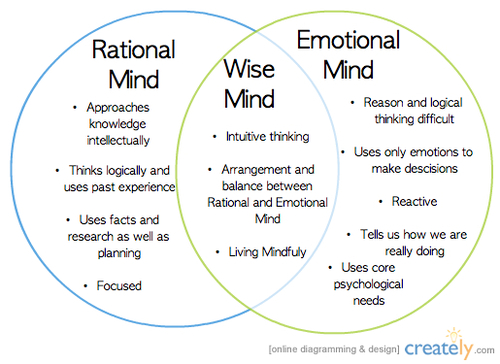
I’ve been in and out of therapy since I was 16. No one ever discussed mindfulness, and I certainly would not have wanted to practice mindfulness as it pertained to my own state of mind because I did not live in a validating environment. What I had going for me in terms of learning mindfulness later on is self-awareness and hypervigilance. In order to do well in my environment, I was required to be very aware of everything going on around me. I could not be reactive because that would trigger a negative response in my mother. My mother lived in emotional mind. I had to, therefore, live in reasonable mind to bring balance to the environment.
What happens when we are self-aware as well as aware of our environments? We are prepared for learning mindfulness. What we have to get rid of are the judgments. What I have observed in myself and others who come from intense environments is a tendency to judge others based upon a tendency to judge ourselves. This tendency seems to originate in judgmental and negative self-talk. It might look like this:
“Why did I do that? I shouldn’t have done that. What kind of person does a thing like that! My mother (or father or someone else) was right. I am selfish or ___________ (another quality). I don’t deserve anything. I am just a _________ only good for ________.”
The only useful statement or question in this running commentary is “Why did I do that?” Even “I shouldn’t have done that,” is questionable because it involves the S-word–should. Should is often used in invalidating statements which are part of the larger category of cognitive distortions known in DBT as Stinkin’ Thinkin’. I will cover Stinkin’ Thinkin’ later. The point here is that what I wrote here is just one big, nasty judgment, and many of us engage in this kind of self-talk on a regular basis. Why? We grew up hearing it. If this was the outer atmosphere in our environment, then it makes sense that it would become the inner atmosphere in ourselves. So, what can we do about it?
Here is an introduction to the Three Steps To Achieving Wise Mind–The What Skills
Observe
Simply notice the experience in the present moment. Wordless watching. Watch your thoughts and feelings come and go like clouds in the sky or as if they are on a conveyor belt. Don’t push away your thoughts and feelings or apply meaning to them. Just let them happen even when they are painful, shocking, or go against your value system.
Note: This may be a challenge to a Christian particularly if you were raised in a legalistic environment. There is a great deal of teaching around taking our thoughts captive based upon 2 Corinthians 10:5. There is another verse, Matthew 7:1, that simply says, “Do not judge so that you are not judged.” There are another eight more verses in the New Testament that address judgment and clearly instruct us not to judge. And, of course, there is Romans 8:1 which directly says that there is now absolutely no condemnation of any kind for those in relationship with Jesus. So, if God does not condemn or judge us, then we can stop judging others, and, more to the point, stop condemning and judging ourselves for our perceived shortcomings, thoughts, and actions. If you notice a thought go through your mind that disappoints you, simply let it pass. Remember–God is not disillusioned with you. He never had an illusions about you to begin with. We are the ones in need of therapy and a paradigm shift. Not God.
Describe
Wordful watching: Label what you observed with words now. Put words on the experience like “I feel sadness in my heart, ” or “I notice that I’m thirsty,” or “I’m feeling anxiety about a project at work,” or “I feel relaxed.” Describe only what you observe, but do not interpret your observations.
Participate
Become one with your experience meaning experience or lose yourself in it. Fully experience your feelings without being self-conscious. Actively practice. Don’t worry about tomorrow or focus on yesterday. Fully be present in the current moment with all your heart whether it be dancing, cleaning, taking a test, or having coffee with a friend.
Three Steps to Achieving Wise Mind–The How Skills
Don’t Judge
- Notice but don’t evaluate as good or bad.
- Acknowledge the harmful and the helpful but, again, don’t judge. For example, replace “You’re such a jerk!” with “I feel angry when you do that.”
- Don’t judge your judging. **This one is very important. We all engage in this one, and it can lead us to spin out. We may notice a thought or a behavior that triggers us or causes us to apply a judgment to our character. Then, we judge ourselves for judging ourselves, and the cycle starts. For example, we might feel annoyed by a coworker’s recent tardiness to meetings. Perhaps we’ve shared our frustrations with another coworker. We then find out that the tardy coworker has been late because she was recently diagnosed with a serious illness that has required her to go to many morning doctor’s appointments, and she is very fatigued. Suddenly, you feel selfish and ashamed. You begin to say things to yourself like, “What kind of person am I? Oh my gosh, I am a horrible person! I should have asked her if she was okay! Of course, she’s sick. She looks sick! How come everyone else knew that she was ill and I didn’t?” And now you feel too ashamed to even look her in the face. Then, you realize that you’re engaging in negative self-talk. “Oh my gosh, I’m beating myself up! I shouldn’t be doing that! I’m judging myself now! What kind of person does that? I’m mean to everyone! Even myself!” And on and on it goes. Stopping the Judgment Train before it leaves the depot can put a stop to a lot of this negativity before it even starts.
Stay Focused
- Do one thing at a time like observe or describe.
- Let go of distractions.
- Concentrate your mind.
- Live in the present moment.
Do What Works
- Focus on what works. Don’t let emotions control your behaviors.
- Play by the rules that govern the context of the circumstances.
- Act as skillfully as you can.
- Do what you need to do to achieve your goals.
- Let go of negative feelings that hurt you and make things worse.
Letting go of negative feelings may be one of the more difficult things to do when practicing mindfulness, but it is essential for learning emotional regulation.
Taking it one step further, here are basic strategies for developing Zen Mindfulness. What is Zen Mindfulness? It is:
Continuous, clear awareness of the present moment. Always returning, whether from an enjoyable fantasy, an emotional outburst or a melancholy remembrance; always returning to this moment. Being fully here, present-moment after present-moment. This is mindfulness. It’s not about having your “mind-full” of something, it’s actually the opposite – it’s the setting aside of your mental and emotional baggage, resulting in a clarity and a fluidity that lets thoughts, feelings and perceptions flow smoothly through your awareness without sticking. (Zen Mindfulness)
- Focus your attention on the present moment and observe whatever you are experiencing.
- Let go of any concern for how others perceive you.
- Observe and put words to your feelings and thoughts and to your experiencing of sight, smell, sound, touch, and taste.
- Quiet your mind and notice your breathing several times a day.
- Practice being nonjudgmental daily.
The important thing to notice in the language about mindfulness is the word “practice”. Mindfulness is a practice because it is skills-based. Learning to be nonjudgmental is a skill. Mindfulness flows around the dialectic as does being nonjudgmental, and this is something that many people in our culture do not understand. The dialectic can be a hard concept for people to grasp. Remember: the dialectic is two opposing ideas that are true at the same time. So, you can have an idea like “I can see where you are coming from and even empathize with you, but I still don’t agree with you.” That is a validating statement and even a dialectical statement. It’s not a judgment, but there are those who feel judged simply because one doesn’t agree with them.
Dipping your toe in the mindfulness waters often begins with mindfulness exercises. One of my favorites is exercises that center around radical acceptance because radical acceptance is the opposite of judgmentalism. Here are a few suggestions:
- Read a controversial story in the newspaper without being judgmental about what has occurred.
- The next time you get caught in heavy traffic, wait without being critical.
- Watch the world news on television without being critical of what’s happening.
- Listen to a news story or a political commentary on the radio without being judgmental. (The Dialectical Behavior Therapy Skills Workbook)
When I did these exercises I chose the last suggestion. I was amazed at just how critical I really was, but it clued me in to my reactions and thoughts. I could then apply that chain reaction to other areas in my life where I was being critical and judgmental and use mindfulness instead in the form of radical acceptance.
The next topic in DBT is distress tolerance, but the foundation for everything is mindfulness. This is something that is constantly practiced and developed. So, start practicing, and remember that the first time you play a new song on an instrument it sounds pretty awful. The same will be true in your mindfulness practice. Over time, the more you practice the art of mindfulness, the better it will “sound”.
Miller, Rathus, & Landsman (1999). Adapted from Marsha M. Linehan’s Skills Training Manual for Treating Borderline Personality Disorder, Guilford Press, 1993.
Resources:
- How to Zen Doodle
- The Dialectical Behavior Therapy Skills Workbook
- Mindfulness: An Eight-Week Plan for Finding Peace in a Frantic World
Resources:
DBT Assumptions
There is one core dialectic nestled in the DBT assumptions:
People are doing the best they can, and people need to do better, try harder, and be more motivated to change.
Here is the entire list of DBT assumptions:
- People are doing the best they can.
- People want to improve.
- People need to do better, try harder, and be more motivated to change.
- People may have not caused all of their own problems, but they have to solve them anyway.
- The lives of suicidal, depressed, anxious and angry people (or teens) are painful as they are currently being lived.
- All people must learn new behaviors in different situations in their lives (e.g. home, school, the neighborhood).
- There is no absolute truth.
- People cannot fail DBT.
If you come from an emotionally intense family of origin or have experienced trauma, then some of these assumptions might trip you up. I was certainly bothered. I was bothered by the first assumption and the seventh assumption the most.
Are people really doing the best they can? When the therapists leading the group read these aloud to us I wanted to raise my hand and ask, “Was my mother doing the best she could when she was raging? Should that be my takeaway?”
And, there is no absolute truth? Really? So, it isn’t absolute that I can say ‘no’ if I don’t want to have sex on a date? That’s just a suggestion? Or, every human being isn’t valuable and deserving of, at a minimum, a safe environment?
These were the thoughts that immediately came to mind when I heard these assumptions. Clearly, I was triggered and very defensive. My own defensive state caused me to, ironically, feel even more defensive. I was upset with myself for feeling triggered. So, what’s the key here to understanding these DBT assumptions?
A validating environment. For these assumptions to work there must be a validating environment in which they are made. In a validating environment, it probably is safe to believe that people are doing the best they can while at the same time required to do better (there’s that dialectic. Two opposing ideas that are true at the same time). It is safe to believe that there is no absolute truth because we’re talking about point of view and perception, not philosophical truths like the value of people or fundamental boundaries like a person’s right to say no to a sexual encounter. My perception, for example, is mine, and I can acknowledge that it may not be yours. In other words, my perception is not absolute nor is my point of view. I can make room for another perception and point of view in my worldview. In a validating environment boundaries are respected, not questioned and violated. Perceptions and points of view are also respected.
So, the validating environment is our starting point when we consider assumptions. That is our given, and this makes sense. Feeling safe, secure, and validated is a necessity if we are to pursue a paradigm shift, learn new skills, better our behaviors, and put everything into practice. We can’t take risks if we don’t feel safe.
Next up? Mindfulness.
Material adapted from Marsha M. Linehan’s Skills Training Manual for Treating Borderline Personality Disorder.
Currently on the Nightstand
Share this blog

RSS


thrivingisthegoal.com
is licensed under a
Creative Commons Attribution-No Derivative Works 3.0 United States License.

 Out of the Mire