Out of the Mire
…because thriving is the goal
Learning from Hitler’s Children
I watched the documentary “Hitler’s Children” last night. The filmmakers found the direct descendants of Rudolph Höss, Heinrich Himmler, Hermann Göring, Hans Frank, and Amon Goeth in order to find out how they cope with carrying the surname and legacy of such notorious and high-ranking Nazis. Has life been different for them? Do they feel different knowing that they are the direct descendants of some of the most hated men in recorded history, guilty of such atrocities and crimes against humanity?
In a word: yes.
I was fascinated by the narrative woven by the Nazis that was passed on through oral tradition to their children and children’s children. Amon Goeth, the commandant of Plaszòw made famous in the film “Schindler’s List”, was thought to be nothing more than the overseer of a work camp by his daughter. When she began to ask questions of her mother, Amon’s wife, she was beaten with an electrical cable, but she was nonetheless determined to know if her father had killed any Jews. Eventually, she found out that Plaszòw was not a work camp. It was a concentration camp, but she wasn’t able to conceptualize her father as the commandant of a concentration camp until she watched “Schindler’s List”. Watching Amon Goeth’s daughter describe how she felt watching Spielberg’s representation of her father on film was deeply disturbing for me. It was the picture of dissociation. I could see it in her eyes. After all this time, she is still trying to reconcile that her father is the Amon Goeth, most likely one of the most sadistic Nazis and the commandant of the Krakòw-Plaszòw concentration camp.
Hermann Göring’s great-niece, I believe, was interviewed in the film. She left Germany and began a new life in Santa Fe, New Mexico. She and her brother have both opted for sterilization so as not to carry on the family line. They want to remove all traces of Göring from the earth ending his bloodline with themselves. I understand this. When I was younger I was very fearful that I would be like my mother, or worse, my father. I watched my mother try to murder to my stepsisters. My father is a sociopath. Could I be like them? Would something of their character break forth in me under pressure? Would the cycle of abuse continue if I had children? As a young adult I was convinced that I would not have children. I did not want to hurt an innocent child, and I was fearful that I might simply because of my origins. I even hated that I looked anything like my parents. Hermann Göring’s great-niece looks like him, too. She struggles with it. She wants nothing to do with her family of origin which is why she changed her last name.
It is, however, Rudolph Höss’s grandson, Rainer Höss, who moved me the most. He was so honest about his life and struggles. Rudolph Höss was the commandant of Auschwitz. Can there be a more infamous Nazi than this man? He was responsible for the death of more than 3,000,000 people. Höss, in my mind, was evil incarnate. He enjoyed his position. He reveled in the power, and he got satisfaction from trying to figure out the best ways to implement the Final Solution.
An excerpt from Höss’ affidavit at the Nuremberg Trials in 1946:
I commanded Auschwitz until 1 December 1943, and estimate that at least 2,500,000 victims were executed and exterminated there by gassing and burning, and at least another half million succumbed to starvation and disease, making a total dead of about 3,000,000. This figure represents about 70% or 80% of all persons sent to Auschwitz as prisoners, the remainder having been selected and used for slave labor in the concentration camp industries. Included among the executed and burnt were approximately 20,000 Russian prisoners of war (previously screened out of Prisoner of War cages by the Gestapo) who were delivered at Auschwitz in Wehrmacht transports operated by regular Wehrmacht officers and men. The remainder of the total number of victims included about 100,000 German Jews, and great numbers of citizens (mostly Jewish) from Holland, France, Belgium, Poland, Hungary, Czechoslovakia, Greece, or other countries. We executed about 400,000 Hungarian Jews alone at Auschwitz in the summer of 1944.
Bearing the Höss surname would be burden enough. Being raised by a father who grew up at the Auschwitz villa with Rudolph Höss himself? I find that hard to imagine. So it is for Rainer. He can’t imagine his own life. He hates his grandfather, and he might just hate his own father. He described his father as cold and stoic. Rainer and his siblings were beaten for showing any sort of emotion. If they cried during a beating, they were beaten more. Growing up, Rainer was not allowed to learn about Auschwitz so as an adult he decided to go. He went with an Israeli journalist who was a third-generation survivor. He had never visited Auschwitz either. Immediately, it struck me that these two people taking a sort of pilgrimage to Auschwitz together was odd. One man was the grandson of the man responsible for the imprisonment and possible partial extermination of the other man’s family. What a strange relationship, but the stage was set.
Rainer was taken on a tour of Auschwitz alone with his acquaintance, and he was allowed to tour the residence of his grandfather which was perfectly preserved. For years, Rainer had been tormented by a photograph that he found in Rudolph Höss’ chest. It was a black and white photograph of his father as a child standing just in front of a garden gate. Rainer had wondered what might lie beyond the gate. Did the heart of the concentration camp lie beyond the garden gate? Was his grandfather such an evil man that he could raise his family at Auschwitz in full view of the horrors? Was his father so cold because he had seen the atrocities as a child? He was attempting to write a narrative that made sense. When he stood in the garden and saw the gate he stopped. Once he knew the truth about what was beyond that gate, he would have to finish his narrative. He would know the true nature of his family line. He walked through the gate. Nothing but a concrete wall completely blocking the view. The second-story windows in the villa were a mottled glass that prevented one from seeing outside. The entire villa was designed to create a delusion of grandeur. It was a fiefdom built on the backs of the suffering of millions of innocent people. Rainer could not make sense of what he saw. He kept uttering, “Insanity!”
Word spread to a group of Jewish students that the commandant’s grandson was in Auschwitz. Rudolph Höss’ grandson was there. The Jewish students were in Auschwitz to pay homage to loved ones who had died. They had been walking the grounds with Israeli flags. Candles were lit. Rainer walked into a hall where they were all gathered, and, even on film as an audience member, you could feel something settle in the room. It was like time regressed. Höss himself stood before the Jewish people. Some of the students looked almost terrified. Others were indignant. Rainer simply looked ashamed and nervous. He wanted to put himself out there and do something. A girl stood up and almost accused him, asking, ‘Why are you here?” He stammered, “I’m trying to help,” or something like that. I don’t know if Rainer knew entirely why he was there. Another girl stood up and tried to speak. “Your grandfather exterminated,” she tried to say, but she could hardly stand. She wept and trembled, but she stood up anyway. “Your grandfather…exterminated my family.” She said it. Rainer looked profoundly affected. “What would you do if he were here today?” She looked like she was pleading with him. This is one reason people go to Auschwitz. To make sense of it. To find peace. I suspect that when they get there and see first hand what was done, they realize that there is no peace to be had because you cannot make sense of it. Rainer responded to the girl, pleading back, “I would kill him! I would kill him!”
Something washed over the group as he said those words. Rainer went on to say that he carried such a burden because of what his grandfather did. He was so sorry for what happened. He looked desperate to be free of the burden he carried. He felt so personally responsible for the suffering in that room. Watching this man attempt to fix what his grandfather had done was profoundly painful. Watching these Jewish students look at Rainer for some sort of answer as to why his grandfather was such a monster was equally painful, but there was hope. An older man appeared from the back of the room. He approached Rainer, stood in front of him, grabbed his arms and told him that he was a survivor of Auschwitz. He had been there. The room fell silent. He looked Rainer in the eyes and said, “You are not guilty. You did not do this. You are not him. You are free from this.” And it was then that Rainer cried. It took a survivor of Auschwitz doing the equivalent of releasing Rainer from the legacy of his bloodline to free him of that terrible burden. Once that proclamation was made, the Jewish students began to gather around Rainer and touch and embrace him. Rainer embraced them as well. Something passed between them. Something of healing. Something of understanding. Something of closure. A release of toxic anger and a permission to enter into something like pure grief.
I was profoundly moved watching it. To witness such a thing in real time captured on film seemed almost miraculous to me, and I think we can learn something from this. We all carry legacies that we would reject. If we are victims of abuse and our abusers are family members, then it becomes even more relevant. We can do as Göring’s great-niece did and run from ourselves. I don’t judge any of her choices. To live with something like that defies my imagination. I am speaking metaphorically here. Metaphorically speaking, however, denial is always an option, but where is the redemption or hope in that? We can do as Amon Goeth’s daughter and face it head on. Stir the pot. She struggled terribly for a while. She wrote a book. She dealt with it. Katrin Himmler, Heinrich Himmler’s great-niece, married an Israeli Jew and also wrote a book. When asked why she wrote the book, The Himmler Brothers, she explained,”When my husband and I had our son, it became clear I had to break with the family tradition of not speaking about the past. I wanted to give my son as much information as possible, so that when he starts asking questions about my family, at least I can answer him.” For many victims of abuse or even people hailing from dysfunctional families, loyalty to the family code is king. What Himmler did in breaking the family’s code of silence was courageous. She created a new example of what it means to be a human for her son. She proved that she is, in fact, not like her family specifically not like Heinrich Himmler, the architect of the Holocaust, and she paid a price. She has lost relationship with members of her family.
This is the path of recovery and healing, I think, when it comes to building an identity. For Hitler’s Children, they have had to go to extremes to forge an identity that makes sense to them, and that makes sense because they come from a family line founded upon the most extreme events in recorded history. To deny that these events occurred in certain countries in Europe will land you in a prison cell!
Genocide is an extreme. There is no denying that, but even the families of Nazis have found a way to remain loyal to them. It’s these people in this film who have rejected their lineage and spoken out. It’s hard to imagine loving a Nazi, isn’t it?
But, incest is also extreme. Long-term abuse is also extreme. It’s one thing to beat a kid once, right? We can overlook that. Can we overlook beating a child for years? Can we overlook Uncle Ron touching little Jenny that one time because he was drunk? What about Uncle Ron touching Jenny every time he comes to visit. It’s just that he’s been down on his luck for such a long time, and he just loves little girls so much. Sure, Mom yells a lot. She’s just Irish. You know how the Irish are. You know she loves you. She doesn’t mean it when she calls you those awful names. Toughen up. People can justify anything to write a story that they can live with. We all do it at one time or another. To heal our identities, however, is risky, and oftentimes we must do as Amon Goeth’s daughter did and begin asking questions. Begin pursuing the truth with passion no matter how much it costs us. She was beaten, but she didn’t give up. Rainer Höss faced the demon of his grandfather and even his father at Auschwitz and found a measure of healing. Katrin Himmler forged an entirely new path. Were her great-uncle alive, her son would be exterminated simply for having a Jewish father. These people are working out their identities and laying a path for themselves and their children because they pursue truth and tell the truth.
The truth is the most powerful tool in our hands where our identity development is concerned. The Nazis manipulated it as do abusers, and it’s up to us to reclaim it, edit our narratives, and rewrite them so that we know the correct story about our past and present. When we do that, our futures are in our hands no longer controlled by others.
Watch “Hitler’s Children”. Your life will be enriched for having seen it (Pssst! It streams for free on Netflix).
A False Perception of Self
I’m finally getting around to writing a follow-up post to Breaking The Mold. What are our options if we have confused our personae for our authentic identity? More than that, what if we can’t tell the difference and feel trapped in some sort of outwardly applied identity originating in how others view us? I think that this is probably the more common experience of the two. Even people with a well-developed, strong sense-of-self will, at times, experience confusion about their identities particularly if they experience gaslighting. It’s very difficult not to question how you feel about yourself when your perceptions are being manipulated in a specific environment designed to accomplish that very thing.
One could have an overbearing boss or even a kind of crazymaking culture at work. This isn’t that unusual. There are a few companies in my city that are notorious for their culture as in it doesn’t matter how much they pay you; no one stays there long. They simply can’t survive the culture.
If a person in the midst of working in a crazymaking culture is asked how they feel about themselves, they might reply with statements like this:
- I feel completely inept.
- I feel like no matter what I do it won’t be good enough for my boss.
- I feel like I’m being given things to do that I can’t possibly complete. Like I don’t measure up.
- I feel like I’m being set up to fail.
- I feel like everyone is talking about me behind my back.
- I feel like I’m not accepted.
- I feel trapped. Who is going to hire me after working here?
- I’m afraid.
- I feel like I do my best, but it’s never good enough.
Stay in a culture like this long enough, and everything you thought you knew about yourself might change. People spend most of their time at work. At what point does a persona or even a culture begin to seep inside and become an identity, and how do we prevent it?
Well, it becomes a question of studying that which is authentic. For example, the Secret Service is in charge of finding counterfeit money. How do they do it? They have to know what real currency looks and feels like in order to spot the fakes. This includes the portraits, the federal reserve and treasury seals, the borders, the serial numbers, and the weight, feel, and look of the paper. Getting to know the real thing is what makes them experts in the false things. It’s not very different in the world of identity.
If we want to discover what a healthy identity looks like, then we might begin with something like this:
- What does an authentically healthy person with a properly fenced in sense-of-self and good self-esteem look like?
- How would this person behave?
- What would their relationships look like?
- What would their boundaries look like?
These are not small questions, but they are vital questions if we are seeking to develop and/or heal our identities. And then, we must begin moving in that direction. Now, this is entirely in the realm of the abstract. I’m speaking theoretically here. This process would take time for people with low-self esteem who originated from a dysfunctional family. It’s also worth noting here that we “think” our self-esteem and “feel” our shame. So, let me start with a simple question:
What do you think about yourself (notice the thinking word here as it relates to “thinking” your self-esteem)?
That’s the most basic identity question I can ask. It’s not an easy question to answer. If we’re not in touch with our deeper feelings, then many of us might answer, “I don’t know. Fine, I guess?” Let me help you out. Here are some attributes of what healthy self-esteem is:
- Honest respect for your own abilities, potentials, and value.
- Knowing your strengths and trusting in them.
- Appreciation and open acceptance of your limitations.
- Acceptance of these limitations whilst understanding that some limitations can be overcome.
- Freedom from being overly concerned with what we imagine others think of us. Whilst accepting these perceptions do play a part in everyday life, remember they do not determine who we are. (attributed to Mark Tyrrell)
Here are some attributes of genuinely low-self esteem (a false perception of oneself):
- Social withdrawal
- Anxiety and emotional turmoil
- Lack of social skills and self-confidence. Depression and/or bouts of sadness
- Less social conformity
- Eating disorders
- Inability to accept compliments
- An Inability to see yourself ‘squarely’ – to be fair to yourself
- Accentuating the negative
- Exaggerated concern over what you imagine other people think
- Self-neglect
- Treating yourself badly but NOT other people
- Worrying whether you have treated others badly
- Reluctance to take on challenges
- Reluctance to put yourself first or anywhere.
- Reluctance to trust your own opinion
- Expecting little out of life for yourself (attributed to Mark Tyrrell)
I can look at both lists and see myself in both. Honestly, it depends on the day. Today, I think I am finding myself living from the first list more often, but, if I’m in a lot pain, I do accentuate the negative, expect little out of my life, neglect myself, withdraw socially, and experience profound emotional turmoil. Generally, however, it seems that the negative cognitions seem to cause the withdrawal, lowered expectations, and neglect. In other words, how we think about ourselves, our lives, and our future success has a lot to do with our present choices.
Tyrrell defines low self-esteem as:
Low self-esteem usually results from how we are conditioned by other people. If you were systematically insulted, criticized, or bullied, then you are more likely to have absorbed the negative messages about yourself instigated by other people. Think about who these other people were and when you feel bad about yourself, take a moment to ask yourself: “Hold on. Whose voice is that in my head?” I bet it really belongs to someone else originally. Starting to override other people’s conditioning of us is the first step to psychological independence; the real ‘you’ (that you should be listening to) can be much kinder and more reasonable about yourself.” (attributed to Mark Tyrrell)
Tyrrell’s description of low self-esteem’s origins reinforces my persona/identity hypothesis. Those of us with low self-esteem (a false perception of ourselves) have internalized an applied persona and accepted it as our identity. Depending upon our history, some of us have an extraordinarily low self-esteem. Our sense of self has been so systematically annihilated over time through abuse that we have no sense of ontological existence or significance. We might feel gossamer and light on the inside. There is no weightiness to our being. There is such a long history of dissociation resulting in our very self being divided and split into so many compartments that discussions of self-esteem seem trivial or even fanciful. The idea of self-esteem, however, should not be overlooked due to the self-esteem movement of the 1980s and 90s. Self-esteem refers to our sense of self. It refers to identity, and victims of abuse must pay attention to this idea. Every time a victim splits and compartmentalizes a shard of their identity in order to protect it, there is usually a lie that goes with it. This is why the split happened in the first place. A false perception of oneself is often what motivates the dissociative action in the first place. Later on, when we are safe, we must go back and revisit those old compartments. We have to look at the lies that we once or even continue to believe. These lies can be immensely powerful.
For example, when I was about six years-old, I visited my father and his new wife in December to celebrate Christmas with them. I did not know my stepmother well at all. They were newly married. In my mother’s family, Christmas was a very traditional Scandinavian affair. We did exchange gifts but not many. It was considered gauche to give too many presents. My grandparents were Norwegian and Swedish Lutherans. Thrift was considered a virtue as was charity. The Christmas Eve dinner was also part of the tradition so money was spent on the lutefisk and other traditional fare. Temperance and moderation were, above all, always observed. My father’s wife’s family, however, were Southern and in no way Scandinavian. Even as a six year-old, I was overwhelmed. They were loud. The food was very rich. And, they gave each other so many presents. Cheap presents. It was like someone went to a dollar store and cleared it out. In my family, a nice quality gift was given. In her family, fifty crappy gifts were given to each person. Quality didn’t matter. Just quantity. The sheer mass of gifts shocked me. But, I was also a little kid. I had never seen such a spectacle. I dove in. I might have rolled around in the all wrapping paper. It was the most stimulating thing I had ever experienced. My mother never let me do much of anything as a kid that involved fun. I think I behaved very obnoxiously when it was my turn to open something like thirty presents!
Well, I did something wrong. Apparently, I forgot to say thank you in the midst of the Christmas Extravaganza. I was told by my new stepmother that I was the most spoiled and selfish child she had ever met–repeatedly. As soon as I was reminded, I said thank you repeatedly. It didn’t matter. I forgot once. I would never live it down. Come next Christmas, I made sure to remind myself to say thank you. I didn’t want to be rude. When I arrived at my father’s house I noticed that there were a lot less presents under their tree. In fact, there were no presents for me. They hosted a Christmas party. They made me pass out presents to family and friends. Before everyone opened their gifts my stepmother made an announcement, “My stepdaughter won’t be getting a present this year because I’m teaching her a lesson. Ungrateful children don’t get presents. Perhaps she’ll say thank you next time. Okay everyone, let’s open our gifts now.” Everyone stared at me. I felt like I was going to throw up. I really didn’t understand. She made me clean up all the wrapping paper. On Christmas morning, oddly enough, my father did give me one present. Just one with the caveat that the only reason I was getting it was because he probably should give me something. A few years later, when I was forced to visit them, I went into their guest room where my toys were kept and found that all my toys were gone. Once again, my stepmother told me with a sadistic hiss, “We gave all your toys away to grateful children. Entertain yourself, you little brat.”
Now, why does this matter? As an adult, I have a habit of compulsively saying thank you. I know why I do it. I have a very deep-seated fear that if I don’t say thank you, then everything that I love will be taken away from me. If I am found to be selfish (a false perception of myself) in anything, then I will be punished. In life, we are allowed to fail and make mistakes, but if we come from abusive homes, then we are never allowed to fail, take risks, or make mistakes. What’s more, we don’t know what the rules are because the rules are constantly changing. One day you are allowed to sleep in. The next day you are lazy and good-for-nothing if you aren’t awake at 5 AM. So, the first step in building a foundation for a true perception of oneself, I would say, is making sure that you live in a predictable and safe environment. The next step is that you are in relationships with safe people. It is very, very hard to begin identity work if you aren’t interacting with safe people or living in a safe environment. You need people in your life who will remind you that you don’t need to say thank you all the time. You need people to tell you that you needn’t say sorry every five minutes. These behaviors originate in how we feel about ourselves and also in how we fear others will think of us. If I fear that someone thinks I’m selfish, then what? Let’s ask the bigger question? If I fear that God thinks I’m selfish, then what? If an abuser used God to justify their abuse, then your sense of self can be deeply affected. Profound fear and anxiety can rule your life.
Stability and predictability are key in order to begin addressing identity. Safe relationships are the context wherein we can begin asking some very important questions about how we feel about ourselves, and we can ask the safe people in our lives how they feel about us. Authentic compassion, empathy, and love is often hard to internalize, but it is a stepping stone to real internal, longterm change over time.
Dealing with Dissociation
I want to talk for a moment about dissociation. There will come a moment in almost all our lives when we will check out. A part of us will go away in order to cope with pain. The human brain is very complex, and our limbic system will do whatever it takes to see to it that we survive. We may walk around like a robot for a while until we are able to come back to ourselves. This sort of thing isn’t uncommon around sudden traumas like deaths, disasters, and accidents. We feel out of body, out of touch, and numb. Eventually, we fully merge into ourselves and deal with whatever caused our dissociation. Our minds have come out of denial and accepted the present reality however painful or shocking it might be. This might be described as acute dissociation.
For people who have grown up in intensely dysfunctional environments where longterm exposure to abuse was at play, chronic dissociation may be an issue. Many of us have heard a character in a movie who was raped describe the experience as such: “I felt him push into me, and, suddenly, I saw myself on the floor. I saw him raping me as if I were watching a movie. I couldn’t feel anything.” That’s a classic description of dissociation. Part of the victim leaves and, somehow, she is standing outside her body acting as a witness to her own assault. For children who grew up in abusive homes, the option to leave is not available so the brain creates it through either a fugue state, dissociation through lack of memory, or dissociation through fantasy. Part or, parts, of the self abandons the child disappearing into compartments. Severe forms of this can become DID (Dissociative Identity Disorder) later in life. There is, of course, the option to simply disappear and feel nothing. A child might fall into depression if left alone to walk this path. There is only hopelessness in that state. Ultimately, if left untreated, apathy results and one simply stops thriving in life. If one doesn’t give up completely, one must do what it take to feel something. Enter addictions, substance abuse, risk-taking, and myriad other issues. The desire to feel anything other than the pain that is crucial to avoid is present. Anger may also be present because anger isn’t pain, and anger is, at least, a drive of some kind. It’s a sign that someone hasn’t entirely given up. Anger, however, can be highly destructive, and it’s just a step or two away from rage.
I used to live in a dissociated state. I didn’t know it at the time. I thought that I was feeling all the emotions on the human spectrum, but, for some reason, when I would gather with friends or their families, I would feel invited but not included. I would feel like an outsider. I would see their happiness and expression of enthusiasm, and I couldn’t get there. I thought that maybe I just had a different personality. Maybe other people were just…stupid. I had to come up with a reason why I felt so different and out of place. Why do they look so happy? Why do I feel so…neutral? I could certainly feel anxious. I could feel scared. I couldn’t really feel happy. I couldn’t feel peace. I avoided feeling pain. I didn’t like sex. I did not want to be seen naked. I wanted to be in the dark if at all possible. Life was not to be enjoyed because I lacked the capacity to enjoy it. Life was to be endured. Oh, I liked a good cliché as much as the next guy, but, if I was honest, I couldn’t achieve it.
Why?
I was dissociative. How many times can a child be beaten, sexually exploited, screamed at, left alone for hours at a time, and abandoned before a child simply finds a way to leave? The brain will find a way. Mine did. I created a vast fantasy world for myself at a very young age. I was not allowed to play with many people as a child so I stayed in my room most of the time for hours at a time. I recall being very happy in my room. I got lost in my world. As I grew older, my world changed from stuffed animals and Barbies to an internal world that I manipulated. If I didn’t like my circumstances, then I simply retreated into new scenarios that I created. I was present physically but miles away inside. I held conversations with people, worked, went to school, and showed up in life, but I wasn’t there. There are weeks of my life that I don’t remember because I wasn’t present. I was gone. If my mother screamed at me, I just disappeared. If pain tried to come forward, I went away. I had so many exit strategies in place in my being that it really didn’t matter to me anymore how I was treated.
It started to matter when I was in therapy. My therapist was very direct with me when he realized that I was dissociative. He very plainly said that I could no longer do that. I had to integrate. I was horrified. He said that I was never going to learn distress tolerance or heal if I continued to dissociate, but, unfortunately, I didn’t know how to stop. I had always been dissociative. I had been sexually abused and beaten as a toddler. My brain was wired for it. I didn’t have DID, but I had a fair number of compartments. So, we set about going through each compartment–each world–and examining it. Each world was built upon a memory. Heal the memory. Close off an exit. Eventually, I was fully integrated and unable to voluntarily dissociate. I was locked in.
I hated it.
I had to fully feel all the pain in the moment and learn to deal with whatever stress, anxiety, or pain my circumstances presented to me. There were days I wanted to peel the skin off my body. I was so angry that I had agreed to this. I felt like my therapist had taken away my only coping strategy. Even writing about it now–remembering it–I feel sad. Dissociation is powerful. It is a powerful coping strategy for dealing with profound pain as well as for dealing with crazymaking behaviors that we’re not able to make sense of. Brother and sex don’t go together. Mother and abuse don’t go together. Father and hatred don’t go together. Trying to reconcile such things will drive us insane. Trying to accept such horrors will only make us feel like we’ve taken crazy pills. It’s not possible! So the brain steps in to protect us, hence, dissociation. Coming out of dissociation, however, is very difficult because we are left to deal with what drove us to split in the first place. We are very fragile in this state.
What is the first step in healing or even beckoning a person to consider integrating who is dissociative? I can only speak for myself, and I write about this because I know that there are people out there who struggle with this very thing.
Last week, I had a kerfuffle with my husband. Like most married people, we argue about the same ol’ thing over and over again. We don’t fight. We just talk. And, then I say something he doesn’t like at which point he shuts down the entire conversation. This is a very unproductive communication style. He stops talking. I cry. Very textbook. I’ve tried to shake things up a bit by not crying and putting on a brave face. It doesn’t work. Well, after having the same “argument” for almost nineteen years, I think he had enough, and he said as much, punctuating his statement by slamming a car door in my face. As much as I don’t like to admit that I might be triggered by my history, I probably was. I don’t function well if I’m yelled at. In fact, if someone shows any aggression toward me in a relationship, I will freeze. Have I worked on this? Lord, yes. For years. Do I know how to handle conflict? Yep. Tell me that I’m the problem and then slam a door in my face? Apparently, I’ll dissociate. I haven’t dissociated in at least five years, but, as I sat in the car hearing the echo of the car door’s slam reverberating through the frigid air, this overwhelming exhaustion swept over me mixed with a kind of engulfing pain. I wanted to give up. I was so tired of being the active one in my marriage. I didn’t want to be the catalyst for change anymore. I wanted to stop. Was I bad for wanting something better? Was I wrong? And, in a millisecond the words, “Feel nothing,” were spoken in my mind. Suddenly, I felt a strange sensation in my chest as if I actually felt a part of my inner being depart. It was like it was happening in slow motion. I could feel it all happen. I felt the splitting. Then, I felt nothing. Absolutely nothing. Like my soul was anesthetized. I emerged from the car with this phony smile on my face, and I said a lot of stupid things along the lines of “It’s all my fault,” and “I’m sorry,” etc. You know, The Victim’s Mantra. I haven’t behaved like that for a long time most likely because I haven’t dissociated in a long time.
What’s important here? I saw my therapist, and, yes, she said I had dissociated. She also talked about what it would take to bring me back. I stubbornly sat in her office chair quite certain that I was not coming back. I was equally annoyed that I had done such a thing in the first place. I strongly dislike being “handled”. What would it take to convince me that it’s safe to return? I had no idea. I couldn’t remember what was done for me in the past to get me to agree to stop dissociating in the first place.
Today, I visited the Facebook page of an author who a friend recommended to me. She sent me one of his quotes via text message the other day, and my curiosity got the better of me because I was so struck by his words:
“Spousal abuse is just as common in Evangelical churches as it is anywhere else. One study asked 6000 pastors what they would do if a woman came to them for counsel about domestic violence. Here are the shocking results:
26% would counsel the wife to continue to submit to her husband, no matter what.
25% would tell the wife the abuse was your own fault for failing to submit in the first place.
50% said that women should be willing to “tolerate some level of violence” because it is better than divorce.”–Danny Lee Silk
As I was reading through his page, I read this:
“Even people who once held the” most intimate” place in our lives find themselves unable to access us as they did previously before because the size of the mess that they have to cleanup is beyond their willingness to fix..it maybe (sic) a while before we feel safe enough to allow that level of intimacy once again.”–Danny Lee Silk
I felt my heart swell. That paragraph describes my marriage. More than that though, I felt understood. Part of me went away because I was protecting myself, and isn’t that why we dissociate? I process so much of my life and feelings in my relationship with God as I understand Him. My therapist can tell me whatever she wants, but, at the end of the day, I must connect to God. God, as we understand Him, speaks to us in so many different ways. When I read this Facebook post, I felt warmth in my chest return and tears finally came. I felt divine validation, and it is in being understood and validated that we can practice feeling safe, and that’s when the absent parts of ourselves begin to return. That’s where the invitation lies. Looking back, I think that’s how my former therapist brought me back from the hidden places. Each part that had dissociated was honored. She was given dignity. She was told that what she had done was okay. She was understood. She had not been safe, but she was going to be safe now. There was protection now.
In my connecting to God, I look at how God connected to people in the past. God has many names in the Bible. One of His names is ‘El Roi’. ‘El Roi’ means “The God Who sees me”. God is only called ‘El Roi’ once in the entire Bible. Hagar, Abraham’s mistress, calls God ‘El Roi’ after she’s been thrown out and left to wander the desert alone and pregnant. God appears to her and tells her that she will be okay. Hagar is comforted and calls God ‘El Roi’ because He has seen her as she is. What’s more, He sees exactly what she’s endured. He sees every detail. He knows. And, isn’t that something profound particularly for those of us who were made to keep secrets or pretend, or for those victims who were abused but never believed? Someone besides us knows. We are believed. We are seen. The entire character of God fulfills every one of His names so when El Roi comes to us, we can be sure that the entire being of God is embracing us with “I see you. I believe you. I know what you’ve endured. I KNOW.” Amazing validation.
There are many of us who have been walking the road of healing for a long time, and, when setbacks occur, it often feels like we are alone and left to wander the desert of pain aimlessly. I have learned once again that God is indeed a God that sees us. More than that, we experience healing through our interactions with others. There is nothing mystical about it. Where others had the power to drive us away from ourselves through their abuse, others have the power to bring us back to ourselves through their love, acceptance, and validation. To be understood, loved, affirmed, and accepted is truly the entry point into long-lasting healing regardless of where you are on your healing journey. Healing is always a possibility.
Resources:
Powerful and Free: Confronting The Glass Ceiling for Women in The Church by Danny Lee Silk
What Is The Kingdom of God?
This post isn’t a follow-up to my last post. It’s a question really.
What would happen if you were hanging out at a café with a friend during the fall, enjoying some tea and a scone and good conversation, when a stranger approaches you. His expression is angry and haughty. He stares at you as you eat. He glances at your friend. He looks almost offended. Finally, you ask, “May I help you, sir?” You notice the muscle in his jaw flex. Is he grinding his teeth? Whatever on earth for? He inhales as if trying to maintain his civility. “No, you cannot help me. You cannot even help your own soul.” You laugh out loud not because you find his response humorous but because you are now very uncomfortable. “Uh…what do you mean?” He sweeps his hand towards your table in a grand gesture. “Look at the two of you sitting here with such pride. You eat. You enjoy yourselves. You live with such wanton abandon. Do you not know what day it is? Do you not know that you are living in sin?” You are now curious. “How are we living in sin? Is it sinful to visit a café? I mean, it’s not Sunday. Not that it’s sinful to go out on a Sunday or anything, but to some people it is, I suppose.” The man produces a pedantic laugh. “Sundays? Who cares about Sundays?” You are beginning to feel annoyed. “Sir, make your point or leave please.” His eyes narrow. “You are sinning. You are breaking the Law. Today is Yom Kippur. You are not allowed to enjoy yourself today. Today is the holiest day of the year. It is a day to confess sins and fast. How can you sit here and eat and drink and partake of any kind of merriment forsaking your own soul?” You sigh with relief. “Oh, I see. I’m not Jewish, sir, but I do see what you are saying. If you are Jewish, then I bless you in your day of atonement and wish you well.”
The man stares at you. “I am not Jewish. The Bible, however, is clear. Are you a believer?” You pause and ask, “What do you mean?” He asks again, “Do you read your Bible?” You ask, “Do you mean to ask me if I’m a Christian?” He nods. “Yes, I am.” He looks smug and responds, “The command to keep the Day of Atonement is in your Bible. Even your Christ kept it. What sort of Christian are you then if you do not?” He then leaves.
Now, this is a weird interaction. A man is imposing his religious worldview upon someone else and judging them at the same time calling their faithfulness into question. His adherence to his own religious practice is his standard for devotion in all others even if other people don’t believe what he believes. It matters not to him. Does the celebration of the Jewish feasts make sense for someone who is not Jewish even if they are a Christian? This is a big question; one that takes time to answer. Is it right to judge a Christian for not celebrating them? That’s an easier question to answer. No, it’s not right. Matthew 7:1 is very clear on this point: “Do not judge others, and you will not be judged. For you will be treated as you treat others. The standard you use in judging is the standard by which you will be judged.” Just in case we don’t understand what Matthew is saying, the same sentiment is repeated in Romans. Three times!
- You, therefore, have no excuse, you who pass judgment on someone else, for at whatever point you judge another, you are condemning yourself, because you who pass judgment do the same things. Romans 2:1
- You, then, why do you judge your brother or sister? Or why do you treat them with contempt? For we will all stand before God’s judgment seat. Romans 14:10
- Therefore let us stop passing judgment on one another. Instead, make up your mind not to put any stumbling block or obstacle in the way of a brother or sister. Romans 14:12
And again in 1 Corinthians 4: Therefore judge nothing before the appointed time; wait until the Lord comes. He will bring to light what is hidden in darkness and will expose the motives of the heart. At that time each will receive their praise from God.
Yes, we all have our own measure for what is good, healthy, or even holy, but we are not allowed to apply that to anyone. It is absolutely forbidden for Christians, for lovers of Jesus, to judge another human being. The standard is set very high for those who claim to love Jesus because the word ‘Christian’ means ‘like Christ’.
Why write this out? Nothing I’m saying here is new or provocative. Well, I continually read accounts of Christian leaders condemning the “homosexual lifestyle”. I find this odd and weirdly funny. Why pick homosexuality? I’ve asked this question before of the very passionate people who are participating in this culture war. They angrily respond with something like, “The Bible is very clear on the matter. Homosexuality is a sin!!!” Huh. Let’s look at this for a moment. I’m going to examine 1 Corinthians 6:9-11:
Or do you not know that the unrighteous will not inherit the kingdom of God? Do not be deceived: neither the sexually immoral, nor idolaters, nor adulterers, nor men who practice homosexuality, nor thieves, nor the greedy, nor drunkards, nor revilers, nor swindlers will inherit the kingdom of God. And such were some of you. But you were washed, you were sanctified, you were justified in the name of the Lord Jesus Christ and by the Spirit of our God.
I do see homosexuality among the list of “violations” that are considered unrighteous, but I see a heckuva lot more violations, too. What about the sexually immoral? What does that mean exactly for us today? What does it even mean to be sexually immoral? Well, in terms of Judeo-Christian ethics, it means violating the standard of ethics known to be in play within this belief system. We could sit back and have a very long discussion about the nuances of sexual immorality and never come to an agreement on the subject because the spectrum of sexuality is so wide and varied even in the Church. Furthermore, Jesus never discussed it. Not once!
What about idolaters? Idolatry is the act of putting anything before God–loving anything more than God. That’s all of us. I’m sorry to be the one to tell you this, but every human being on the planet will, at some point, engage in idolatry because we use idolatry to cope. Every time you use chocolate to comfort yourself rather than asking the Holy Spirit to be your comforter, you are engaging in idolatry. The sobering truth behind this is that eating chocolate or ice cream or Lay’s potato chips in order to numb yourself to pain is on par with homosexuality according to 1 Corinthians 6. In fact, committing adultery–and Jesus said that adultery included just thinking about getting it on with someone who was not your spouse–stealing, being greedy, exploiting other people, being abusive–even verbally–or being on the spectrum of manipulative from an emotional manipulator all the way to a con artist like Bernie Madoff–are all unrighteous choices. There is no hierarchy here. From the view of heaven, it’s all the same thing. We will all meet the criteria for at least one of these acts of unrighteousness at some point in our lives. We will all violate this ethical standard in some manner and be cut off from kingdom of God. This is what it means to be human.
Why are we then not seeing Christian leaders speaking out on news programs and radio shows about idolatry? How many marriages are affected by a lifestyle of idolatry in the form of gaming, for example? Why are there not conferences of Evangelicals gathering to condemn the rise of adultery in the Church today? What about greed? The 2008 Great Recession was a direct result of greed and thievery. I don’t recall church leaders standing together to speak against the direction of the culture then. What about the hook-up culture and excessive alcohol consumption that goes on at so many college campuses today? This isn’t necessarily about sex and experimentation. It leans a little too far towards exploitation. Fox News and Jim DeMint aren’t discussing this at length today. Sure, someone will occasionally bring it up, but star college athletes seem to be a protected and elite group of individuals who are granted a wide berth when it concerns bad choices and highly questionable behavior. Communities value their college and pro sports and the income it brings in. If innocent women are hurt along the way, then the most common trope you’ll hear is, “Boys will be boys.” This is greed in action! I’m not attacking anyone or even attempting to be provocative. I’m merely pointing out that Paul is very clear that these choices, according to the Bible, are just as grievous as the very thing for which most conservative Evangelicals today are willing to condemn another person–being gay.
What if one of these fraternities, however, were a homosexual fraternity? What if they partied just as hard as the other Greek organizations? What if it weren’t girls who were being roofied and raped but boys? What then? I can almost guarantee that a shitstorm of epic proportions would come down upon that organization that has never before been seen. Why? Why are heterosexual males allowed to behave badly and illegally with little consequence but homosexual males are not? 1 Corinthians 6 makes it pretty clear that, in God’s eyes, we are all the same. There is no ‘us’ and ‘them’. Sexual exploitation is sexual exploitation. The Greek word used in 1 Corinthians 6 for ‘homosexuality’ is ‘arsenokoités‘. Arsenokoités is a compound word constructed of two Greek words: arsen and koité. Arsen means male or man, and koité, in this context, means ‘repeated immoral sexual intercourse’ or sexual promiscuity. In other verses in the Bible, koité is used to mean ‘sexual promiscuity’. During this era, there were a few cultural habits at play. Older men would choose younger men for long-term sexual relationships. This was not an uncommon lifestyle in the Roman Empire. Paul’s letters to the Corinthians and Romans were, in fact, instructing them to stop engaging in that behavior. It was a form of sexual exploitation.
Secondly, any form of sexual exploitation is simply not healthy to body and soul. Historically, the women in this time period were viewed as chattel. Society was segregated, but men would often have a great deal more contact with each other. The public baths, for example, were a favorite gathering place for the Romans. Sexual activity was very common there. You have to remember that the Roman Empire worshiped the phallus. When groups of Romans converted to Christianity, Paul had to discuss their sexual practices and phallus worship. This was a very different time. Older men had to give up their pedophilia, and men had to stop having sex with each other in the public baths–if they were going to convert to Christianity. Nowhere in the Bible, however, are these practices ranked as somehow far more offensive than any other behavior. This became a Judeo-Christian ethics issue. That’s all.
So, why are Christian leaders so freakin’ obsessed with homosexuality? Why do we seem to have a group of self-appointed culture warriors ready and willing to condemn another group of people to hell even though Jesus didn’t do that? Jesus never talked about homosexuality. Jesus talked about a lot, but he did not press the SEX button. Isn’t that fascinating? I think that one of the bigger reasons behind general cultural homophobia is shame as well as a political agenda. Americans, in general, struggle with shame around sexuality. We are very odd in that way. We are far more comfortable looking at a nearly naked Victoria’s Secret model than we are seeing a woman nursing her baby. Americans are often very offended by sexual content in films, but we are not usually bothered by extreme violence. “24” was a very popular television show among American Christians, but show an American Christian some sexual content and watch the religious fervor and judgment rise to the surface. Violence and war are lionized in our culture because it can be linked to nationalism, and, for many American Christians, nationalism and even jingoism go hand in hand with faith. One cannot be considered a good Christian if one is not a patriot. Because of the military’s historical stance on homosexuality, the American Christian cultural link between faith and patriotism, and the enmeshed attitude betwixt shame and sexuality, it becomes clear why conservative Evangelical leaders have launched a culture war against homosexuality singling it out as if it’s the chiefest of all sins when the Bible is very clear that: 1) it is not and 2) arsenkoités is a specific act or rather set of acts occurring in certain contexts.
Compare this cultural reality to Jesus’ teachings. He never discusses sexuality, but he talked frequently about how we were to treat others. Generally speaking, American Christian culture simply does not line up with what Jesus taught. Sure, there are pockets in North American Christian culture that are very life-giving, but, as a whole, what do agnostics and atheists believe that we believe based upon their cultural experiences with American Christianity? In general, how do American Christians engage the culture? What messages are coming across the loudest? Someone could very well engage me on my points and tell me that Leviticus 20:13 is very clear: ““If a man practices homosexuality, having sex with another man as with a woman, both men have committed a detestable act. They must both be put to death, for they are guilty of a capital offense.” It’s true. Leviticus does indeed say this. Do you know what else the Old Testament commands? We are commanded to keep all the feasts as well. The commands are quite explicit, and they are laid out in great detail in both Leviticus and Deuteronomy. If people are condemned by Christian leaders for disobeying God and practicing homosexuality, then why aren’t all Christians censured and harshly condemned for disobeying direct commands that explicitly direct us to keep the many feasts? The obvious answer is because we’re not Jewish. Christians do not keep Torah. And, there it is. Christian leaders can’t have it both ways. Christians either follow the teaching of the Torah to the letter or they do not. This is what Jesus was saying when he said to the mob of people ready to stone an adulteress in John 8 that anyone without sin in their lives could throw the first stone at her.
We cannot pick and choose “sins”, decide which ones are better and which ones are worse, categorize people based upon which groups make us more uncomfortable, and then condemn them accordingly. We either fully keep Torah which would then make us Jewish (and even modern Jews decide which parts of the Torah apply today) or we do not. We either cast stones at the guilty of which we are a part, or we cast no stones at all. Let’s be honest here, sexuality will always make us uncomfortable. It’s a private issue that has been made public and turned into a commodity in order to sell products. What’s more, our identities and the deepest part of ourselves are tied up in it. How we feel about ourselves is tied into sexuality. What right do any of us have to actually condemn another human being for their sexual identity when God does not? Nowhere in the Bible does it actually say that homosexuals will go to hell. It says that people who engage in all forms of sexual exploitation will not inherit the kingdom of God, and the kingdom of God is present now. It’s “at hand”–it’s now. That includes heterosexuals as well. How many people do you know who are engaged in sexually exploiting other people for their own satisfaction actually care about cultivating the presence of God? That is the point. Lifestyles that harm others do harm us as well. We lose our self-awareness, our sensitivity, our compassion, and our God awareness. We don’t function as we were created to function.
The kingdom of God is not just about God. It’s about humans living at peace with each other. It’s about humans becoming everything that they were created to be, going as high as they can, fulfilling their destinies, and doing so in a blessed community, under the smile of God. Lives where greed, abuse, sexual exploitation of the self and others, substance abuse, broken relationships, stealing, and deception is present will not flourish. The kingdom of God will not be present there. In the end, for Christians, it’s all about relationship with the person of Jesus. It will always, always, always come down to that. This is why Jesus never talked about sex. Sex, at its heart, is a relational act. Talking about it, condemning it, shaming people for liking it, marginalizing those who do it, alienating those with fetishes, exiling those who are into kink, and gossiping about those who have used it to make a living should be forbidden activities for followers of Jesus. Why? Look who Jesus called ‘friend’. If Jesus was friends with prostitutes, then you can bet he was friends with the homosexuals of his day. He was beloved by the marginalized in his community. This is what changed everyone around him. He simply loved people at their starting points. He offered them himself and a new way to experience life. He called forth their true identities and showed them that God, His Father, looked just like him. Love is what changes people. Love is what makes a person begin to love themselves. Maybe you can ask for something better in life because where there is love there is hope. Where there is hope there is faith. A belief in oneself is the beginning of a trajectory change in life. This is what knowing Jesus is like. His unwavering belief in our worth is relentless, and it changes how we feel about ourselves–for good. Once one person in a community experiences this kind of love, it spreads. Suddenly, communities are changing. This is the kingdom of God at work.
This is what the Church’s role is. Our job is to tell every single person on Earth that they are beloved. In God’s eyes, they are clean. They are priceless. They are forgiven. They are welcome in His presence. In God’s eyes, they are perfected, beautiful, and so incredibly worthwhile. There is healing and restoration waiting for them. This should be everyone’s starting point for themselves. It all begins with a relationship. If there is no relationship with God, then we have no business saying anything else. If we do not love people, then we have not earned the right to speak. As far as I’m concerned, if this is not the message of every Christian leader, then they need not speak at all.
“The Lord your God is in your midst,
A Warrior who saves.
He will rejoice over you with joy;
He will be quiet in His love [making no mention of your past sins],
He will rejoice over you with shouts of joy. Zephaniah 3:17 AMP
Breaking The Mold
I have never contacted an author for any reason. Never because I’ve liked their material. Never to complain. Never because I was fan-girling over their latest novel or having a fit over how they wrote a character out of a storyline. I am an introvert and, admittedly, a lurker. Lurkers skulk around on the Internet. I don’t contact authors. Ever. That changed for me recently, however, when I was reading the material of a certain writer. He’s a non-fiction writer and speaker. I’ve heard him speak numerous times. I really like his material. I’ve recommended it to many people who are looking for a different take on God, faith, and the problem of suffering. His material is very empowering. I recall sitting at my dining room table reading one of his shorter books. I came across a statement that confused me. I reread it. It was still confusing. I read it yet again. Nope. It made no sense to me. It made no sense because of a certain word. The word was ‘persona’. The author said that God will only interact with our persona. Huh. I stopped and thought about it. That didn’t make any sense to me. That couldn’t be correct.
I have to explain something about myself. I’m a word nerd. I’ve always been like this. I studied Latin for four years. I went on to study Russian in college. I grew bored with it so I decided to study French. I devoted eight years of my life to that language and even moved to France to attend university there. I got sick of French whilst living there so I started studying German just to shake things up a bit. I can only order a beer and a piece of cake in German now, but my French really improved thanks to attempting to learn German while only speaking French. On top of it, I’m a synesthete. Certain spoken words cause me to feel a physical sensation. Synesthesia is actually a sign of faulty wiring in the brain. I know someone who tastes ear wax when she hears a certain word spoken aloud. My primary form of synesthesia is seeing words as they are spoken. When people speak, I see a stream of words pass before my eyes much like an LED stock ticker displaying the latest stock information. My synesthesia combined with my logophilia are probably what contributed to my stumbling over the improper use of the word ‘persona’ in the book I was reading. I can be quite rigid about words and their use. I know this about myself. I work hard to be flexible and non-judgmental when it comes to others and their journey with grammar, language, and writing. This author and his use of the word ‘persona’ in his chosen context, however, got under my skin! So, I emailed his publishing house. I really respect this author so I felt some fear in doing this, but I wanted some clarification. My logophilia and need for clarification in his writing overrode my need to be liked. I never thought I would get a response, but I did.
The author himself emailed me and explained his word choice. He stood his ground, linguistically speaking, and he was very kind and gracious about it. I was surprised and grateful for the response although I stubbornly held my own view. I still disagree with him. ‘Persona’ is the wrong word. I have to stop here and explain what a persona is. The word ‘persona’ comes from the Latin for ‘theatre mask’. In fact, the word itself has not evolved at all. ‘Persona’ is itself a Latin word. In Latin, ‘persona’ means ‘mask’ or ‘character played by an actor’. We derive the word ‘personality’ from it. Why does this matter? It matters because of this author’s statement that God only interacts with our persona. What he intended to say, I think, is that God only interacts with our identity. NOT our many personae. BIG DIFFERENCE.
What happened next is altogether strange and wonderful. For three days after I received his email response, I saw my life pass before me as if I were watching a movie. It was as if all the events and experiences both inner and outer were reorganizing according to a new paradigm–persona vs. identity. This is something I’ve been exploring for years except that I never called it a persona. I always called it a ‘false self’. M. Basil Pennington, a Trappist monk, wrote a book called True Self/False Self: Unmasking The Spirit Within, and I read that book cover to cover years ago hoping to make some connections I intuitively knew existed.. What are these so-called connections?
I’ll explain it by asking another question. Why do we go to therapy? Why do we read self-help books? Why do we seek out the truth regarding our life experiences? We do these things because we are looking to define ourselves in terms of what is really true about us vs. what is not true. Let me break it down into something very familiar–social roles.
When I go to book club, I behave differently amongst the women there than I would were I going to see my gynecologist. When I am spending time with my husband I behave differently with him than I do when I’m with him at one of his work functions. I speak to my cousins differently than I speak to a close friend. We all wear masks that serve us because we have to move along a social register. It’s an expectation. What’s more, we’ve probably all encountered someone who doesn’t know that they are required to wear a mask, or persona, that suits the occasion. I’ve been at social functions wherein a man has spoken to me in an overly familiar manner that caused me to feel very uncomfortable. He crossed boundaries through physical touch and language. He spoke to me as if I were his girlfriend when, in fact, I was a complete stranger to him! We had only just met. In part, I could explain this by saying that he was not wearing an appropriate persona. He was disinhibited most likely due to alcohol consumption. People take off their masks for all sorts of reasons, but alcohol is often a primary reason.
Our many personae, however, do not necessarily define us in whole or even in part. Sometimes we put on a persona that feels like it isn’t us at all. It’s just habitual because it’s expected. We put on the persona to get through an experience. When we leave the experience we feel exhausted, drained, and almost confused. We ask ourselves why we even bother getting together with those individuals if we always leave feeling so psychically exsanguinated. In my opinion, these are all rather normal experiences. As we grow, we find that we’ve outgrown certain roles. We outgrow certain relationships and can’t be ourselves within certain groups. The more exhausted we are when we leave a gathering, the more we realize that there is a lack of congruency between our persona and our identity within that group. Are we free to be ourselves? Are we spending more time hiding our true selves and overcompensating? Why? To me, this is all very fascinating and even healthy. This, however, is not the most interesting part of what I saw during the three days of watching my life experiences play before me.
There are personae that we carry and choose to put on and take off. We go to work, parent, have friendships and romantic attachments. We don’t make love wearing a parent persona. That would never work unless you have a certain fetish, but I’m going to stay within the bell curve for the sake of discussion. There are, however, many personae, I would argue, that we carry that we did not choose. They are applied to us by others, and we wear them perhaps often or even all the time–maybe even unknowingly. These applied personae affect everything that we do and even how we think about ourselves. The tragic consequence about these outwardly applied personae is that we often internalized these personae as our identities, and, when we do this, our lives change.
Why? Our behavior and choices follow what we believe about ourselves. It’s really that simple. If you believe yourself to be completely worthwhile, intelligent, capable, and lovable, then you will make good decisions. You will choose healthy people as friends and potential mates. You will have good boundaries. You will have a sense that you have a good future ahead of you so you will make plans. You will not fear failure so you will learn from your mistakes rather than practice avoidance behavior. What if you don’t value yourself? What if you are functioning in life with toxic internalized personae that are masquerading as identity statements? How did they get there, and what might that look like?
Frankly, I could write a novel about this, but here is an example. I’ve written about the No-Good Child in another post. The No-Good Child is a term given to children raised by a caregiver with Borderline Personality Disorder. The child is personified in the family as 100% evil. No matter what the child does to earn the parent’s love, affection, and acceptance, they are rejected, abused, and typically outcast because the parent only perceives them as bad. This is the definition of a persona. A borderline parent perceives a child through a filter. This filter causes the parent to see a particular child as bad in every way. Due to this perception, the borderline parent then feels justified in their abusive behavior. The child has two choices before them. They can reject the beliefs of the borderline parent; this belief that they are all bad is the applied persona. Or, they can believe that they are, in fact, all bad and, thusly, deserving of all the abuse. Why would their own parent abuse and hate them if they didn’t deserve it? This belief that they are all bad is the internalizing of the applied persona. Essentially, they are exchanging their own identity for their parent’s belief.
They are making a persona their identity.
They are taking on their parent’s hatred and making it their own. Their identity becomes one founded upon self-loathing which was originally the loathing of a parent, and a new borderline is created. It all began with an exchange. The child gave up their identity, which was still forming, for a persona that didn’t even belong to them. It was a persona that was forced upon them by a very influential adult.
I have come to believe that this is often what happens to us in life as we are developing and growing into adulthood. It’s usually not as extreme as the aforementioned situation, but it’s common nonetheless. What are the roles of our mothers and fathers? They are present in our lives for so many obvious reasons. One role that they play is in the area of self-actualization. Parents see who we are and who we are becoming. They are there to call forth the beauty, strength, and gifts that are merely kernels within us when we are children. They are there to connect us with resources and mentors so that these kernels are fertilized and cultivated. They are also there to protect us from those that would seek to cut us off from experiences that would expand us. Parents are in our lives to help us make sense of the experiences we go through as we grow up so that we do not internalize any falsely applied personae.
Think about things that were said to you in middle school and high school? Those statements that you just can’t forget? For example, I’m 6 feet tall. I was teased relentlessly for years. My mother commented on my height. My father teased me. I left high school feeling like an unfeminine oaf due to all the comments I heard. It took me over ten years to be comfortable in my own skin, and there are days I still remember the words of my best friend in ninth grade–“Who would ever want to date a string bean?” I went home and cried. “I’m a string bean.” That persona statement became my identity. “I’m too tall. I’m unattractive. No one would ever want to date me.” But, those were not my words. Those were the words of other people, and no one ever told me that I didn’t have to accept them. I just did.
What about the words of abusive parents or even cruel teachers who were using shame to force compliance? What about religious teachers or pastors who were trying to motivate congregants?
- “You’re so lazy! Why don’t you clean your room! What makes you think you’ll ever get a good job or amount to anything? You won’t even make your bed!”
- “You are so worthless.”
- “You didn’t turn in your confirmation homework again? God helps those who help themselves. Clearly, you won’t help yourself. Don’t expect to get any of your prayers answered. Sloth is not rewarded.”
- “How’s the weather up there? By the way, nice tits…”
- “You are stupid. You will never get anywhere without me. No one would ever want you. Who could put up with you and your sniveling? Do you see what I have to deal with? Crying again? Again? You are so selfish.”
Many people grow up in environments, familial, educational, and religious, wherein statements like these are declared. Individuals with more resiliency tend to fare better than those who lack resiliency. Studies have shown that resiliency originates in a conviction that one is lovable, worthy of love, or already loved. If an individual has experienced love from just one person, then they will be more resilient even if they are subjected to long-term abuse. So, what kind of persona might be formed from statements such as this?
“I am a lazy, worthless person. God will not help me if I’m not productive all the time. No one is interested in my feelings. Never show anyone weakness. They will leave you. I’m an object. Needing anything means that I’m selfish. Being tired and needing to rest means that I’m lazy and slothful. Never ask for help. I can’t ever need help.”
This statement used to be a part of my identity statement, and I know many people who have tied their identity and worth to a persona that was applied to them through a religious organization, an academic institution, or their family of origin. They change their behavior like a chameleon by wearing different personae depending upon the context. If you were to ask them who they really are, they don’t know. What they do know for certain is that they hate who they are when they are with certain people. They do know that it’s just not them. They know that, for example, their family is wrong about them, but they don’t know another way to behave. It’s been this way for too long. How do they break out of the mold?
How indeed?
In my experience, the best way to begin separating personae from identity is by building a true identity. Some false persona statements are so integrated and internalized that they honestly feel like truth. Life experiences have only ratified and reinforced what has been declared by influential people. When a person is abused as a child and then raped as an adolescent only to be assaulted in a relationship later on, for example, the thought that one truly is worthless feels absolutely true. Hasn’t life experience proved that?
What are our options then? After reorganizing my life experiences according to this paradigm, I think that no matter who you are or what you’ve been through, we have a lot of options. Stepping back and looking at this from a persona paradigm is one way to untangle this.
Dangerous Religion
I think I’m going to be learning a lot from that brunch for weeks to come. Snippets of conversations overheard are replaying in my mind. There is a benefit to being viewed as a second-class citizen; no one pays attention to you, thus, you are permitted to be a fly on the wall.
I’ve mentioned the idea in past posts of a “religious spirit”, but I’ve not elaborated on it. There are a few ways I could define the notion of a “religious spirit”, which may sound weird and “Christianese” to readers. I’m not sure if there is another way to put it so read on for clarification. The first way that I will try to define it would be in terms of legalism which I would define as a strict adherence to one’s own interpretation and understanding of the Law forsaking even relationships. People are viewed through a filter of performance. How well do they keep the Law? Their value is proportionate to their obedience, and their value to their faith community is likewise proportionate to their performance. This legalism is observed when the laws of the faith community are ever changing but yet strictly enforced. One day someone is criticized for not attending church every Sunday. Suddenly, it is not holy enough to attend every Sunday. Wednesdays and Sundays are now required to meet the holiness standards of that particular community and so on. If someone dares to confront the keepers of the Law in that faith community and they are met with a form of alienation which includes being exiled from the community, slander, direct accusation towards one character, or plots to blacklist a member from the larger faith community, then you know for certain that you have encountered legalism. One key element of legalism is a draconian commitment to the preservation of the status quo. Change is to be avoided at all costs.
I heard a man speak a few years ago who experienced great passion for God. He caught a vision for his faith community that would completely change it and would, at the same time, revitalize it. The church leaders wanted nothing to do with him or the change he suggested so they exiled him and plotted to kill him. He actually had to leave his home country and immigrate to the United States to avoid being murdered–by his pastor! When you distill legalism down to its essence, this is what you will discover. It steals life be it your exuberance to pursue God twisting your relationship into some kind of soul sucking labor, or it replaces your wonder and self-esteem with fear and anxiety causing you to believe that God is the Great Accountant in the sky constantly weighing your every thought and deed, recording your every sin in some weird religious ledger that will be held over your head, opened at any moment. God becomes Santa Claus. You better watch out. You better not cry. You better not pout. He sees you when you’re sleeping. He knows when you’re awake. He knows if you’ve been bad or good so be good for Goodness’ sake! It is absolutely impossible to experience a relationship with God or even believe that you have true value when your faith is influenced by this kind of religion. Why? Because you are just a number who must perform to appease an angry deity. Maybe you’ll get to sit on God’s lap once a year and ask for something–if you’ve been good. More often than not, however, you’re too busy avoiding the lightning strike as well as the all-seeing eyes of your church leadership and fellow spying congregants.
Another flavor of religiosity is Gnosticism. I’ve discussed this in depth in another post, but it’s important to mention it because Gnosticism combined with legalism, in my opinion, is the Zeitgeist of the modern church. Basically, Gnosticism is the belief that the physical world is evil and the spiritual is what is most valuable. This is where the secular/sacred duality originates. Gnosticism is rooted in neo-Platonic thought. It is heretical. There is no such thing as secular vs. sacred. God does not value one thing more than another in terms of whether a pursuit is sacred. He made the entire universe and called it good (Gen. 1:31). I spent time with a missionary family when I was living in France, and I overheard one of the women in their social group say, “It took me a long time to even go see a movie. We were taught to weigh all of our activities by whether or not we would want Jesus to come back and find us doing it. I would never want Jesus to come back and find me sitting in a movie theatre! So, I still don’t really go to movies. I think that might be sinful.” This is a Gnostic view of life combined with legalism. Not only was this woman attempting to perform well in order to attain God’s good favor, but she was also categorizing activities based upon that which she believed was sacred vs. secular. Would she have felt better about going to the cinema if she were seeing a decidedly Christian film starring Kirk Cameron? What about this notion about Jesus coming back and catching us in the middle of some secular pursuit? What sort of burden is that to put upon a group of people? How much anxiety do you think that provokes in a faith community? What about important life pursuits such as sex? “Oh no, honey, we better not. I wouldn’t want Jesus to come back tonight and catch us in flagrante delicto!” What about going to the bathroom? “I better hold it. What if Jesus catches me on the toilet?” How many activities of daily life are mundane and fairly base? What about all those dirty jobs that have made Mike Rowe so famous? What about coroners? “I better not perform this autopsy. I wouldn’t want Jesus to come back while I’m weighing this man’s spleen.” What about ranchers? “I better not inseminate this mare. I wouldn’t want Jesus to see me with my hands all up in this horse’s lady business.”
It is the Christian belief that Jesus was fully God, but He called Himself the Son of Man for a reason. It was to tell us that He was 100% human. He was born of a woman. There is no such thing as a sacred/spiritual dichotomy. We need to banish that idea from our consciousness. If you want further proof that Gnosticism and this notion of a sacred/secular dichotomy is completely untrue, then I give you 1 Corinthians 5:
All this is from God, who reconciled us to himself through Christ and gave us the ministry of reconciliation: that God was reconciling the world to himself in Christ, not counting people’s sins against them. And he has committed to us the message of reconciliation.
The Greek word for ‘world’ used in this text is kósmos which means ‘universe’ among other things. It is the word from which we derive the English word ‘cosmos’. What this text is saying is that there isn’t one part of the created order that has been left out of the redemptive work of Jesus. One cannot say that it is holier to go to church on Sunday and less holy to watch a movie. The Old Testament book of Esther does not even mention God one time. Not once! Does this make the book of Esther a secular book? If we’re really being legalistic, the Sabbath, according to scriptural text, begins on sundown on Friday and ends on sundown on Saturday. So, if you are going to church on Sunday, then you have failed to keep the Sabbath holy. That thought brings me to another religious notion–fundamentalism.
Fundamentalism on its own is merely a literal interpretation of sacred texts. There are forms of fundamentalism in every religion. Fundamentalism on its own isn’t necessarily problematic excepting the issue of insular thinking. Fundamentalism, however, rarely exists in a vacuum. There is often a tendency amongst fundamentalist believers to impose their beliefs on others even if that means following a violent call to action. Many sacred texts were never intended to be read literally. They follow the literary traditions of the times in which they were written, and often those traditions involve hyperbole, metaphor, and leitmotifs common to the poetry and literature of the era which would be immediately understood by their intended audience. Context matters. I can’t emphasize this enough. Valuing a sacred text more than one’s relationship with God is actually a form of idolatry. One cannot love one’s neighbor as oneself and love God with one’s heart, mind, soul, and strength and maintain a fundamentalist viewpoint at the same time because fundamentalism, by definition, requires strict adherence to literal scriptural interpretation even at the expense of relationships and community. By definition, one is then in violation of the ministry of reconciliation mentioned in 1 Corinthians 5. This is why fundamentalism is a form of a dangerous religiosity. The primary relationship with God becomes secondary to the texts, and the texts become a means to an end justifying any number of harmful behaviors which are almost always entirely carnal, selfish, and often violent. For example, it doesn’t matter if you are opposed to abortion. In no way are we permitted to murder physicians who perform them. A few fundamentalist believers, however, have justified those actions by means of textual manipulation.
Keeping all this in mind then, what might this multi-faceted “religious spirit” look like in an everyday interaction? Well, I saw it in action at the now infamous brunch. As I said, I was largely ignored, and when you’re ignored, people get comfortable. The niceties fall away. They speak freely. Here’s a part of a conversation I overheard:
“The question you have to ask of addicts is ‘What’s your idol?'”
“That’s an interesting question.”
“Well, yeah. Your emotions will tell you what your idol is. Just ask yourself what you’re most afraid of, and then you’ll find your own personal idol.”
“I don’t follow…”
“Well, if you’re afraid of being poor, then money is your idol. If you’re afraid of losing your family, then you love your family more than you love God. You’re not supposed to love anything more than God.”
“….”
“Okay, let me put it like this. What’s the only thing you’re supposed to fear?”
“I don’t think we’re supposed to fear anything really.”
“Sure we are. We are required to fear God. The fear of God is the beginning of wisdom. Have you heard of Tim Keller? He says that if we aren’t being confronted with God every single day then we aren’t in an active relationship with God. Where’s the idol?”
“I’m not comfortable with what you’re saying.”
This dialogue happened right in front of me. I felt like I was watching a Wimbledon match. We have legalism in the form of the question “What’s your idol?” because the question is being asked with a focus on sinfulness. That was a performance question. More than that, there was no understanding of the human heart behind the question. People experience fear for a plethora of reasons, and God’s answer to that is found in 1 John 4:18:
There is no fear in love. But perfect love drives out fear, because fear has to do with punishment. The one who fears is not made perfect in love.
This verse is profound if you read it in the Greek. The Greek word used for fear is phóbos, and it is the Greek word from which we derive our word ‘phobia’. It means ‘terror’. It also means, in the Greek, ‘fleeing because feeling inadequate, avoid because of dread, fleeing because of fear of judgment’. We are not to fear, but we are to instead desire the love of God experientially which will, as we sojourn, drive away our many fears which might lead us to build those idols. So, in all those places where we are fearful, we can simply ask God to increase our capacity to experience His love so that, in time, our capacity for fear is decreased. God is looking to penetrate our identities and shift our paradigms so that we see who He really is and, thusly, who we really are. Behaviors change only when identities change. Not the other way around. The end result is transformation.
The other problem with this conversation is fundamentalism. The scripture that the man was quoting is Proverbs 9:10 which is, “The fear of the LORD is the beginning of wisdom, and knowledge of the Holy One is understanding.” The Hebrew word for fear used in this text is yirah which does mean ‘fear’, but it is also translated numerous times in the Old Testament as ‘reverence’. We can assume then that yirah does not hold the same meaning as the Greek word phóbos since the text clearly indicates that God does not want us to be fearful. Fear and trust cannot coexist, and God’s primary desire is relationship with us. This is why Jesus was born into the world. The man at the brunch who so boldly exclaimed that we should be fearful misread the text due to literalism. He is basing his own spiritual journey on performance which produced an air of judgmental smugness in him. After all, when we begin to believe that our standing with God is solely dependent upon our performance, then we will believe this about everyone else. What do we become? Judges.
What then can we do?
That is, by far, one of the most interesting questions to ask. Firstly, just so that you can get a sense of what God has in mind for how we are to treat each other, read through all the “One Anothers” in the Bible. I made it easy on you. Here they are:
- Mark 9:50 – “Salt is good; but if the salt becomes unsalty, with what will you make it salty again? Have salt in yourselves, and be at peace with one another.”
- John 13:14 – “If I then, the Lord and the Teacher, washed your feet, you also ought to wash one another’s feet.
- John 13:34 – “A new commandment I give to you, that you love one another, even as I have loved you, that you also love one another.
- John 13:35 – “By this all men will know that you are My disciples, if you have love for one another.”
- John 15:12 – “This is My commandment, that you love one another, just as I have loved you.
- John 15:17 – “This I command you, that you love one another.
- Romans 12:10 – Be devoted to one another in brotherly love; give preference to one another in honor;
- Romans 12:16 – Be of the same mind toward one another; do not be haughty in mind, but associate with the lowly. Do not be wise in your own estimation.
- Romans 13:8 – Owe nothing to anyone except to love one another; for he who loves his neighbor has fulfilled the law.
- Romans 14:13 – Therefore let us not judge one another anymore, but rather determine this–not to put an obstacle or a stumbling block in a brother’s way.
- Romans 14:19 – So then we pursue the things which make for peace and the building up of one another.
- Romans 15:5 – Now may the God who gives perseverance and encouragement grant you to be of the same mind with one another according to Christ Jesus,
- Romans 15:7 – Therefore, accept one another, just as Christ also accepted us to the glory of God.
- Romans 15:14 – And concerning you, my brethren, I myself also am convinced that you yourselves are full of goodness, filled with all knowledge and able also to admonish one another.
- Romans 16:16 – Greet one another with a holy kiss. All the churches of Christ greet you.
- 1 Corinthians 11:33 – So then, my brethren, when you come together to eat, wait for one another.
- 1 Corinthians 16:20 – All the brethren greet you. Greet one another with a holy kiss.
- 2 Corinthians 13:12 – Greet one another with a holy kiss.
- Galatians 5:13 – For you were called to freedom, brethren; only do not turn your freedom into an opportunity for the flesh, but through love serve one another.
- Galatians 5:26 – Let us not become boastful, challenging one another, envying one another.
- Galatians 6:2 – Bear one another’s burdens, and thereby fulfill the law of Christ.
- Ephesians 4:2 – with all humility and gentleness, with patience, showing tolerance for one another in love,
- Ephesians 4:25 – Therefore, laying aside falsehood, SPEAK TRUTH EACH ONE of you WITH HIS NEIGHBOR, for we are members of one another.
- Ephesians 4:32 – Be kind to one another, tender-hearted, forgiving each other, just as God in Christ also has forgiven you.
- Ephesians 5:19 – speaking to one another in psalms and hymns and spiritual songs, singing and making melody with your heart to the Lord;
- Ephesians 5:21 – and be subject to one another in the fear of Christ.
- Philippians 2:3 – Do nothing from selfishness or empty conceit, but with humility of mind regard one another as more important than yourselves;
- Colossians 3:9 – Do not lie to one another, since you laid aside the old self with its evil practices,
- Colossians 3:13 – bearing with one another, and forgiving each other, whoever has a complaint against anyone; just as the Lord forgave you, so also should you.
- Colossians 3:16 – Let the word of Christ richly dwell within you, with all wisdom teaching and admonishing one another with psalms and hymns and spiritual songs, singing with thankfulness in your hearts to God.
- 1 Thessalonians 3:12 – and may the Lord cause you to increase and abound in love for one another, and for all people, just as we also do for you
- 1 Thessalonians 4:9 – Now as to the love of the brethren, you have no need for anyone to write to you, for you yourselves are taught by God to love one another;
- 1 Thessalonians 5:11 – Therefore encourage one another and build up one another, just as you also are doing.
- 1 Thessalonians 5:13b – Live in peace with one another.
- 1 Thessalonians 5:15 – See that no one repays another with evil for evil, but always seek after that which is good for one another and for all people.
- 2 Thessalonians 1:3 – We ought always to give thanks to God for you, brethren, as is only fitting, because your faith is greatly enlarged, and the love of each one of you toward one another grows ever greater;
- Hebrews 3:13 – But encourage one another day after day, as long as it is still called “Today,” so that none of you will be hardened by the deceitfulness of sin.
- Hebrews 10:24 – and let us consider how to stimulate one another to love and good deeds,
- Hebrews 10:25 – not forsaking our own assembling together, as is the habit of some, but encouraging one another; and all the more as you see the day drawing near.
- James 4:11 – Do not speak against one another, brethren. He who speaks against a brother or judges his brother, speaks against the law and judges the law; but if you judge the law, you are not a doer of the law but a judge of it.
- James 5:9 – Do not complain, brethren, against one another, so that you yourselves may not be judged; behold, the Judge is standing right at the door.
- James 5:16 – Therefore, confess your sins to one another, and pray for one another so that you may be healed. The effective prayer of a righteous man can accomplish much.
- 1 Peter 1:22 – Since you have in obedience to the truth purified your souls for a sincere love of the brethren, fervently love one another from the heart,
- 1 Peter 4:8 – Above all, keep fervent in your love for one another, because love covers a multitude of sins.
- 1 Peter 4:9 – Be hospitable to one another without complaint.
- 1 Peter 4:10 – As each one has received a special gift, employ it in serving one another as good stewards of the manifold grace of God.
- 1 Peter 5:5 – You younger men, likewise, be subject to your elders; and all of you, clothe yourselves with humility toward one another, for GOD IS OPPOSED TO THE PROUD, BUT GIVES GRACE TO THE HUMBLE.
- 1 Peter 5:14 – Greet one another with a kiss of love. Peace be to you all who are in Christ.
- 1 John 1:7 – but if we walk in the Light as He Himself is in the Light, we have fellowship with one another, and the blood of Jesus His Son cleanses us from all sin.
- 1 John 3:11 – For this is the message which you have heard from the beginning, that we should love one another;
- 1 John 3:23 – This is His commandment, that we believe in the name of His Son Jesus Christ, and love one another, just as He commanded us.
- 1 John 4:7 – Beloved, let us love one another, for love is from God; and everyone who loves is born of God and knows God.
- 1 John 4:11 – Beloved, if God so loved us, we also ought to love one another.
- 1 John 4:12 – No one has seen God at any time; if we love one another, God abides in us, and His love is perfected in us.
- 2 John 1:5 – Now I ask you, lady, not as though I were writing to you a new commandment, but the one which we have had from the beginning, that we love one another.
Then, instead of ‘one another’ insert ‘myself’ or ‘I’ into the text. For example, “Beloved, if God so loved us, I also ought to love myself.” The reason I suggest this is because we cannot give what we do not have. There is a strong tendency in the modern church to externalize the faith relationship with God rather than first see to it that people know experientially that God’s promises apply to them and their lives before they can go out into the world and “make disciples”. So, when people are reading their Bibles and they see a piece of Scripture come alive right before their eyes causing their spirits to quicken, they assume that the text is coming alive to them so that they can give it to someone else. They don’t understand that the Holy Spirit is speaking to them! That piece of scripture is for their lives and circumstances. Not for anyone else. Just as we first put on the oxygen mask so that we can breathe air before responding to the person nearest us during an emergency, we must know God for ourselves intimately before we can share Him with any sort of truth with someone else.
The religious spirit in all its forms has no place in our churches and, most of all, in our relationship with God. We were not made for performance, criticism, judgment, or striving. We were made for an empowered, joyful, intimate relationship free from all anxiety with the living God who loves us far more than we might even attempt to imagine. May 2014 be the year that we break away from all religious striving and break into the good plans that He is waiting to give all of us.
14 For this reason I bow my knees before the Father, 15 from whom every family in heaven and on earth is named,16 that according to the riches of his glory he may grant you to be strengthened with power through his Spirit in your inner being, 17 so that Christ may dwell in your hearts through faith—that you, being rooted and grounded in love,18 may have strength to comprehend with all the saints what is the breadth and length and height and depth, 19 and to know the love of Christ that surpasses knowledge, that you may be filled with all the fullness of God.
20 Now to him who is able to do far more abundantly than all that we ask or think, according to the power at work within us, 21 to him be glory in the church and in Christ Jesus throughout all generations, forever and ever. Amen. Ephesians 3:14-20
Being Your Authentic Self
I had a really weird social interaction yesterday. I didn’t think I was going to write about it, but here I am, sitting in my bed in my pajamas under the down comforter, exhausted from the day, and my mind feels restless and preoccupied. My husband described it as carrying a charge and needing to ground oneself. Yeah, that’s it. I’m charged from the true oddity of the social exchanges, and I’m looking to ground myself.
So, what happened?
Well, have you ever had a chance to meet a person years after they betrayed you? It’s an opportunity to take your own emotional temperature. Essentially, I was invited to brunch by a former mentor who, in my perception, betrayed my trust profoundly. We used to minister alongside each other way back in 2003. I look back at that time in my life and I see how young I was. My fourth daughter was only a babe. The last ten years of my life hadn’t happened yet, and, as painful as the last ten years have been, I wouldn’t trade this journey for the world. That betrayal was the catalyst for my healing process. I see that now. I needn’t harbor bitterness, resentment, or a jot of unforgiveness. God has truly used those events to enlarge me and lift me out of the mire. I look back at the woman I used to be, and I don’t recognize her at all. She was so scared, wounded, and paralyzed. She had no sense of who she was or who God wanted to be for her. She tried hard. She tried too hard to please everyone all the time, but deep down she was afraid of being discovered. She was afraid that she was just a fraud. She was terrified that every dark deed done to her and every despicable word said over her was really deserved. She was trying so hard to prove to herself that she was worthwhile all the time fearing that she was really worth nothing.
That’s not me anymore. What happens though when the people from your past treat you as you used to be in the present? That’s what I experienced yesterday.
I had a feeling it was going to go that way. I was the only woman at a table of ten men who all exceeded my age by at least fifteen years or more. All the men, save one, inquired after my husband. Not me. There was no interest in my personal life or interests. Only my husband’s. My former mentor told me a story or two about his current ministry. Whenever I engaged him in conversation he looked away and showed little to no interest in what I was saying. I wasn’t discussing ministry, therefore, it wasn’t valuable. This is a very gnostic view. I listened to these men at the table discuss addiction and the men they sought to reach through ministry. I wasn’t sure what to make of any of it. I wasn’t sure why this brunch was arranged. Weren’t we called together to see each other? Catch up with each other after all these years? I hadn’t seen a few of these people in close to a decade.
Aside from being shunned, the oddest part of this brunch was the seating arrangement. Guess who I happened to sit next to? My former therapist!! Can you imagine walking into a brunch and finding your former therapist there? This was the man with whom I did most of my work. He knows almost too much about me, and I haven’t seen him in a few years. Lo, he’s the man I’m sitting next to at this brunch. It all felt like some weird set-up. Perhaps it was.
I felt compelled to go to this brunch. I didn’t want to go. I don’t want to go hang out with a bunch of men I haven’t seen in almost ten years many of whom I never knew that well in the first place–particularly men who seem to be a bit misogynistic in the name of a few lines of Pauline scriptural text. There was more to this gathering, however, than some story swaps about the good ol’ days of ministry. This brunch was about identity–my identity.
You see, we all see ourselves differently depending upon the context. Some people would call this self-view a ‘persona’. The word ‘persona’ comes from the Latin word for theatre mask and refers to actors playing a part. So, when you interact with your mother, you inhabit a persona, if you will, that not only identifies you as a child but also carries with it the messages you received from your mother throughout your childhood, adolescence, and adulthood. If you were a much loved child, then the persona you occupy before your mother might bring forth feelings within you of security, a sense of belovedness, self-esteem, happiness, and the like. If you were mistreated or even abused, your persona before your mother would be quite different. You might be angry, defensive, and deeply insecure in your attachment to your mother. You might have the traits of a victim in that relationship, thus, exhibiting very poor boundaries which may cause you to always feel run over by your mother. Your persona with your boss, on the other hand, might look very different. Perhaps your boss is supportive and empowering; he sees your strengths and seeks to release you into a higher level of performance. In this relationship, you are freer to take risks because you know the boundaries so your persona in this context is one of strength, openness, and joy. And, of course, our persona with our spouse is very different than with anyone else. We express our sexual selves within this context. Depending upon our life experiences, the sexual persona will either be empowered and relational, predatory and exploitative, or helpless and that of a victim. The point here is that we have many different “personae” that are expressed daily within different contexts depending upon the people with whom we interact.
What if, however, we are interacting with an individual or group of individuals who attempt to apply a false persona to us by treating us in a certain way? This is what happened to me yesterday. It is a ridiculous assumption to believe that anyone is the same person that they were ten years prior. For a Christian to hold such a belief about another Christian is preposterous because this presumes that God is not actively working in the lives of His children to bring about their highest good. What sort of faith is that? I know that not one of those men whom I met today is developmentally the same as he was a decade ago. If he is, then he’s been living under a rock as a hermit. A lot happens in one year. How much happens in ten? How much can happen to a person and within a person in ten years when that person is completely committed to a dynamic relationship with God? If God is committed to us and that commitment includes our personal development, then the heights we can achieve in character development within a decade are almost unimaginable. How much healing, reconciliation, expansion, restoration, and development might we experience in ten years if we were committed to God’s way of doing things in our relationships? It’s an astounding question to ask. This is why I found yesterday’s interactions so…pitiful.
I was not perceived as ‘me’. I was viewed through a filter of who they all thought I used to be, and this is how I was treated. A persona was applied immediately, and I was not allowed to expand from that set point. Who was I ten years ago? I was a victim of human trafficking and the daughter of a pedophile. I needed help. I was the “woman with the problem”. I needed therapy or some sort of “healing ministry”, as they put it. I became an Untouchable simply because I had been victimized by other people and admitted it. I admitted that I was in pain over it, and no one knew what to say about it.
I am not that woman today, and what I discovered, sadly, is that most of the men I met yesterday are still largely the same as they were ten years ago. I went into the meeting expecting growth, change, compassion, and open eyes. That’s not what I experienced. I bumped up against a great big wall of passive judgment. My worth was tied to my husband, and I felt marked simply because I was a rape and incest survivor.
The application of a false persona or false self by others to another person is often a huge stumbling block for people. Many of us work very hard to learn what is really true about our essential identities. We seek out the most powerful truths that will override the lies spoken to and over us so that we might build an identity rooted in truth and empowerment. This takes a long time, but it’s one of the most important efforts that we can pursue. To make a comparison, it’s akin to repartitioning your hard drive except that you have to reprogram each partition at a time adding new code to replace old data files that are no longer needed. This is, in large part, why we go to therapy. A good treatment plan does not exist so that we can sit in a chair and talk. Our talking in a clinician’s office merely provides the bread crumbs which lay out a trail that leads the therapist to the source of improper thinking–the partition gone bad. Cognitive Behavior Therapy (CBT) is one way in which therapists repair improper thinking which fuels false personae. Dialectical Behavior Therapy (DBT) is another way. For those people with PTSD and other anxiety disorders, in vivo and imaginal exposure therapies are essential to getting rid of false personae.
In my experience, however, the most powerful way to cut through all the false selves is a power encounter with God. I could write about this at length and perhaps I might, but, at this time, suffice it to say that God has a way of clearing a path in the heart and mind for immense growth and healing that would be impossible in a therapist’s office alone. Collaborating with a gifted clinician and the Holy Spirit will produce remarkable results and lead one to the discovery of what is most true about oneself completely apart from life experiences be they traumatic, middling, or negative. What I have discovered is that God’s intention for each of us is that we know experientially what it is to be renewed in our minds and hearts, and this renewal is possible regardless of past experiences. It doesn’t matter how bad your prior life experiences were. In fact, I have found that God excels at creating something magnificent from shit. The worse you feel about yourself at the outset of your journey, the more wondrous God intends for you to feel about yourself later on. This is the nature of God, and every encounter He intends on giving you will be to show you exactly who He wants to be for you so that you not only truly know Him as He is but also so that you shed the skins of all those negatively applied personae in favor of the true self that is most authentic to you–the new creation that you really are. This new creation is how God sees you. You are new. You are perfected. You are clean. You are whole. These are very basic identity statements upon which we build a true identity. Our feelings about ourselves don’t speak to us of who we are. Often they speak to us of how others feel about us.
- You’re worthless.
- You’re fat.
- You’re never gonna amount to anything.
- When will you get your shit together?
- When will you settle down and get married?
- Why can’t you do anything right?
- You’re so selfish.
- Why can’t you just be like your brother (or sister)?
- I will never let you leave me. Besides, who would want you anyway? You’re nothing without me.
- Your car broke down because you weren’t giving enough money at church. You’re being punished by God.
How many false selves are we carrying around with us that have nothing to do with who we really are but have everything to do with how we perform and please others? One of the primary goals of our healing journey is that we find our true placement in life by discovering what it means to wear our true self at all times forsaking all other personae. Then, we occupy that place at all times regardless of who we’re in front of. We no longer feel triggered by that predatory boss and fall into the victim persona because we know that we are an empowered individual who has rights. We occupy a place of strength in front of our parents regardless of how they speak to us because we know that we do not have to sacrifice ourselves for anyone else. Blood is not thicker than water. No indeed. In fact, the true saying goes like this: The blood of the covenant is thicker than the water of the womb.
There is immense joy in discovering who we really are, who we are called to be, and what God’s intentions are toward us because only good exists here. What might we look like completely free of a victim persona or some other kind of false self? What might we look like walking in complete freedom, expanded and certain of who we truly are not bound by dependencies on others’ opinions, judgments, and slights?
That was what I tasted yesterday. I sat amongst people who attempted to apply an old persona to me, but I didn’t allow it. The result? I was shunned by almost everyone at the table. You know what? I wasn’t that bothered by it. I found it to be weird and a bit sad, but I found closure. God made promises to me years ago that I didn’t understand at the time, and yesterday I felt in my heart that I had grown past the experience of being hurt by the man who mentored me. God’s promises came to pass. I didn’t require his approval anymore. I didn’t belong in that group of people, and that was okay. My not belonging amongst that group didn’t mean that I was weird or didn’t belong anywhere at all. It simply means that I can fully move on now. I needn’t look back anymore. There will always be people who don’t truly see us for who we are. They will always want to apply a false persona to us based upon their own biases and life experiences, and it’s not our job or calling to accept that persona. We are in no way required to wear a mask in order to make another person or group comfortable. We are to show up, be authentic, and let them feel the weight of who we are and who we are becoming. If they can’t accept the truth of our authenticity and the genuine work that God has accomplished in our lives, then shake the dust of your feet and move on. There are better communities to offer your peace where you will be loved and accepted.
Truly the healing journey is never dull.
What, what would have become of me had I not believed that I would see the Lord’s goodness in the land of the living! Psalm 27
Context Matters
For the faithful and faithless alike, it is vital to lead an examined life. It’s important to ask questions like: Why do I hold certain beliefs? Why do I adhere to a certain lifestyle? The wanton incuriosity that has descended upon our time isn’t helpful to anyone. Certain Christian groups are sensationalized in the media because it draws attention, and the qualities of the part are ascribed to the whole by the general population (a logical fallacy). People react to this. Agnostics and atheists alike engage in ad hominem attacks against an entire religion based upon what a few do. Christians do the same. We all do this.
I have a friend who grew up Catholic but identifies herself as agnostic now. She doesn’t pull any punches in my presence when it comes to what she really thinks about God. While she claims not to believe in God, she has called Him a “douchebag”. When discussions of abstinence education in schools arise, she quickly says, “Take a look at Mary. I guess abstinence didn’t work out so well for her, did it?” Other statements are made like, “What kind of idiot god would say, ‘Turn the other cheek’? Hit me once, your fault. Hit me again, it’s my fault. What, are we all supposed to be victims?” I think that these are actually very valid questions. Jesus said some weird things, and, if we follow Jesus, then it is our responsibility to figure out what He meant. Why? Well, frankly, the phrase “Turn the other cheek” is a phrase that has been used historically to cow people into tolerating oppression. It still is.
Starting points matter. Every person that you know has a set point in your internal character graph. A husband, for example, is often set very high on the Trust axis. So, if an acquaintance were to come to me and say that she saw my husband at a restaurant with another woman, then I would ask my husband about it. I would not immediately sell his clothes and burn him in effigy on the lawn. Why? Because my starting point is high. Were my husband a drug-dealing pimp, however, and I were given the same news, I might consider divorce court. The starting point would be very different because the character of the person in question is different.
This is where our view and experience of God comes into play. When we hear Jesus’ words from The Sermon on The Mount we might be tempted to think all sorts of things:
To the one who strikes you on the jaw or cheek, offer the other jaw or cheek also; and from him who takes away your outer garment, do not withhold your undergarment as well. Give away to everyone who begs of you who is in want of necessities, and of him who takes away from you your goods, do not demand or require them back again. Luke 6
For adult children of borderline parents or even abusive parents, there is a temptation to feel erased by these words. How many battered women have been told to stay with their abusers by well-meaning pastors using these very verses? An enormous amount of victimization has been perpetuated historically because of the words of Jesus in this text. I would ask, however, what did Jesus really mean? If our starting point regarding Jesus is that He came to heal people and free people from oppression, then why would He simultaneously preach a lifestyle of tolerating ongoing victimization? When I talk about passive incuriosity, this is what I mean. Clearly, there is an inconsistency between who Jesus claimed to be and how He is coming across to modern readers if we come away from reading the Bible feeling disempowered and helpless. This is the point in our reading of scripture when we must stop and say, “I must be missing something important.”
Context. That’s what is missing.
Who was Jesus talking to when He gave the Sermon on The Mount? First-century Jews. First-century Jewish culture is nothing like 21 st. century Western culture. Here are some givens that the Jews knew:
- There were cultural rules around striking someone in the face. Firstly, one didn’t strike someone with the left hand because the left hand was viewed as unclean; it was used for cleaning oneself after urinating and defecating.
In Latin, sinestra means “left”. It is the word from which we have derived sinister. This concept, therefore, of the left hand not being used due to uncleanness has even found its way into our language. It is far-reaching. One struck a person with the right hand, and, generally, striking a person in the face was considered an act of dominance. This was done with the back of the hand. When Jesus suggested turning the other cheek, he was being counter-cultural. One cannot backhand a person with the right hand on the left side of the face. One would have to strike a person with a fist or the palm. In Jewish culture, however, striking a person in the face with an open hand or with a fist was seen as a sign of equality. Do you see what Jesus was doing here? He was using the culture against itself and encouraging people to think.
- So, in 1st. c. Jewish culture, Jesus is telling his audience that if a violent person backhands them across the face, then offer them the other cheek. In order for the person to hit them again, they would either have to hit them with an open hand or fist, thus, negating the message of the first strike and declaring them an equal with the second strike. Or, they would have to twist their arm around to backhand them again, thus, making themselves look all the more evil and their victim look all the more submissive. Either way, the aggressor loses. Violent, reactive people tend to back themselves into corners when faced with non-violent thinkers. Eventually, they either have to overplay their hand and get caught doing something illegal, or they must back down. This is the spirit of the passage. It is up to us to apply the spirit of the passage to our modern circumstances. Jesus is not encouraging victimization here. He is, in fact, encouraging wisdom, critical thinking, and incredible self-awareness and an awareness of the culture.
I’ve been asked about the second part. What about giving someone the shirt off your back? What if it’s your last one? How many of us have been taken advantage of by family members in the name of blood? By the time they’re done with us, we’re broke, ruined, and completely out of emotional resources. What was Jesus talking about here? Jesus was making a reference to Deuteronomy 24:
When you lend your brother anything, you shall not go into his house to get his pledge. You shall stand outside and the man to whom you lend shall bring the pledge out to you. And if the man is poor, you shall not keep his pledge overnight. You shall surely restore to him the pledge at sunset, that he may sleep in his garment and bless you; and it shall be credited to you as righteousness (rightness and justice) before the Lord your God.
The Torah forbids that a man accept the shirt off his brother’s back. Jesus is presenting situations where the oppressor is systematically put into situations where they will be breaking the law or, at a minimum, compromised. The Sermon on The Mount isn’t some fairytale. We aren’t supposed to be passive victims accepting whatever life gives us. Jesus was a brilliant teacher, whether you believe him to be the Messiah or not, who was trying to teach some of the most oppressed people in the Roman empire, the Jews, how to live in their own time and culture. Our starting point about Jesus should not be that He was a nice guy or a peace lovin’ milquetoast. Our starting point about Jesus should be that He was a subversive political dissident who equipped and taught people to live empowered lives.
Once again, God’s plan for our lives is that we walk in empowerment. No matter what our past or present circumstances look like, there is favor and God’s empowering presence available to all of us in. We do, however, have to think for ourselves. Find your starting point, and go from there.
In Remembrance
Nelson Mandela died today. He was 95 years old. I don’t know what to say to honor him so I shall let Mandela do what he always did; I shall let him speak for himself and in so doing inspire us to reach higher, run faster, and never, never, ever give up.
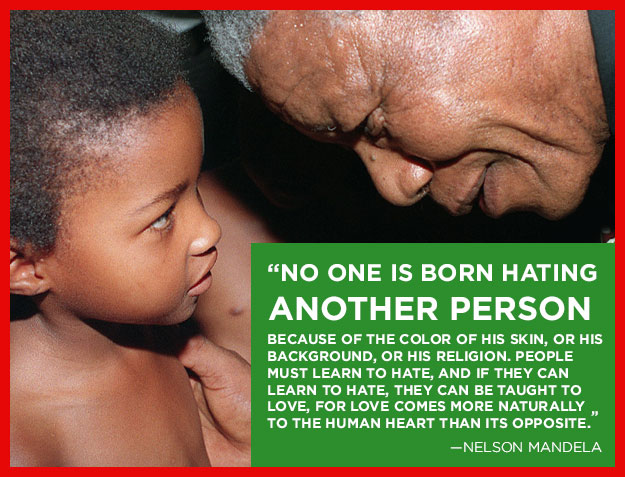
(Thank you, Buzzfeed, for your gorgeous photos of Nelson Mandela!)
Distress Tolerance and Radical Acceptance
I feel it’s time to continue discussing DBT and what it looks like to use the tools that it has to offer. I’ve discussed the topics of Gnosticism and logical fallacies in an attempt to explore two of the primary road blocks why Christians often fear dipping their toes in the therapeutic waters. While it is true that the human condition has often been pathologized in order to diagnose and medicate following a medical model in many cases, too many people overly spiritualize their trauma and mental health issues which, in turn, hinders them from getting the appropriate help resulting in unnecessary and longterm suffering. We needn’t be afraid to pursue help from mental health clinicians. We just need to be wise. We are careful about who does our taxes. Not all accountants are good. It is the same with mental health practitioners, cardiologists, gynecologists, pediatricians, and podiatrists.
On to DBT…
Dialectical Behavior Therapy is comprised of many tools, and the first tool that I am reading about in the Dialectical Behavior Therapy Skills Workbook is distress tolerance. Increasing distress tolerance starts with radical acceptance. What does this mean?
“Often, when a person is in pain, his or her first reaction is to get angry or upset or to blame someone for causing the pain in the first place. But unfortunately, no matter who you blame for your distress, your pain still exists and you continue to suffer. In fact, in some cases, the angrier you get, the worse your pain will feel. Getting angry or upset over a situation also stops you from seeing what is really happening. Have you ever heard the expression ‘blinded by rage’? This often happens to people with overwhelming emotions. Criticizing yourself all the time or being overly judgmental of a situation is like wearing dark sunglasses indoors. By doing this, you’re missing the details and not seeing everything as it really is. By getting angry and thinking that a situation should never have happened, you’re missing the point that it did happen and that you have to deal with it. Being overly critical about a situation prevents you from taking steps to change that situation. You can’t change the past. And if you spend your time fighting the past–wishfully thinking that your anger will change the outcome of an event that has already happened–you’ll become paralyzed and helpless. Then, nothing will improve…So, what else can you do? The other option, which radical acceptance suggests, is to acknowledge your present situation, whatever it is, without judging the events or criticizing yourself. Instead, try to recognize that your present situation exists because of a long chain of events that began far in the past…Denying this chain of events does nothing to change what has already happened. Trying to fight the moment or say that it shouldn’t be only leads to more suffering for you. Radical acceptance means looking at yourself and the situation and seeing it as it really is….Keep in mind that radical acceptance does not mean that you condone or agree with bad behavior in others. But it does mean that you stop trying to change what’s happened by getting angry and blaming the situation. For example, if you’re in an abusive relationship and you need to get out, then get out. Don’t waste your time and continue to suffer by blaming yourself or the other person. That won’t help. Refocus your attention on what you can do now. This will allow you to think more clearly and figure out a better way to cope with your suffering.” (The Dialectical Behavior Therapy Skills Workbook 10-11)
I was stopped in my tracks when I read this passage a few weeks ago. I read it after writing a post on living a lifestyle of acceptance. I can’t speak for anyone else, but the idea of radical acceptance is positively foreign. It is not in my nature. Me? I fight. I don’t fight people. I fight myself. It’s how I’ve survived. If I see something in my circumstances that needs to be changed, then I focus on it like a laser until it’s different. I accept nothing. I forge ahead. Never stop. Always, always, always keep moving. Never give up. Never, never, never. But, then, this is not what the passage is saying. It is telling us not to judge and criticize ourselves and others. Stop looking back and saying, “It shouldn’t be this way. How did I get here? Why is it like this?” And, I have to admit, I have been doing that.
So, what does radical acceptance look like then?
How is it done? Well, there are coping statements that one can use, and the workbook has a suggested list.
- All the events have led up to now.
- I can’t change what’s happened already.
- Fighting the past only blinds me to my present.
- The present is the only moment I have control over.
- It’s a waste of time to fight what’s already occurred.
- The present moment is here, even if I don’t like what’s happening.
- This moment is exactly as it should be, given what’s happened before it.
- This moment is the result of over a million other decisions.
You have an opportunity to write your own. I wrote this:
- I can change my future, but I must accept the present.
I don’t like to feel stuck in the moment. So, my statement has to have some sense of empowerment.
The authors of the workbook provided an exercise in which we were to practice not being judgmental or critical. They are:
- Read a controversial story in the newspaper without being judgmental about what happened.
- The next time you get caught in heavy traffic, wait without being critical.
- Watch the world news on TV without being critical of what’s happening.
- Listen to a news story or a political commentary on the radio without being judgmental.
- Review a non-upsetting event that happened in your life many years ago, and use radical acceptance to remember the event without judging it.
Radical acceptance is the first tool used in distress tolerance.
We humans are resilient. I encourage you to begin the practice of radical acceptance. Don’t be afraid to discover what lies beneath your own criticisms and judgments. Allow yourself to feel. It’s an act of self-love. Once we are able to nurture ourselves in this way we are finally able to offer that nurturing to others. Loving ourselves is part of how we learn to love others, and that is indeed part of every person’s destiny.
Currently on the Nightstand
Share this blog

RSS


thrivingisthegoal.com
is licensed under a
Creative Commons Attribution-No Derivative Works 3.0 United States License.

 Out of the Mire