Out of the Mire
…because thriving is the goal
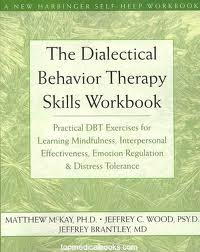
The Dialectical Behavior Therapy Skills Workbook
As the title of this post might imply, I am now in possession of a workbook. I subscribe to Psychology Today, and September’s issue did a spread on Borderline Personality Disorder called “The Kings and Queens of Chaos”. The article on BPD was okay. It’s hard to go beyond the surface of any personality disorder because even within the disorder there is a spectrum of functionality. For instance, there isn’t just one type of narcissist. On the narcissistic personality spectrum, one might find the Phallic Narcissist who does behave differently than the classic narcissist who behaves differently than the narcissist with borderline tendencies or the narcissist with sadistic tendencies. The same applies to those diagnosed with BPD. The high-functioning BPD can be a highly successful person in their job but experience great difficulty in interpersonal relationships. This is where the article in PT misrepresents the disorder. Most BPDs I’ve known have been very driven women with narcissistic tendencies. They have a certain set of skills, find a niche, and experience success in their chosen career. They can be volatile at work often described as perfectionistic, the Office Bitch, or scary, but they get the job done. Why? Because their identity is tied to their ability to do well in the one place where they can and do feel successful–the workplace. PT implied that BPs have a hard time holding down jobs because of their lability, and I was actually irked. It’s an entire misrepresentation of a diagnosis. This misinformation will also give people a sense of false security like one guy I know.
He is successful in his job. He has numerous degrees one of which is a PhD in psychology although he is not a practicing clinical psychologist. He used to email me about his wife, and if she didn’t fit the bill for for having BPD, then Joan Crawford wasn’t Mommy Dearest. Some of her behavior was off the charts, and I was astounded that he wasn’t putting the pieces together. He told me that he discussed his wife with a friend, who was a practicing clinical psychologist. He indicated that his wife did indeed sound like a borderline. My friend’s response? But, she’s so good at her job! Marsha Linehan, the creator of Dialectical Behavior Therapy and pioneer in the field of treatment for BPD, was herself diagnosed with BPD. Clearly, one can be successful in their career, make contributions to society, and get better with such a diagnosis. This isn’t really why I wanted to write this post.
Within PT’s article on BPD was another article on the most successful form of treatment for it–Dialectical Behavior Therapy commonly known as DBT. While DBT is commonly known to some, it seems to be a bit rarer in the field at large. I haven’t come across that many practitioners. I am hopeful that this is going to change because, as the article stated, DBT just might be what everyone needs. DBT is not talk therapy. DBT is a kind a therapeutic approach that equips people for life because, let’s face it, pathologies are on the rise. People are more depressed and anxious now than they ever have been. Affairs are on the rise, narcissism and loneliness are increasing as are addictions. The human body is simply not fit for the 21st century. Post-modernity is taking a toll, and most of us are overdrawn. This is where DBT steps in.
So, what is it exactly? Basically, DBT teaches four skills:
- Distress tolerance
- Mindfulness
- Emotional regulation
- Interpersonal effectiveness
Who doesn’t need this? There isn’t one person I know who doesn’t need help with distress tolerance. What does that mean exactly? Put very simply, you feel distressed, how will you handle it? Our culture today is saturated with escapism. If i’m upset by something in my circumstances, there are exits everywhere. I do not have to stick around and work on my own resiliency. I can get a dopamine hit through any number of venues both virtual and real. What’s more, it’s encouraged! “You need a break!” We are told this over and over again. Distress tolerance, therefore, teaches resiliency which is exactly what is needed. On the flip side, if you come from an abusive background, your distress tolerance is often distorted. You might not know what not to tolerate because you were forced to tolerate too much. If you watched your drunk father beat up your mother every Saturday night for years, then you might not know that an emotionally abusive spouse is not to be tolerated.
Mindfulness is something that I love while at the same time something that challenges me. I am the Queen of Perseveration. “Hello, my name is MJ. I perseverate.” I don’t do this all the time, but when I get going I won’t stop until I’ve Thelma and Louised myself over a mental cliff. It usually starts with a feeling. A bad one. That bad feeling will bring forth a memory from times past when I felt the same way. An entire gestalt memory recall event will occur, and my mind will bring forth every single time I ever felt this way. A memory train will form, the events forming cars, the cars linking together, the emotional pain becoming the steam locomotive, my perseveration tying me to the tracks, and the whistle blows! Full steam ahead! I am run over again and again by every painful memory until I’m weeping and shrouded in negativity. There are train tracks in my mind from these events ready and waiting for the next time the Memory Train pulls into town. Mindfulness training, however, dismantles that train. It teaches us not to focus on past events or look anxiously to the future. It teaches you to let go of negative thinking and judgments as well.
Emotional regulation is a vastly important skill, and emotional regulation is something everyone struggles with at one time or another. It’s really about becoming aware of what you are feeling, observing your emotions while not becoming overwhelmed by them. It’s also about not reacting in destructive ways due to a lack of emotional modulation.
Lastly, interpersonal effectiveness “gives you new tools to express your beliefs and needs, set limits, and negotiate solutions to problems–all while protecting your relationships and treating others with respect.” (p 2) How’s that for a goal? Who doesn’t need that skill?
On some level, I feel like I have these skills, but I see that I could grow immensely in all of them. This is why I bought the workbook. It costs $15. You can do it alone. You could do it with a friend. You could do it with a therapist. But, I think the point is that it’s worth doing even if your only goal is to become a better person. By the way, there’s one for anxiety, too! Just thought I’d tease you a bit.
Resources:
One Question
I spent time with a friend today. The weather is beautiful here right now. Autumnal perfection. It’s easy to sink into contemplation when straddling seasons. It feels a bit like summer but not quite. The bright, red Maple leaves announce the coming fall temperatures. it’s a time of transition. We are tempted to look back upon the last season and, at the same time, we are either hopeful about the future or anxious about the upcoming holiday frenzy. This time of year is laden with meaning for many.
Our conversation drifted to the topic of service dogs. She trains service dogs among other things, and the United States has few regulations around the service dog industry unlike Canada. I have watched her train two service dogs, and I now have a better understanding around what it really means to need a service dog and what services these dogs provide. There should be regulations. It’s very costly to train and handle a service dog. The notion that psychiatric service dogs are being requested came up, and this is controversial. Should those with mental health issues have a service dog? A service dog is only provided to those who physically cannot perform a certain task, but, at the same time, can handle the dog. Under what circumstances would a person with mental health issues require the aid of a service dog? The idea was put forth that a person with an anxiety disorder might want a service dog. Why? To feel better? That isn’t a service dog issue. That’s a therapy issue. That’s a self-care issue. What if they were having an anxiety attack? If a person has anxiety attacks that are so debilitating that they cannot find and take their Ativan, then how will a service dog help them? This is still a therapy issue. That person most likely has a panic disorder and requires a different sort of intervention requiring different medications, appropriate psychiatric care, CBT/DBT, a support group, as well as family/peer support. This is not a service dog issue. This is, once again, up to the person. This is a will issue.
I have met a fair amount of people who talk a good game, but when push comes to shove their good game is just that. A game. Underneath the talk and Christianese and psychobabble is an insidious passivity that enables some sort of mindset that permits self-victimization. This is what makes a person think that a service dog is a better idea than attending a DBT Support Group. After all, a service dog isn’t going to say anything when you lie on the couch bingeing on Oreos watching a “Breaking Bad” marathon marinating in self-pity because no one has called you to see how you’re doing. Never mind that you haven’t called anyone to see how they’re doing. But, a DBT Support Group? What would they say? They would use phrases like “distress tolerance” and “emotional regulation” and “personal responsibility”.
Something I have come to call “responsible religion” has a wonderful way of cutting through all the bullshit. We see an example of this in the New Testament text of John 5. Jesus was in Jerusalem. He strolled past the pool of Bethesda where many sick people would gather for legend had it that when the water moved an angel had touched it. The first person to get into the water would be healed. Jesus saw a man who had been coming to this pool for over thirty years. He approached him and asked, “Do you want to get well?” That’s a powerful question. That’s a question aimed at the will and the heart. “What do you really want here?”
- “Why do you really want a service dog?”
- “Why are you really here?”
- “What do you really want?”
- “Do you want to get well?”
“What would you do to get well?”
When I was growing up, attending Vacation Bible School, going to Lutheran Summer Camp in the wilderness, and church hopping, there was one tenet that was always driven home with a fury. If you want to follow Christ, then you must count the cost. Count the cost! There is a cost to discipleship! I never really understood what that meant. I just felt afraid. I thought that perhaps God would send me off to a lonely, undiscovered country to live amongst cannibals. I would die with a Bible in my hand tied to a spit. Perhaps the cost might be giving up all my desires and living a solitary life. No husband. No cats. No children. I would die a virgin spinster never having tasted the joy of having had a true adventure. What would God demand of me? What price would He make me pay? What cross would He cause me to bear in the name of sanctified holiness?
Fortunately, I had it all wrong. Do you know what the cost is? I had to answer the question. “Do you want to get well?” It might seem easy enough, but when you are asked directly what you really want it’s suddenly not so simple anymore. If you really want to be well, then there really is a cost. True health costs you something. True spiritual, mental, intellectual, emotional, and physical well-being might cost you everything. It means that there are now no more excuses for, well, anything. It means that you have to find your will forsaking all forms of passivity, self-pity, shifting the blame, and negative thinking for something else. No more victim thinking. No more regrets. No more looking back and wishing you had taken a different road. There is only now. And, what if now is a mess?
What if your relationships are in ruins? What if you are addicted to approval? What if you are addicted to anything? What if you are living a secret life? What if you are bullied by your family? What if you are the bully? What if you are trapped in a life that you didn’t choose, or you chose it but hate it? What if you hate your spouse? What if you hate yourself? The point is this is your life. No one else’s. If you are unhappy, then it’s your responsibility to take care of that.
This is the cost. It’s the cold slap in the face of extraordinary personal responsibility. What does it truly mean to be created in the image of God? To carry the breath of God within you? It means to be empowered among other things.
Empowerment and victimization are mutually exclusive. What did I want? I wanted peace. I wanted joy. I wanted healthy relationships. I wanted clear thinking. Did it cost me something? Yes. Does leaving behind codependent relationships, learned helplessness, and old thought patterns cause pain and subsequent grief? Yes, but this is the calling. We exchange one thing for another. If we want to be healed, then we must exchange our infirmities for that which will provide healing. Like the man by the pool of Bethesda, we have to be prepared to answer the question, “Do you want to be well?” and then do whatever it takes to get there.
The profoundly good news here is that there is an empowering presence available to us. We need only ask. God’s grace, that empowering presence, is given freely to us. We don’t earn it. It’s not given to us because we’ve performed well. His empowering presence is given to us because it pleases God to save us. He sees each of us as we are and as we will be. He stands in the space of our future development beckoning us forward, whispering to our hearts through our longings, leading us on with cords of kindness, He gives us a taste of His goodness through experiences of joy and unexpected provisions. “Do you see that I am good?” He loves us through the extraordinary kindness of people. “Do you see that I am kind?” And then He makes you an offer that you can refuse when you come face to face with your pain. “Deny yourself the pleasure of pity. Deny yourself the masochistic rush of reveling in regret again. Deny yourself the self-flagellation. Deny yourself the accusations. Deny yourself the hatred. Deny yourself the avoidance and hiding in the darkness of escapist fantasies. Deny yourself the shame. I see you. I love you. I have plans for your life. They are good plans. You have a future full of hope. (see Jeremiah 29:11)”
And it all starts with that one question.
“Do you want to get well?”
There are some days I have to think hard about that question because sometimes the road feels hard, and it’s lonely. Pursuing God and a better life has cost me a lot. I’ve lost much, but what have I gained? I exchanged profound fear for peace and rest. I exchanged victimization for empowerment. I exchanged self-pity for self-esteem. I exchanged despair for hope. I exchanged grief for joy. I exchanged confusion for clarity. I exchanged passive silence for active communication. I wanted to get well, and I wanted an authentic relationship with God. There are a plethora of false Gods in the world–Aryan God, Milquetoast God, Nice Guy God, Mean God, Hippie God, Neo-Conservative Evangelical God, Liberal God, Lutheran God, Convenient God, Friendly God, Scary God, Baptist God, and even Elvis God and anti-Semitic God and all the others. With all these Gods from which to choose, I can’t help but think of this:
“The story goes that a public sinner was excommunicated and forbidden entry to the church. He took his woes to God. ‘They won’t let me in, Lord, because I am a sinner.’
‘What are you complaining about?’ said God. ‘They won’t let Me in either.”
― Brennan Manning, The Ragamuffin Gospel: Good News for the Bedraggled, Beat-Up, and Burnt Out
So, how did the story of the man at the pool of Bethesda end?
He never really answered Jesus’ question directly. He had been afflicted with paralysis for over 30 years, but every day he had someone bring him to that pool in hopes that he would be the one to make it to the water first. Ponder this for a moment. How does a paralyzed man get to be the first one into the water if there are many other infirmed people lying around the pool just waiting for the waters to stir? It won’t happen, and that was his answer. “There is no one here to lift me into the water should the water stir but I come here anyway.” So, Jesus healed him on the spot. The best the man could do was show up. And in his showing up Jesus showed up. In our small efforts, God shows up. Sometimes extravagantly.
And, you know what? Sometimes that’s all we can do–show up. And that’s often the first and best place to start.
In Memoriam
I just learned tonight that Brennan Manning passed away in April. Many of you may have no idea who Brennan Manning is. That’s okay. He was a speaker, author, and exceptional human being. He was a Franciscan priest. In my mind, what defines Brennan the most is his almost childlike love for the person of Jesus and his honesty about his own failures. He was an invariably truthful man, and he didn’t define himself by success because he viewed himself largely as a failure. He left his order to marry, and that marriage ended in divorce. He was also a recovering alcoholic. Yet he experienced the relentless love of God at every turn–compassion and acceptance when he least deserved it. Forgiveness when he couldn’t offer it or even take hold of it for himself. In one of his most beloved books, The Ragamuffin Gospel, Brennan wrote, “My deepest awareness of myself is that I am deeply loved by Jesus Christ and I have done nothing to earn it or deserve it.”
It was these words that I heard twenty years ago in a little Lutheran church on a cold, snowy night. My grandmother called me while I was studying for an exam. She pleaded with me to go to an evening service at her church: “You must come to church. There is a man speaking. I heard him last night. The way he talks about God…I have never heard anything like it. You must come.” Something in me understood her urgency. She rarely ever begged me to come to evening services during the week. I always took her to church on Sundays. It was our tradition. I remember that I had reached a cold and lonely place in my journey with God. I felt abandoned. Maybe I even felt used somehow. I did not understand the point of believing in God if God was so impotent. I had loved Him since my earliest memories. What had that love ever accomplished? I had prayed, begged even, as a little girl that He would come to me. “Please protect me.” My father and his wife continued to hurt me. My mother was never stopped. I was still abducted. Where was God? What was the point? Where was the God of my ancestors? Where was the God who parted the Red Sea? Where was the God who raised Lazarus from the dead? Where had He gone? Where was the God that people died for? What was I missing?
I went to church with my grandmother that night. I listened to the man speak, and I was astonished at his words. He talked of a God of immense love and goodness. He talked of grace. In all my years, I had never heard of grace. I had only heard of duty, obligation, and the Law. I had been told that I would need to count the cost. I had been told that I needed to deny myself. Who was this God? I found myself weeping. Grace. The immense love of God. As I sat listening to this man speak, I let myself feel again. I felt angry. I felt betrayed. I felt…so hurt. I had been told my entire life that I had to be perfect to sit in a pew. This man told a different story.
“Because salvation is by grace through faith, I believe that among the countless number of people standing in front of the throne and in front of the Lamb, dressed in white robes and holding palms in their hands (see Revelation 7:9), I shall see the prostitute from the Kit-Kat Ranch in Carson City, Nevada, who tearfully told me that she could find no other employment to support her two-year-old son. I shall see the woman who had an abortion and is haunted by guilt and remorse but did the best she could faced with grueling alternatives; the businessman besieged with debt who sold his integrity in a series of desperate transactions; the insecure clergyman addicted to being liked, who never challenged his people from the pulpit and longed for unconditional love; the sexually abused teen molested by his father and now selling his body on the street, who, as he falls asleep each night after his last ‘trick’, whispers the name of the unknown God he learned about in Sunday school.
‘But how?’ we ask.
Then the voice says, ‘They have washed their robes and have made them white in the blood of the Lamb.’
There they are. There *we* are – the multitude who so wanted to be faithful, who at times got defeated, soiled by life, and bested by trials, wearing the bloodied garments of life’s tribulations, but through it all clung to faith.
My friends, if this is not good news to you, you have never understood the gospel of grace.” Brennan Manning, The Ragamuffin Gospel: Good News for the Bedraggled, Beat-Up, and Burnt Out
This was the first time I met Brennan Manning. I shook his hand after he finished speaking, snot and tears running down my face. He blessed me as a Franciscan priest is wont to do. I went home that night feeling that his name sounded familiar, and, sure enough, his book The Ragamuffin Gospel was sitting on my shelf! I read the entire book that night, and I marveled at my own ignorance. How could such a thing have been so near to me and I had not known it? That night was a turning point for me. I was never the same again. Brennan reintroduced me to God and the person of Jesus. It was then that I began to learn that God is indeed kind and good. He was nothing like I thought He was.
I met Brennan again about eight years later. I had the immense privilege of attending a retreat that he led. Once again, I was at a crossroads in my journey, and I was refreshed and directed to a better path.
Brennan’s wisdom came at a price. He suffered. His road was hard. I relate to that. Many people adored him, and many people scorned him. It seems there is no middle ground for such souls who say things like this:
“When I get honest, I admit I am a bundle of paradoxes. I believe and I doubt, I hope and get discouraged, I love and I hate, I feel bad about feeling good, I feel guilty about not feeling guilty. I am trusting and suspicious. I am honest and I still play games. Aristotle said I am a rational animal; I say I am an angel with an incredible capacity for beer.
To live by grace means to acknowledge my whole life story, the light side and the dark. In admitting my shadow side I learn who I am and what God’s grace means. As Thomas Merton put it, “A saint is not someone who is good but who experiences the goodness of God.”
The gospel of grace nullifies our adulation of televangelists, charismatic superstars, and local church heroes. It obliterates the two-class citizenship theory operative in many American churches. For grace proclaims the awesome truth that all is gift. All that is good is ours not by right but by the sheer bounty of a gracious God. While there is much we may have earned–our degree and our salary, our home and garden, a Miller Lite and a good night’s sleep–all this is possible only because we have been given so much: life itself, eyes to see and hands to touch, a mind to shape ideas, and a heart to beat with love. We have been given God in our souls and Christ in our flesh. We have the power to believe where others deny, to hope where others despair, to love where others hurt. This and so much more is sheer gift; it is not reward for our faithfulness, our generous disposition, or our heroic life of prayer. Even our fidelity is a gift, “If we but turn to God,” said St. Augustine, “that itself is a gift of God.”
My deepest awareness of myself is that I am deeply loved by Jesus Christ and I have done nothing to earn it or deserve it.”
― Brennan Manning, The Ragamuffin Gospel: Good News for the Bedraggled, Beat-Up, and Burnt Out
Or this:
“The greatest single cause of atheism in the world today is Christians: who acknowledge Jesus with their lips, walk out the door, and deny Him by their lifestyle. That is what an unbelieving world simply finds unbelievable.”
― Brennan Manning
Or this:
“When we wallow in guilt, remorse, and shame over real or imagined sins of the past, we are disdaining God’s gift of grace.”
― Brennan Manning
And this:
“Do you believe that the God of Jesus loves you beyond worthiness and unworthiness, beyond fidelity and infidelity—that he loves you in the morning sun and in the evening rain—that he loves you when your intellect denies it, your emotions refuse it, your whole being rejects it. Do you believe that God loves without condition or reservation and loves you this moment as you are and not as you should be.”
― Brennan Manning, All Is Grace: A Ragamuffin Memoir
Brennan Manning’s books, words, and the time I spent with him have left an indelible mark on me. The world is a better place today because he lived, and I’m better for having known him. Thank you, Brennan.
Shalom…

The Box
I decided to practice self-care so I met with a therapist. This is what this new therapist has observed. The “cognitive stuff” is done. I know what is true, and I know how to apply it. That feels like a huge victory. What isn’t done? The leftover trauma.
What does this mean? I’ve explained in prior posts that I have a visceral response to hearing my mother’s voice. I’ll even get a migraine within a few minutes of hanging up the phone from a conversation with her. That’s all related to trauma. CBT can’t address this. These are body memories. Telling myself what is true or even knowing what is true won’t stop the release and subsequent cascade of stress hormones. It feels like the perfect time to begin dealing with what I could never reach in the past–these biologically lodged triggers. I want to further the healing process. This therapist specializes in treating trauma and uses EMDR.
Yesterday’s session was my third session. We are finally going to get started on learning some tools now that we have completed the intake. She began with a very basic tool called “The Box”. Another name for this tool is compartmentalization. When something comes to mind and you can’t deal with it at that moment, you need to be able to set it aside until a later time. Sometimes it is very difficult to set aside thoughts or problems that arise in the mind because they feel very pressing or serious; thus, we perseverate on them and whip ourselves up into a nice, foamy lather. If I’m not paying attention to my thoughts and practicing mindfulness, then I am vulnerable to this. Part of practicing mindfulness is paying attention to the flow of your thoughts however weird and foreign they may seem. Our thoughts are generally not linear; at least mine are not. Sometimes my thoughts might flow like this:
Setting: Driving in the car
“There’s nothing good on the radio. I don’t like this DJ. I don’t like the tracks he’s picking. Why do people go into radio? Oh no, I forgot to pay a bill! My stomach hurts. What if my credit rating goes down? What if I forgot to pay other bills, too? Did I forget to lock the house? Wait…did one of the cats get out? No. She was in the window staring at me when I left. Wait, I think Denise is living next door to a predator. There was a guy staring at me at her house when I was swimming over there last week. He was actually looking over the fence and watching me! Was that her neighbor? Does he watch her during the day? Should I tell her? Do I have a neighbor watching me? My dog used to bark a lot. I wish she were still with us. Oh gosh, it’s almost the anniversary of her death…I miss her.”
Thoughts are so random, and jump from one strange connection to the next. One word can trigger a new thought which leads to a new connection which leads to a new thought and on and on. So, when my husband asks me what I’m thinking about I usually tell him nothing because how can I explain this? I’m thinking about my dead dog and potential neighborhood predators, but not really because I’m really thinking about music playing on the radio in the context of a DJ and the tracks he picks. Furthermore, I might have forgotten to pay a bill. And, now I feel sad. Oh, and I feel slightly defiled, too, at the idea of someone watching me.
This entire scenario could have been stopped had I used The Box tool. Notice that as soon as I became anxious at recalling that I forgot to pay a bill, other memories associated with times I felt anxious surfaced. Had I practiced mindfulness, I would have noted that I was in the car driving. I could not address the issue of paying a bill at that time. I would have said to myself, “I cannot take care of this right now so I will set it aside by putting it into The Box. When I am able, I will take it out of The Box and devote whatever attention it needs to resolve the issue.” Problem solved. I do not cause myself further anxiety, and I now know that I will take care of the issue later. My amygdala can stop alerting me and go back to a resting state. This is the point of The Box. The Box teaches us that we can pause the Thought Train.
You can put good things, bad things, in-the-middle things, or whatever you want in The Box. You design The Box. My box is platinum and covered in sapphires. It has a lock, and I have the only key. To me, it is precious because everything in it, even what I don’t like, is valuable in some way. Some people choose to make a box. I have done this exercise with a few of my children. Children often call it their Worry Box because they have such a hard time letting go of their anxieties and perseverations. So, they decorate a box however they wish, and they write their worries on pieces of paper, leaving them in the box. They are free to come back to their Worry Box and look over them at any time, but, once the worry is in the box, they are to try to stop thinking on that particular thing. It’s in the box, we say. Try to think on something else now. It’s a very good way to introduce psychological flexibility and mindfulness to kids. For some kids, it works brilliantly. For others, it does not.
The Box. This is Tool #1 in teaching your brain to think differently as well as a tool used to teach you to bring yourself to a resting state or baseline.

A Resource:

The Professional Victim
We’ve all met one. No matter how much energy you pour into the relationship, be it professional, friendly, or familial, you somehow end up being the bad guy. It’s your fault! There wasn’t a problem until you pointed out the problem, therefore, YOU are the problem. Heaven forbid this person should feel badly in your presence. What will you get? A tantrum of some kind be it The Sulks, The Rages, or Cold Indifference. Sometimes, you’ll even get The Pouts. The stories you hear are heart-wrenching. You want to make it better for them, but Professional Victims don’t want to get better. Not really. They want attention. A lot of attention. They want to be told that they are right. They want to be told that self-pity, entitlement, and inaction are justifiable, or, worse, that poor choices that potentially hurt others and even themselves are okay because they deserve that momentary bit of self-gratification regardless of the fact that they are motivated by things less than virtuous and life-giving.
I have a family member who could be described as a Professional Victim, and I know I sound judgmental when I say that; I say this descriptively. We grew up together. She got a degree in psychology, but she chose to use her degree differently. She learned to manipulate. She consistently complained, “I never had a life! I deserve a life, right? I don’t wanna work. I wanna be taken care of. I need to find a man with money!”
So, that’s what she did! She deceived two, wealthy Ivy League-educated men by getting pregnant hoping to force a marriage. It’s a plot older than time: Woman traps man into marrying her. Alas, this didn’t work–the first time. The first guy didn’t marry her so she was left with a baby. She was, thusly, left in an even worse situation responsible for a child and feeling even more trapped and victimized by circumstances of her own creation. So, she left the baby with whomever would take him and began looking for Wealthy Man #2. She did meet another well-to-do man from Yale, and her plot was enacted once again. He begrudgingly married her, and they did not enjoy an authentic marriage of any kind.
What do you suppose she did? She got herself pregnant again to really seal the deal! Three kids later she was still wailing, “I have no life! I deserved a life. Now, I’m stuck here with three kids. I’m not a mother. I deserve better. How did I get here? I hate this! My body is ruined. Look at my stomach. My husband won’t touch me!” So, what did she do? She flew to Atlantic City and refused to come back. She actually abandoned her children, one of whom had a life-threatening illness, and her marriage all in the name of entitlement masquerading as victimization . The only way she would return to her family was if her husband would pay for a complete plastic surgery overhaul complete with breast augmentation, tummy tuck, Botox injections, and liposuction which he happily did because he only married her out of obligation.
This is the Professional Victim in action. No matter what they claim to know–“I have a degree in psychology!”–or how intelligent they are, they play the Blame Card as easily as I use my debit card. It is always someone else’s fault. If they have a sense that their behavior affects others, they will never admit it. The narrative that they’ve crafted is dependent upon them being the victim in all scenarios. If you attempt to dismantle this paradigm, then you will be met with blame, accusations, or more victim-like crying and tantrums–“I just try and try and no one seems to understand me. I just want you to be happy! Can’t you see that? That’s all I want for everyone! I’ll just never be good enough. NEVER!” Every response you get from a Professional Victim will be a form of gaslighting. Why? Because they themselves are confused about what is really true. Gaslighting is about perpetrating mental confusion on another person so it makes sense that Professional Victims will use confusion as currency in relationships of all kinds.
Confronting the Professional Victim can be very difficult. You’ll know for sure what you’ve got on your hands based upon the response.
Scenario:
A woman has been in counseling for five years. She is yet again retelling the story of her father’s adultery, a story you’ve heard countless times. She tells it with the same emotional intensity that she told it the first time you met her four years ago. She has been receiving CBT and is also medicated and seeing a psychiatrist. After hearing the same stories repeatedly, you finally say, “I understand that this is still painful for you because your father’s actions have far-reaching consequences on your family. But, what has your therapist recommended to you as far as new thoughts around this event? Have you been able to grieve the loss of your family and form a new picture of what that might be for you now and in the future?” She then hisses, “Don’t you dare talk to me about CBT. I’m very aware of it.” Your response is then, “Okay. I’m glad that you are, but, as your friend who has been with you through this, why do you not use what you know? If you know and are aware of all the tools given to you through CBT, then why do you continually not contain yourself or even practice emotional regulation? Why do you not use the tools you have acquired? There does come a time when you must choose to progress and use what you have. It’s not like I don’t know this myself. I make these choices, too. Daily.” She throws her napkin on the table, “Fucking know-it-all! You think you’re so superior! How dare you analyze me! I’m being open here and you tell me that? I’m leaving.”
This is not an uncommon response when attempting to ask a Professional Victim why they choose to remain a victim particularly if they have the tools to empower themselves. They don’t really want empowerment. They want to be enabled. They want to stay right where they are, be patted on the head, and told that everything that they are doing is just fine. One of the funnier Professional Victims in film is actually depicted by Will Ferrell in “Anchorman: The Legend of Ron Burgundy”. Ron Burgundy is an entitled narcissist who believes that he should be allowed to do whatever he pleases sans consequences. Vince Vaughn’s Wes Mantooth questions Ron Burgundy before an epic fight between San Diego’s rival news teams. He asks him if he needs his mommy to rub Vaseline all over his heinie and tell him that its special and different from all the others. There is a kernel of truth in the absurd which is the point of satire. Burgundy loses his job in the film and is completely unable to take responsibility for his actions. The film is hilarious if you like over-the-top, dirty humor not to mention a brilliant a cappella performance of “Afternoon Delight”, and it portrays Cluster B personality disorders albeit exaggerated and parodied pretty well. There isn’t a man or woman in this film who one would want to actually know personally. That’s why it’s entertaining.
The problem with the parodies and caricatures is that many of these personality problems are indeed real. If you walk away from a person feeling like you’re dealing with a child, then you probably are. Developmentally speaking, there are people who are arrested in their emotional development. Is it our job to parent them? There is a word for this–parentification. It’s one thing to parent your own screaming toddler. It’s quite another to be dealing with an adult hellbent on throwing a tantrum. It’s a question worth asking, and it’s a question I can’t answer…yet. What are the boundaries within relationships when someone you love refuses to use the tools they have acquired to progress and mature? Where do we draw the hard lines, and what does it look like to enforce those boundaries? Does it ever become necessary to leave the relationship?
This article, however, might help you find the right answer for YOUR situation. What I have learned is this. I can’t rescue someone who wants to be a victim. If someone has the tools but refuses to use them, then that’s my cue to move on. If someone refuses to even seek help and prefers their own misery and learned helplessness, then I have to consider what my role in that relationship is. As soon as someone begins blaming me for their unhappiness, starts enjoying their own misery, or, worse, begins using their painful circumstances to garner sympathy, I am not sticking around to enable that dysfunction. There are better relationships to be had, better ways to think, and healthier ways to get needs met. Something that Professional Victims don’t often want.
Strategies to Deal with A Victim Mentality by Dr. Judith Orloff
The God Card
An aptly named post, I think, as it’s beginning to feel like a soap opera over here. I just need a guy named Dirk to move in next door, and my neighbors across the street to start throwing down outside. But, hey, we did have SWAT and about ten officers armed to the teeth on our block last July. There was a domestic disturbance that turned into a hostage situation. There were two officers with automatic weapons sitting on the picnic table in my backyard, and our entire block was in lockdown. My youngest daughter was terrified. To cope, she practiced throwing herself to the ground repeatedly should she hear gunfire. We had to put her to bed tout de suite once that started. Does that count as dramatic and soap opera-esque? That sort of thing just doesn’t happen around here!
This blog is really about flourishing no matter what your life looks like. I am not a fan of viewing life through the lens of survival. Sure, there are moments in life when it becomes necessary to survive, but then one must expand from there. I don’t want to survive my borderline mother. I want to flourish in spite of her. I don’t want to survive sexual abuse or any other kind of abuse. I want to flourish even though that’s in my history. So, I talk about my daily experiences and run-ins with very difficult people, namely my mother right now, because there are others who are trying to survive difficult people. How is it done? I can only speak for myself. Each person’s experience will no doubt look differently, but I can say that I have learned to progress and even thrive in my life in spite of very difficult people. It can be done.
That being said, my mother has decided that she does not want to go away. I am not enjoying this. In 2005, she began her disappearing act. For adult children of borderline parents, the toxic dance between their borderline parent and themselves can become very normal. There’s a predictable rhythm that we hate but expect. My hatred for this ceaseless back and forth overtook me, and I walked away from the dance by simply asking one question: “What would happen if I just stopped calling her?” I realized that I was the person that kept that relationship going. In that way, my mother behaved like the Waif or the Hermit. Although my mother fits the Queen archetype more, she has a strong tendency to isolate herself. She does not cultivate friendship with anyone. She only leaves her house to do errands. She calls no one. She seeks relationship with no one. She would prefer not to work. She hasn’t always been like this, but she has become more hermit-like as she has aged. I decided that I didn’t like being treated so rudely so, against all my better instincts, I stopped phoning her. She never called me again. For years. This was what caused the beginning of the end of our relationship. I just didn’t call her.
In a healthy relationship, when one person doesn’t call the other, a person usually picks up the phone and says, ‘Hey! How are you? I haven’t heard from you so I thought I would give you a call.” This is a very normal thing to do. To my mother, however, my refusing to call her represented abandonment. It’s akin to a narcissistic injury. When injured so deeply, borderlines must do something about it. Historically, my mother holds the relationship hostage. When we lived together, she would usually retreat to her bedroom and refuse to interact with me unless it involved raging. She had to restore the power dynamic which meant that I was subservient, kissing the ring as it were, and she was in complete control of the relationship. I had to feel as lonely and isolated as she felt. It’s the definition of relational sadism. Unfortunately, her ploy only served my purposes this time because I finally saw the truth. She truly had a personality disorder, and I was experiencing a life without her oppressive behavior and presence. She held her ground until 2010. She actually refused to call me until 2010. That’s a long time to hold a relationship hostage.
Oh, there were letters in between 2005 and 2010, and they were full of invective and character denigration. She even showed up at my house uninvited one Christmas morning. That was a treat, but she never once made an attempt at being relational on her own. No phone calls. No discussions. No accountability.
Something has, however, clicked in her brain, and she is after me. I have received three letters and two emails. Last weekend, my husband received a text from my mother’s husband that essentially read, “Christian people forgive and let others learn from their mistakes. Open up the lines of communication.” I wanted my husband to text back, “Parents don’t harass their children. Colossians 3:17” I find it terribly odd that they are now playing the God card. My stepfather is a failed Catholic who has never once behaved in a way that indicates he cares about faith, God, or adhering to any sort of moral code. Sometimes it’s easier to talk to people who aren’t trying to separate religion from faith–the Ought from genuine relationship with God. He is from a huge family, and he hates most of his siblings. He leans towards embittered. My first instinct when people like this attempt to manipulate me into doing their bidding with religion is to remind them that they have their own forgiveness work to do. Go home. Deal with your own siblings and parents. Make peace with your sons. Don’t come here and “should” me into bending the knee to your demands when you have a mess to clean up in your own domain.
The God card is ever popular today particularly in America. My mother might believe in God and even claim to be a Christian. I am not going to judge the state of that relationship. What comes to mind, however, is Ted Bundy’s final interview in prison. He claimed to have a powerful conversion experience in prison. He might have. Would I want to hang out with him, an admitted serial killer? Honestly, no.
I used to volunteer at a rehabilitation center that worked solely with men. This recovery center was viewed by the courts as a sort of last-resort-before-prison option. Many guys opted to go there instead of prison, and it was a strict place. It was a religious environment, and, while I wasn’t a fan of some of the fundamental beliefs backing the center, I liked working with the guys. I led small groups and did a few presentations there. I got to know a lot of the guys on a personal level, and I was not offended by most of them or their stories. They were from very rough homes with few advantages. You do what you have to do to get by. I understood. There was, however, one story that bothered me. Immensely. His name was Sam. Sam had a powerful conversion experience at the center one night. He was an addict. In his words, he was a bad person. Then, as he was eating a cheeseburger, something extremely powerful but entirely loving fell upon him, and he fell out of his chair. He felt his body fill and become hot. He described feeling powerfully loved in such a way that he began weeping, and his desire for drugs left him in that moment. That is not the part of his story that bothers me. I’ve known people including myself who have had powerful encounters with the Spirit of God which have brought almost miraculous healing to otherwise immovable hurts in their lives. What bothers me is another part of his story.
One night, Sam shared that he had taken part in a crime against a woman. He was with a group of guys involved in a breaking and entering, and a woman caught them in the act. The guys, looking for a fix, robbed her as well, and then decided to rape her. Sam did not rape her, but he stuck around to watch. He didn’t stop his friends, defend the woman, or intervene in any way. He just watched this woman get gang raped while he smoked a cigarette. He told me this privately. I think he told me this privately because he knew that I had experienced an assault. He wanted me, on behalf of this woman, to forgive him, but the way he told his story felt odd to me. While he seemed to regret it, he didn’t seem to have remorse. There seemed to be a disconnect. I felt very weird sitting alone with Sam while he recounted the tale of the night of the gang rape. How on earth could I ever explain to him that what he did NOT do had changed this woman’s life forever? Sure, he found Jesus, but I couldn’t grant him absolution. He needed to deal with his own passivity as well as any deeper issues he might have with women as a gender. This wasn’t a small thing. What he did, or rather did not do, was a big deal. Can he just play the God card now? “I found Jesus. Shouldn’t I be off the hook for that now?”
The leadership of the group I worked with grew to love Sam because he had a powerful story. He could relate to the guys that came into the recovery center. His story offered them hope. I, however, watched how he treated the few women that were there. It’s one thing to be respectful to a woman of good standing like myself, but what about a woman who isn’t viewed as untouchable? There was another woman who worked with our group, and I loved her. She had a very rough past much like the guys who were going through the recovery center. She loved God passionately, but she didn’t look the part. Do you know what I mean? Typically, godly women wear dresses or pantsuits, have coiffed hair, marry, and bear children. This is the stereotype. There’s just no getting away from it. Dana, however, rode a Harley! She wore leather chaps and a do-rag. She was free with her smiles and familiar with all the guys. They loved her. I thought she was awesome. We became fast friends, and I soon learned that she spent her young life in foster homes where she was sexually abused by every foster-father and foster-brother she ever knew. She was also divorced. She had an affair. Deep down, she hated herself. She thought she was a pariah. She also thought that she deserved it. She just wanted to make a difference in someone’s life so she volunteered with addicts and, as a nurse, she volunteered with the homeless offering them free medical care. I thought Dana was an incredible woman. Sam didn’t think so. He called her ‘damaged’ as if he had a leg to stand on. I was well-liked by all the religious folks because I was married with four kids! I looked the part. I was white and blonde. I drove a minivan. I knew how to pray out loud. Secretly, I wished I could let loose and shed my good girl image, and I felt very protective of Dana. I saw how Sam and the other men in leadership looked at her as if she were trashy. She was divorced. Sinner! She rides a hog and wears leather! Harlot! Where’s her God card?
She was eventually crucified for telling the truth albeit in a very insensitive way and kicked out of the ministry, and Sam spearheaded the effort. Once again, he stood by and watched a woman get treated very badly and did nothing. To his benefit. Dana called me in hysterics after she was taken before the ministry team–all men. She was called a ‘Jezebel’ among other things. Sam also called me and asked if I might think of returning to the ministry. I declined. God cards were played again. Something about Christians are called to spread the Gospel, and there’s a need at the center. Did Sam and the rest of the men on the team spread the Gospel with Dana? He hung up on me when I asked him that.
This is the great problem with playing the God card, and if you are from a family where religion has played a role, then be prepared. The God card will be played more than once. The problem with the God card is that God never plays it. Only humans. God does not should us or ought us into playing a part. We are not shamed into compliance by God. Humans do that. We are not told that “good Christians” do such and such so we better fall in line with the family way. We better return to that ministry or that job if we know what’s good for us because God would have us be good Christians. That is entirely a human manipulation.
God desires truth. There can be absolutely no growth or healing if we are kowtowing to a broken system or perpetuating a twisted mindset. It doesn’t matter if the person who is manipulating you has had the highest of spiritual experiences or not. Some of the worst displays of manipulation I’ve seen have been in the ministry setting. I’ve seen God step in and heal extremely broken people guilty of horrible crimes, but that redemption doesn’t mean that those people are free of the process of accountability and making amends. God’s redemption just means that those people are now finally capable of entering into that process and making it mean something. They can finally move forward whereas, in the past, they were perpetually stuck or even regressing. With God’s powerful presence in their lives, recidivism is drastically diminished. This is true for all of us in some ways. We want to move forward rather than regress. For victims of abuse or people who hail from dysfunctional families where religion is part of the culture, the God card will be played when someone speaks up much like in the latest text from my stepfather. Try to enforce a boundary and see what happens.
The most favorite God card to play is the Forgiveness Card–“Good Christians forgive.” The Christian world is terribly confused about forgiveness. If I were a banker, I could forgive your debt if you declared bankruptcy. It doesn’t mean that I have to lend to you again. It’s the same premise in relationships. I can forgive even the worst of crimes. It doesn’t mean I will ever be in a relationship with you again. This is the difference between forgiveness and reconciliation. So, the real question should be: “Is it possible for us to reconcile?” Some crimes are too weighty and consequential to consider reconciliation. There’s a reason Ted Bundy received the death penalty. Even if he did find Jesus in prison, his crimes were too serious. He had to make amends, and the justice system decided that the only way for him to do that was by giving up his life. Whether you are for or against the death penalty is immaterial here. The premise holds. Bundy himself admitted in his final interview that he deserved his punishment. He wanted to make amends for his crimes, but he had peace because he finally felt worthwhile as a person. It wasn’t up to other people to give him that sense of worth. Only God could him that.
I couldn’t grant Sam absolution for his crime against that woman, and, because Sam really never did his work around that event, he repeated the behavior when he threw Dana under the bus with the ministry leadership. Just because people claim to love God doesn’t mean it’s reflected in their behavior and their treatment of others. The God card is a ploy. It’s a way to deflect personal responsibility and manipulate others.
It needs to be thrown out because that person’s deck is fixed to their advantage. They need to draw a new hand and learn a new way to relate to others. And, I suspect they need to hear the Gospel again as well because if God isn’t playing the God card, then neither should they.
speak.
I wanted to say something about speaking the truth.
I have often found myself in conversations with people discussing personal circumstances that are gridlocked. Marriages are in turmoil. People feel unheard, invisible, and helpless. I’ve been in that situation. Or, perhaps it’s something familial. Fathers are still foisting their high and hidden expectations upon their grown sons causing their sons to feel emasculated and inadequate in other spheres of their lives outside of the father-son relationship. Whatever the case may be, when I find myself talking to people who feel stuck in situations like these I always find myself saying, “Speak up!” The usual response is: “What would that change?” followed up by, “My husband will never change so I have to just make myself as small as possible,” or “My father has been dishing out demands and ridiculously high expectations since I was a kid. He expected me to talk when I was an infant and walk at 10 months. If Neil Armstrong could walk on the moon, then why couldn’t I run on it? I didn’t even run track. He will never see me for who I am. Nothing I say will change anything. What’s the point?”
I understand this. I have lived with this view and experience in most of my key relationships.
When I was growing up, I was the romantic comedy queen not to mention all the classic old movie romances. I grew up in a sprawling Southern Victorian house with almost too much space so, fortunately, we had a lot of room to get away from each other. Oh, and that white porch swing on that wraparound porch allowed me too much room to be dramatic. I would tuck myself away in the “rec room” upstairs and watch Grace Kelly in “The Swan”, Louis Jourdan and Leslie Caron in “Gigi”, Audrey Hepburn and Fred Astaire in “Funny Face”, Cary Grant and Audrey Hepburn in “Charade”, and, of course, I could never forget Hitchcock’s classic leading men and ladies in “Rear Window”, “To Catch A Thief”, and “The Birds”! And then “The Princess Bride” happened to me. I was done for. I was completely slain when I saw “Room with A View”. And, then I was resurrected when I discovered Jane Austen–O, Mr. Darcy…Mr. Darcy…Mr. Darcy. In my head, love and relationships were going to be like that. My husband was going to be a mélange of Mr. Emerson, Westley/The Dread Pirate Roberts, Mr. Darcy, Gaston Lachaille, and Cary Grant. Oh, and he would dance like Fred Astaire in cowboy boots. How’s that for high standards? It explains my constant sense of deprivation and disappointment every moment of high school. I would moan, “Where are you, Mr. Darcy? Where are you, Westley? Where are you, Mr. Emerson?” I wish I could say that I am embellishing my memory, but I’m not. My mother used to call me Sarah Bernhardt for my constant displays of drama. I hated that nickname.
All this is to say that I came into marriage with obviously high expectations. I wanted the fairy tale. I think I expected to be rescued. The more I read about the psychology of adult children of personality disordered parents, the more I am able to to understand myself. I am better able to organize my past and present emotional experiences and give feelings and responses a context.
I have written in the past that I found life coaching, which I did for six months after three years of intense psychotherapy, to be far more challenging largely because a life coach does not carry you as a therapist does. Therapists share the load, but life coaches direct you to do your own work–all of it Since my therapist transitioned into being my life coach, he knew me well, and he felt quite free to be blunt with me. His message? “If you aren’t happy, then the problem is you. No one is responsible for your happiness except you. So, define ‘happiness’ in the context of your own life and begin crafting a life that helps you take responsibility for what happiness means to you.” This might not be a shocking sentiment to any of us but putting it in a context can be quite shocking.
“I’m not happy in my marriage.”….”It’s not your husband’s job to make you happy. That’s your job. So, what are you going to do about your level of happiness in your relationship?”
Uh….
“I’m not happy quite a lot.”….”What are you going to do about that?”
Uh…
“Can we just go back to therapy? I feel like I’m getting slapped in the face repeatedly for 30 minutes, and I feel like you like it.”….”No, we can’t, and I know that this is very hard for you. You’ve been in the therapeutic environment for a long time. You’re used to finding problems and attempting to solve them. You aren’t used to building a life for yourself. It’s time to starting learning empowerment. It’s time for you to start learning to see positives. Not just problems. It’s time to start answering the question: What do I want? Not just ‘What don’t i want?'”
Life coaching was the beginning of my learning empowerment. It’s where I learned that I could speak for myself. The first time that I started to say ‘no’ came about in life coaching, and I started acting like a toddler when I finally found my ‘no’. I said no all the time! I mean it. I even said no to things I wanted to say yes to. My therapist found it hilarious. No, no, no, no, no! People called me to ask for favors. NO! People wanted something from me. NO! Would I like to volunteer? NO! I looked quite self-involved, but I was really doing something that I should have done years ago–individuate. When we individuate, we find our voice.
When you find your voice, something happens to you. In the beginning, you want to use it all the time, and sometimes you misuse it. Just like toddlers who say ‘NO!’ when they really mean ‘maybe’ or ‘yes’, you might find yourself throwing your newly discovered weight around. The point of this isn’t intent. It’s principle. We need to know that we can speak and be heard. We need to know that we can lay down a boundary and that boundary will be respected. Using our voices is actually identity work. That’s what is happening when 18-month old toddlers begin communicating intent. The strength of their ‘no’ is really meant to convey: “You are not me, and I am not you. Let me be me.”
Why does this matter? Recall what I wrote at the beginning of this post about speaking up. In my last post I mentioned that a friend of mine referred to me as a battered wife because I had the intent to engage my mother. She viewed this as an exercise in futility. She asked me directly, “What would your engaging her change?” She missed the point. I have no illusions that engaging my mother will change her, but engaging my mother will change me and fortify the delicate neural connections I’ve been attempting to forge regarding identity. When we engage a perpetrator with the intent to stand our ground, tell our story, and self-advocate, we do so for ourselves. We are actually coming against being re-victimized over and over again, putting down a boundary, and adding weight and substance to our own voices.
Many people who grew up with BPD/NPD/APD parents are terrified of them. They would sooner cut off a finger than confront their parent. This paralyzing fear resides in the brain and body, and, while they can provide evidence from their childhood that this fear is rational, this fear has no place in an adult who no longer lives with a parent. This sort of entrenched paralysis isn’t benign. It roots itself in a person and invades other areas of a person’s life like a cancer. The cure for this fear is, in part, learning empowerment because when you are empowered and able to self-advocate, then the object of your fear isn’t all-powerful anymore.
I experienced this for myself a few years ago the first time I told my mother no with my voice. I had written her quite a few letters before that moment, some with the help of my therapist, which specified boundaries and even had the word ‘no’ written. The written word, however, is not the same as the spoken word. I am very comfortable writing down my thoughts, but, in my mother’s presence, be it on the phone or in person, I am rarely able to advocate for myself. I fold. I, however, chose to tell her no for the first time in my life, and as soon as that word passed over my vocal chords it felt like adamant fortified my spine in that instant. I grew tall in the next breath. I trembled and my mouth grew dry, but I stood my ground and let my voice be heard. She seethed and cried. She attacked me, but, to me, it was worth it. It was the best moment of my life. I let all those years of effort and therapy quicken me. I had arrived. After I hung up the phone, I was completely triggered and shaking so badly that I had to take a hot shower to settle myself. I didn’t look like I had just won a war. I was drained and exhausted, but something inside me had shifted. I had crossed into a new space, and I was not going back to being the silent victim.
This is why we speak up. Does it change others? Often it does not, but it changes us. Every time we speak up, use our voice, choose to speak the truth rather than choose passive silence, we are actually pursuing our own mental health. We are demonstrating what it is to have integrity. We are demonstrating that which we want for those who are perpetrating abuse. I want my mother to take ownership of her mental health and happiness. How could I tell her to pursue such a thing if I sit in silence and say nothing when she behaves so poorly? How could I insist that she seek help for herself if I won’t even take responsibility for my own happiness by falling back on a passive declaration like, “Why bother saying anything? It doesn’t change anything.”
This is what it means to take responsibility for your happiness. It starts with learning to use your voice and learning to speak up. We advocate for ourselves not to change others but because it brings long-lasting change to us. This is reason enough.
How To Recognize A Mindf*ck
If it weren’t in such bad taste, I would post my mother’s latest letter and use it as an object lesson in “How To Recognize A Mindfuck”. Excuse my language, but there’s no other way to put it. Her entire letter was an exercise in gaslighting. I’m getting much better at recognizing it, but, oh Heaven help me, I didn’t pick up on it fast enough. I still got the stomach ache, the shakes, and the watery eyes before I figured it out. What were the finer points of this latest poison pen letter?
- It was handwritten on yellow legal paper entirely in capital letters. Her emails are also written entirely in capital letters. It sort of feels like I’m being yelled at.
- She loves me so very much, and she has always wished me every happiness. Even if I thought she did not.
- She then digressed into a sort of strange memory recall of my childhood. It was very uncomfortable to read. She recounted my swimming in a pool in an apartment we lived at when I was a baby. She mentioned my playing with a childhood friend in our neighborhood. She went on to describe me when I was a teen riding my bike to work. It ended with her reminiscing about her visiting me in France and our trip to Paris. This trip down memory lane was unwelcome and weird.
- This is where the gaslighting starts. She started to speak for me. “I THINK THAT YOU DID ENJOY MY COMPANY AND WE WERE FRIEND AS WELL AS MOTHER AND DAUGHTER. THERE WERE BAD TIMES BUT I DO THINK THAT THE GOOD DOES OUTWAY (SIC) THE BAD. MY HEART’S DESIRE IS THAT WE COULD BE MORE THAN ON SPEAKING TERMS. I KNOW THAT I HAVE MADE MISTAKES…THERE WERE BOUNDARIES CROSSED IN SHARING INFO REGARDING YOUR FATHER AND OTHER MEN I DATED THAT I SHOULD HAVE KEPT FROM YOU AND FOR THAT I AM TRULY SORRY.” This is a weird statement. I did not enjoy her company, but she felt free to speak for me as if she had the authority to convince me of my own thoughts and/or feelings. This is often what happens in emotionally manipulative environments. We are told how we feel rather than asked. It’s just yucky.
- She then launched into an exposition about time flying. My daughters are getting older. They are getting so much older! My mother is missing so much not being able to be a part of their lives! I am the only daughter she has. My daughters are the only grandchildren she has. She is insinuating that I have created this situation. I have not. She did. She refused to speak to me for five years. This situation started in 2005 and really took off in 2006. I’m a little shocked that it’s 2013.
- She then resorted to begging as if I am a spiteful queen. Her letter took on a victimized tone. “WE DON’T KNOW WHAT ELSE TO DO! NONE OF THIS IS EASY AND A BIT SCARY FOR US. I AM BEGGING YOU FOR OUR FUTURE.”
My Queen/Witch mother has become the Waif. I have never seen this side of her. I am beginning to wonder if this persona is working for her with her therapist who has misdiagnosed her. She is playing the victim, and she is now playing the victim with me. So, where’s the mindfuck? The entire letter is a mindfuck. This is why it was so confusing to me.
Imagine a known sexual predator coming into a court setting, facing his accuser, and then cowering in front of her–a woman he raped, bludgeoned, terrorized, and, for the sake of argument, stalked for a year by sending her dead kittens. Who is the real victim here? The sexual offender or the victim? The victim. Who should be afraid? The victim. Who should be begging? The victim. Begging for justice, for healing, for peace. Not the perpetrator. So, when my mother writes me a letter like this wherein she recalls how wonderful my childhood was, tells me how I really do feel about her, and then begins begging me “for her future” because I’ve somehow victimized her because she has missed the opportunity to know her granddaughters even though she made that choice–not me–the experience is victimizing. Her narrative is so off the mark it’s crazymaking.
My mother is indeed a victim. She was a victim in that my father did gaslight her. She is a victim of sexual assault and childhood sexual abuse. It’s almost impossible not to experience victimization of some kind in life. She was, however, not a victim in our relationship. She was the adult. I was the child. She was the power broker there as all parents are in relation to their young children. There is absolutely no room for her tone in our relationship. I have deprived her of nothing.
This, I have realized, is our primary problem. It is the clash of narratives. Her letter revealed a striking truth. Her story revolves around herself. She only made a few mistakes. Come on, Daughter, move on now! This is trivializing at its finest. The entire letter is steeped in denial. Her latest narrative says that she is now a victim, and I’m victimizing her. I am not. This is very hard stuff to stand up to. Mark my words, this is very painful stuff because my narrative is the opposite. She is fearful of me? I’m no longer shocked. How could I be? I’ve never known my Queen mother to play the Waif, but if it no longer serves her then why not change personas.
I have been crafting a letter to send in response to my mother’s July email. I had chosen not to send it yet as I wasn’t feeling peaceful. I revised it today. I feel it’s ready to send. It is very long, and this is a portion of my response:
I know that there is fear on your behalf, but you have missed something. You are my mother. I am your adult child. For most of our relationship, you have been in the position of power. I saw you almost kill my stepsister by strangling her. I saw you physically attack your second husband on numerous occasions. I saw you punch holes in drywall with your bare fist. I was the victim of a few beatings that left me unable to sit for a day. You withheld relationship, security, privacy, and love from me consistently for most of my young life. The sound of your voice can trigger a migraine in me in 5 minutes.
Who do YOU think is more afraid?
I will not kowtow to this new Waif, and I won’t be victimized by this manipulation. This feels like the work of a lifetime. Earlier today, I felt utterly defeated. I have grown so weary of this fight. It will end one day.
And, I will be the better for the fight.
Related Posts:
Understanding The Borderline Mother, Part II: The All-Good Child
I finally decided to stop fooling around and powered through Christine Lawson’s book Understanding The Borderline Mother. I have some odd ability to quickly absorb books like this. I read 200 pages in three hours. I feel raw after reading it, and the only way I’ll be able to adequately process Lawson’s material is to write about it.
I feel rather unsettled inside where my mother is concerned. I think it’s because I’ve been working on a response to her latest contact. She wants to have a relationship. I don’t. It isn’t that I don’t want something good for her. I don’t hate her. I don’t feel bitterness. Perhaps I’m simple-minded, but I don’t understand the point. I am getting ahead of myself.
I put the book down a few months ago. Yesterday, I began my reading at a chapter entitled “Make-Believe Children”. Lawson is using classic fairy tales as a metaphor to discuss borderline mothers so it makes sense that she calls their children ‘make-believe’. It’s fitting really because that’s how I have felt for so long–depersonalized and unreal. Life is a nightmare. When will I wake up? In this chapter, Lawson divides the children of borderline mothers into two groups–the all-good children and the no-good children. Lawson states:
“Children of borderlines learn to sacrifice their true selves because survival requires that they meet their mother’s emotional needs. Masterson defines the true self as: ‘a self that is whole, both good and bad, and based on reality; it is creative, spontaneous and functioning through the mode of self-assertion…in an autonomous fashion.’ Autonomy, the freedom of self-direction and self-expression, is impossible for the borderline’s child. Because the borderline mother views separation as betrayal and punishes self-assertion, the child develops a false self. The true self is buried alive.” (Lawson 155)
There it is. My former raison d’être. I only existed to meet my mother’s needs. I was responsible for her happiness as well as her unhappiness. None of this information was new to me as I was reading the text. It just caused my heart to ache a bit–“Yeah, I remember this. I worked on this. I think I’ll put this on my blog. Maybe someone needs to read this…” I kept reading.
Lawson went on to write:
“The borderline’s children become experts at deciphering emotional messages that often have hidden significance. As adults, these children may become preoccupied with discovering hidden motives behind the actions of others. An adult child explained, ‘Things weren’t the way they were supposed to be when I was a child. Now, I’m suspicious whenever things are going well.’ Adult children may have difficulty expressing themselves and fear that others may take advantage of their honesty. They are never sure where they stand and question whether others mean what they say. As children, what they knew to be true one minute changed the next minute. They search for validation, for others who might confirm their reality. Daniel Goleman describes the task of the emotional brain as focusing attention on threats to survival, ‘ to make split-second decisions like “Do I eat this or does it eat me?” The borderline’s children are preoccupied with what researchers call ‘risk assessment’–with determining the nature of their mother’s state of mind from one moment to the next. It is an unconscious and involuntary process, like breathing. They do not realize they are doing it. A thick wall of denial protects children from seeing what is too terrifying to face.” (Lawson 157)
This I understood completely. This defines the status quo of my inner landscape for the majority of my life with my mother. I still tend to do this when I’m socializing. When I’m nervous I will default to “reading” people. I find I am doing this less and less, but if I feel threatened or see a friend being mistreated by a spouse I will immediately begin looking for microexpressions, observing body language, looking for the pulse in the neck to gauge heart rate, observing the clenching of the jaw, watching the muscles in the forearms for twitching, listening for fluctuations in tone of voice, and watching the sheen on the skin of the face for oil production and sweat. I might ask benign questions to gauge honesty like, “When’s your birthday?” or “What’s your favorite color?” in order to establish a baseline for truth telling.
Lawson was quick to get into the notion of splitting:
“The borderline’s all-or-nothing thinking results in split perceptions of her children. Because Rachel was an only child, her mother alternated between perceiving her as all-good and no-good…A borderline mother’s projections…are intense and may fluctuate wildly from perceiving a child as all-good one minute to no-good the next minute.” (Lawson 158)
I was an only child until my mother remarried when I was almost 11 so this resonated with me. My mother and father were married for nine years, and during their ill-fated union my father was the no-good person in the house. All of my mother’s vitriol and hatred had been aimed at him. In her eyes, I was a perfect thing. She dressed me up in little dresses like a china doll. The first thing my mother said when she saw my face after my father had branded my cheek with a cigarette lighter was, “How could you! She isn’t perfect anymore!” She never took me to the doctor. She didn’t call the police. She did nothing. She just saw me as a flawed object that my father had ruined. I was suddenly no good. This is very telling.
“Children of borderlines should not be led to believe that their experience is normal. Borderlines sense that they are different and deserve validation of their suffering. The intensity of their fear, rage, jealousy, and resentment is not normal. To state otherwise discounts their experience as well as their children’s. Validation must be reality-based…Children know only what they experience. They may not realize that other mothers do not lash out unexpectedly over minor slights, are not chronically upset, depressed, fearful, or overwhelmed. Children have no experience other than their own by which to judge the world and themselves. Unfortunately, the tendency among borderline mothers to split their perceptions of their children leaves their children with distorted impressions about themselves. The way parents see their children is the way children see themselves. Why one child becomes designated as all-good and another as no-good depends upon the nature of the mother’s projections.” (Lawson 158-159)
After my parents’ divorce, I became the center of my mother’s attention. I was six years-old. I learned quickly to be quiet and compliant although that is not my nature. I’m a firstborn girl. My nature is actually to be a bit bossy and loud…I think. That’s what I’ve been told by others anyway, but that was not going to happen in my mother’s house. Sometimes I was perfect. Sometimes I was the most horrible person in the world. I suspect it all depended upon my mother’s mood and how she was feeling about herself. She didn’t understand that her mood affected me. She didn’t understand that I could not physically perform at an adult’s level. I grew up in East Texas, and I’m of Swedish extraction. I don’t tolerate heat very well. I was always the first little girl at recess to start crying due to the heat. My mother would dress me in wool in February even if it was 90 degrees. In her mind, people wear wool in February because she wore wool as a child in February. She grew up in a cold climate. Her parents were Scandinavian. Wool is part of everyone’s wardrobe. No one in Texas wears wool! My needs didn’t matter. The East Texas summers were sweltering and oppressive, and my mother grew tired of mowing our quarter-acre yard. She couldn’t tolerate the heat either. She would come inside with heat stroke and pass out on the floor. She decided that I needed to do it instead. I was seven years-old and barely able to push the mower. It didn’t matter. If I didn’t do it, then she would ground me for disobedience. I, too, would come inside overheated and crying. She yelled at me claiming it was time for me to grow up. I was lazy. The more I cried, the more work she gave me to do. I quickly learned to be silent and do as I was told. I became no-good very quickly when all I really wanted was to be all-good again. I wanted to be perfect.
Characteristics of the All-Good Child
Does not develop borderline personality disorder: “The all-good child doesn’t develop BPD because only the idealized parts of the mother are projected onto this child. Other serious psychological conflicts develop, however, because of the mother’s need for merger with the all-good child. Perhaps the most devastating psychic conflict the all-good child experiences is inauthenticity–feeling as if those who perceive her as good or competent are mistaken.” (Lawson 161) I relate to this. During my mother’s second marriage, I was the preferred child. My mother favored me above everyone in our family. She married a widower with two daughters, and I watched her transform into The Wicked Stepmother. My stepsisters were something akin to the stepsisters plucked off the screen from Disney’s “Cinderella”. Honestly, we all hated each other. We were so different. I was raised in the South by a stoic, rigid Swede who demanded submission, and these girls hailed from a family from New Orleans. To them, it was only Laissez Les Bon Temps Roulez all the time. These girls loathed my mother, and I don’t blame them. She was the antithesis of their mother. I had only seen my mother rage a few times when I was a young child. I spilled chili on our couch once due to tripping on our dog. She dragged me up the stairs dislocating my shoulder and beat me until I stopped moving or screaming. Years later, as an adult, I asked her about her excessive response to my mistake. She told me that I deserved it because I was probably fooling around. During her marriage to my stepfather, she remained in the Witch ego-state almost all the time for seven years. It’s hard for me to explain just how horrific those years were. If she wasn’t raging, then she was threatening to commit suicide or demanding that we kowtow to her. As much as my stepsisters and I didn’t like each other, we became close due to my mother’s treatment. It was the shared experience of living under her reign of terror that forged our bonds. It is, however, hard for us to talk today because we only share trauma bonds. None of us want to reminisce or look back. It’s too painful. Sadly, one of my stepsisters did develop an Axis II disorder, and I do believe it’s due to being exposed to my mother during her formative years. She might very well be BPD. During that marriage, she was the no-good child.
Becoming the parentified child: “All-good children are typically obedient and loyal, and may function as little therapists in their families. The borderline mother attributes special power to the all-good child to rescue and protect her emotionally. Therefore, the all-good child is entrusted with secrets, enlisted as a surrogate partner, and develops impostor syndrome that results from being treated as an adult while still a child. The impostor syndrome reflects the underlying belief that the adult child is undeserving, despite external indications of competence. Accomplishments bring no satisfaction because all-good children attribute success to good luck or good fortune, rather than to their own efforts. The borderline mother unconsciously solicits the alliance of the all-good child. She lives vicariously through this child and seeks validation through the child’s accomplishments. Without recognizing the child’s need for separateness, the borderline mother emotionally merges with the all-good child, leaving the all-good child feeling devoured…The all-good children may be too uncomfortable and guilt-ridden to say no to her mother’s demands for closeness.” (Lawson 162) I identify so much with this. When I read this today, I felt as if I was reading my biography. Every word describes some part of my life or my former life. One of my former fears was that I would be discovered. If people really knew who I was, they would reject me. They would find my true self to be repulsive. I even once told my therapist that I feared that I was nothing more than an impostor. I deserved nothing good in life. The incredible thing about reading things like this is that there is a name for all of these experiences, and if there are names for them, then that means that they are common experiences. Others feel the same. Others have been treated the same. It means that nothing is wrong with me. Nothing is wrong with you. It means that something dreadful happened to us, and we are actually quite normal to feel such profound and intense emotions about our life experiences. I find great comfort in Lawson’s words because it means that I am part of a larger group of people who also have borderline mothers. I am not alone.
Lawson stops and talks about something I had never heard of before. She calls it “forced teaming”. She describes it thusly:
“Forced teaming is an effective way to establish premature trust because a ‘we’re-in-the-same-boat’ attitude is hard to rebuff without feeling rude. The mother unconsciously forces teaming by enticing the all-good child with comments such as, ‘You’re just like me’ or ‘No one else understands me like you do’ or ‘You’re the only one I can depend on’ or ‘If it weren’t for you, my life wouldn’t be worth living.’ The mother’s need to merge with the all-good child can drive the guilt-ridden child away. The all-good child is treated as an idealized part of herself. Consequently, she cares for the all-good child according to her needs, rather than the child’s needs. When mother is cold, she makes the child wear a sweater (think of my mother making me wear wool in February in Texas), regardless of how warm or cold the child feels. If the child rejects the sweater, the mother feels rejected and scolds the child…A parentified child intuitively knows that her role is inappropriate and is terrified knowing that she is solely responsible for her parent’s happiness. She should never be placed in the impossible position of being responsible for her parent’s life.” (Lawson 163)
After I read this, I was struck by the truth of my parentification particularly the idea that a borderline mother parents according to her needs rather than the child’s. My mother did not like to read, therefore, she didn’t buy books for me as a child. Outside of my school libraries, I never went to the library or a bookstore until I was 16 and able to drive. She just assumed that I was interested in what interested her. I read at an early age, and the only book that was readily available to me was a Children’s Bible that my grandparent’s had given me when I turned 4. That’s what I read for a very long time, over and over again. It didn’t seem strange to me then. It dawned on me just how peculiar it was after I had my first daughter.
Is anxious, depressed, and guilt-ridden: “All-good children repress awareness of their true feelings and, consequently, are likely to suffer from depression and anxiety. Because they are preoccupied with the emotional state of others, they have difficulty experiencing pleasure. Although they are acutely perceptive, they lack insight into their own psyche, and may be aware of subtle depression. They suffer from gratification guilt, a gnawing ache that accompanies experiences such as vacations, holidays, or parties. They do not feel entitled to their mother’s idealized perception and may feel undeserving of a good life…They may compulsively provide for others what they need themselves…the all-good child is susceptible to emotional depletion because of compulsive approval-seeking behavior. In addition, the tendency toward depression, anxiety, and guilt is common among all-good children. They can feel overwhelmed with responsibility for caring for others, yet not deserving of being cared for themselves. They have difficulty articulating their feelings and needs, and are extremely uncomfortable with recognition and attention.” (Lawson 164) I relate to this. I have done a lot of work around this one, but I do see tendencies here. I am very uncomfortable with receiving recognition and attention. I no longer repress much of anything, and I am not at all lacking in self-awareness. I don’t have a Messiah Complex although one could have accused me of that a decade or even five years ago. I do not engage in approval seeking. I might have some lingering issues with gratification guilt, and because I live with an ASD child, a child with a schizophrenia spectrum disorder, and another child with a potential bipolar spectrum disorder as well as a teenager, I confess to being preoccupied with the emotional states of others. I think if I were to see my mother again, I would most certainly be hypervigilant and very preoccupied with her emotional state.
Tends to be successful professional: “All-good children tend to be successful adults but not necessarily happy. A preoccupation with doing the right thing can suffocate the real and creative self. All-good children can tolerate unreasonable bosses, unpleasant work environments, and unhappy marriages because meeting the expectations of others is more important than their own happiness. They may have plenty of fame, wealth, or success, but rarely have fun. They continue to function in a parentified role in adult relationships and tend to be conscientious overachievers. Minor mistakes can trigger a catastrophic plunge in self-esteem, and internalized anxiety prevents them from enjoying their accomplishments…Although all-good children do not act on suicidal wishes, when the self is shattered following a minor mistake they may think to themselves, ‘I wish I were dead.’ Success can trigger panic attacks in the all-good child. The more successful they become, the more anxious they are. All-good children experience little contentment or peace of mind, especially if they believe that a no-good sibling was sacrificed.” (Lawson 165) This used to be me. It was very surprising to me how accurately Lawson was able to portray my former self.. I am also greatly relieved to see how far I’ve come. I have spent so much time mucking through the mess in my psyche with therapists. Clearly, I have grown and healed. It can be done. It was just so surprising to me to read the words, “I wish I were dead.” I used to say that after I had mistakes. Just as Lawson wrote. Common experience. It’s so important that we know that others feel as we do.
Messages to the All-Good Child
- “You are the only one who can make me happy.”
- “Without you, life isn’t worth living.”
- “Don’t ever leave me.”
- You are special.”
- “You are responsible for my happiness.”
- “You are responsible for my life.” (Lawson 166)
My mother has said all of these things to me. Once again, I found myself feeling a bit shocked to read these words because it meant that other people had and were continuing to experience what I had experienced. I took a lot of deep breaths and shook my head quite a bit as I perused the text.
All-good children struggle with fear of success. Lawson explains that many all-good children were spared the abuse heaped upon the no-good children in their family, and we, therefore, experience shame and guilt rather than pride and joy when when we are successful in life. We also experience another thing–survival guilt. We drift through life feeling sad and guilty without ever knowing why. It’s because we were made to watch while our mothers (or stepmothers) destroyed someone else in front of us. We grow up being told that we’re special while, at the same time, hearing our mothers roar out denigration and invective towards our siblings or stepsiblings. We don’t know how damaging witnessing that kind of destruction is. We think we’re lucky. We survived, right? Lawson describes this differently:
Although all-good children do not develop BPD, their hearts were pierced with tiny fragments of shrapnel…If it were possible to x-ray the self of the all-good child, one might find a porcelain soul with tiny fractures. Although outwardly appearing uninjured, a child with a fractured soul lives with an inner sense of fragility. The internal self is at war with the external self. All-good children suffer silently, unable to articulate the source of their pain that is too deep and too old to identify. Although a fractured soul cannot fully mend, the all-good child learns to protect it from further injury… through denial, repression, and sublimation. While all-good children need therapy as much as no-good children, they are unlikely to seek it. Analytically oriented therapy is the key that ends the inner war and opens the door to enjoying life.” (Lawson 167)
I am a proponent of therapy. I am, in large part, who I am today because of the gifted clinicians who committed to my process and to me. A therapist’s job is to stand in the place of your parent and advocate for you. They speak truth to you. They tell you who you really are. They call forth your authentic self, fortify it, and encourage you all the while to lay down your defenses so that your brain can forge new neural pathways. This sort of work is vital for children of BPD parents because we were never permitted to have identities. We existed solely for them. I was an all-good child/no-good child until I was 11 years-old. I then became the all-good child when my mother remarried. When she divorced a second time, I became the all-good/no-good child once again except that I was older. Any form of separation or individuation that I displayed was met with talionic rage. I was the no-good child most of the time in my late teens and early 20s. I believe that it is impossible to heal and move forward without the help of therapy. We simply don’t know what normal or healthy is without the help of a therapist. We were never given a compass. They give us a compass. They show us True North.
In my next post, I’ll discuss Lawson’s exposition regarding the no-good child.
Related posts:
Currently on the Nightstand
Share this blog

RSS


thrivingisthegoal.com
is licensed under a
Creative Commons Attribution-No Derivative Works 3.0 United States License.

 Out of the Mire