Out of the Mire
…because thriving is the goal
Is Multitasking Stealing Your Thunder?
This week has been what I used to call in undergrad “Hell Week”–all the final exams were scheduled successively in a rather discouraging 1-2 punch. It was exhausting when I was just entering my 20s living with little to no responsibilities in terms of taking care of another person. Now?
Sweet fluffy lord…I really do wonder what my 21 year-old self ever complained about! Studying for final exams in medical school while raising teenagers, driving them to and fro, running a household, and celebrating a festival holiday? I question my life choices sometimes. I keep telling myself that at least my classes are in English–mostly.
You don’t read my blog, however, to hear me whine. I figured something out yesterday after I took my A&P II exam. I noticed during the exam that I was calmer as compared to my Pathology exam. I recalled necessary information faster, and I felt more confident. I felt totally frenetic during my Pathology exam. Granted, the Pathology exam was brutal. It took me two hours to complete it, and I felt like part of my brain had been sucked out of ear during the essay section. As far as I’m concerned, essay sections on science exams are mean. The bullshit answer sounds like bullshit on a science exam as opposed to nonsense answers on liberal arts exams:
“Baudelaire’s depiction of the darkness inherent within the flowers represented his ultimate struggle with his own existence and that of his culture which makes sense as Sartre’s existentialist notions had resonated quite strongly with the French people generally and specifically with members of l’académie.”
I just made that up right now, and I bet I could sneak that by someone were I discussing French existentialist poetry. That’s quality filler, man! Science filler material is a different matter altogether. If you don’t answer the question with the correct information, it’s wrong even if you wrote out the entire periodic table from memory. So, you really have to study and retain everything.
That’s where it got tricky for me. I was studying, but the retention and recall were a problem. Why? I refuse to blame it on being in my 40s. I noticed that my retention and recall were much better during A&P than in Pathology. Why? What made the difference?
I studied in absolute quiet for my A&P final when everyone was at school for that exam, and I was studying over the weekend for my Pathology exam when too much was going on. I couldn’t find any peace. In other words, I was multitasking, and current research shows that our brains are not designed for it:
“Research conducted at Stanford University found that multitasking is less productive than doing a single thing at a time. The researchers found that people who are regularly bombarded with several streams of electronic information cannot pay attention, recall information or switch from one job to another as well as those who complete one task at a time.
A special skill?
But what if some people have a special gift for multitasking? The Stanford researchers compared groups of people based on their tendency to multitask and their belief that it helps their performance. They found that heavy multitaskers — those who multitask a lot and feel that it boosts their performance — were actually worse at multitasking than those who like to do a single thing at a time. The frequent multitaskers performed worse because they had more trouble organizing their thoughts and filtering out irrelevant information, and they were slower at switching from one task to another.
Ouch.
Multitasking reduces your efficiency and performance because your brain can only focus on one thing at a time. When you try to do two things at once, your brain lacks the capacity to perform both tasks successfully.
Multitasking lowers IQ
Research also shows that, in addition to slowing you down, multitasking lowers your IQ. A study at the University of London found that participants who multitasked during cognitive tasks experienced IQ score declines that were similar to what they’d expect if they had smoked marijuana or stayed up all night. IQ drops of 15 points for multitasking men lowered their scores to the average range of an 8-year-old child.” (Why Smart People Don’t Multitask)
Yeah, I would say that a possibly 8 year-old version of myself tried to take that Pathology final exam after multitasking all weekend. That’s why it was so difficult as opposed to yesterday’s Anatomy & Physiology exam which was challenging but doable.
I don’t have my scores back from my Pathology exam. I can’t tell you if there was a differential between my performances, but I do know how I did on my A&P final exam (the teacher likes to grade them on the spot–in front of you). I owned that exam. So there, brain!
All this is to say that we are far more successful when we focus on one thing at a time. Sometimes we can’t. I couldn’t last weekend, and it might very well show up in my final grade. Worse than that, however, is that I may not have retained all the necessary information that I want and need. There isn’t a damn thing I can do about it except go back and review what didn’t take. The American lifestyle of “doing it all” is corrosive to our brain matter and neuronal connections. If we make small changes accompanied with lifestyle changes and commit to focusing on one thing at a time, then we will actually be able to be more effective and, ironically, more productive. It’s counterintuitive, but it’s proving to be true.
It is something to think about and perhaps aim for as we continue onward.
It’s Upon Us!
Happy Hanukkah from my house to yours. Clearly, she’s so excited. And awkward.

This was the other one.

May your days be merry and bright.
And all that.
With love and peace, MJ
Beware the Sugar Train
A new grocery store opened just a few miles from my house, and, let me tell you, it feels like God designed this store just for me. It has a huge produce section. HUGE. I felt rather like this when I stood in the middle of it resisting the urge to extend my arms and twirl around.
The choice of non-dairy milks was vast and varied. The plant-based protein selection was excellent. There were even vats of locally produced honey on tap to fill my very own honey bear! Whut?!
And then there was the selection of gluten-free products. For the celiac vegetarian, this grocery store is the Valhalla of food acquirement. I was home. But, that’s not what caused me to squeal like a little girl with sand in her underwear. It was the gluten-free holiday cookies. Little Christmas trees with green frosting and honest-to-goodness gingerbread cookies! Soft and chewy gingerbread cookies! I’m a sucker for holiday cookies. I love them, but no one seems to make them for celiacs–until now.
My daughter and I saw them in the bakery section and stopped. We stared. We stared at each other. We did a double-take. Were they real? Did they really say ‘gluten-free’? Truly? We bought them. Okaaaay. We bought a few. We finished shopping and ran over to Starbucks which was ever so conveniently across the street. We ordered almond milk lattes and shamelessly tore into them like ravenous Kindergartners.
What happens to two people who rarely eat sugary desserts when they decide to consume far too much processed sugar in under five seconds?

It feels glorious. Oh, it tastes like the most wonderful, marvelous, delightful thing you’ve ever come upon. We were like Augustus Gloop swimming in Willie Wonka’s chocolate river! The butter spread. The sugar melted. The flavor rose. It’s times like that when I usually wonder why I broke up with sugar. What’s the harm? Thpppppt…how could I disdain such a lovely thing when it makes me feel like flying?
“I’m queen of the world!“
And then this happens…
Suddenly, you don’t feel quite so awesome anymore. You feel strangely awful. And, it doesn’t happen all at once. First, you just feel mildly ill. Then, it becomes a bit…meaner.
Out of the blue you’re lying on the floor in bad make-up, disheveled, potentially topless, wondering where the day went. Or something like that.
That is exactly why I stopped eating sugar. I won’t lie though. The ride down sure tastes good. Beware though. They look sweet, but they’re evil…

A Timely Ending
Jack the New Therapist aka the FNG will be no longer. It has become a failed collaboration. That is what my reasonable self says. My snarky self is pointing at this:

Jack has one of the worst Resting Bored Faces I’ve come across. There are three places you never want to see an RBF: 1) on a date 2) while you’re speaking publicly 3) on the face of your therapist while you’re sharing something. He doesn’t mirror or even change his facial expression very much. He is extremely low affect. He rarely smiles. It is strange. He is putting the clinical in clinical psychologist.
It’s more than that though. He won’t actually therapize. He just expects me to sit and talk ad nauseum, and I hate doing that. That is too client-centered for my taste. He rarely asks questions. When he does he says, “Do you mind if I ask a question?” Sweet fancy Moses, please ask a question!! If I mention a past traumatic event, he looks visibly jarred by it. He then says, “I’m just really angry that you experienced that. That shouldn’t have happened to you.”
I’m way beyond that now. Of course, that should not have happened to me. What I need is some kind of insight into resolving remaining emotional dissonance, and I now see that he can’t offer that. He can’t get past the nature of my past traumatic experiences. He’s hunting for something. An explanation for something. It feels as if he doesn’t believe me on some level. I present how I present, and he continually refers to studies that show that I should be a mess. So, the questions that he has managed to ask are not meant to help me. They have been probing questions.
- Do I trust that my male therapist won’t be sexually inappropriate with me if studies show that our first experience with a man–our father–becomes our template? (Yes, he actually asked me that.)
- How am I able to form solid relationships with men or women since both my parents were abusive? How has that even been a possibility for me since studies show…?
- How am I able to experience any kind of sexual intimacy with a partner after being sexually brutalized since studies show…”
Do you see a theme here? This wasn’t therapy. This was some kind of inquisition, and I don’t say that in cynical way. The Spanish Inquisition was an inquiry into whether or not a Jew who converted to Christianity was, in fact, an honest convert. This felt like an inquiry into whether or not I was “fronting”. Was I really stable? Was I really recovered or effectively recovering? After all, studies show that you can’t fully heal after trafficking, childhood sexual abuse, and longterm exposure to traumatic environments in childhood and adulthood. Studies show that you struggle, your hippocampus shrinks, and you remain fragile in some way for the rest of your life. Well, I never liked those studies. Excuse my language, but fuck’ em. I don’t want a smaller hippocampus or a lifelong struggle. He wants me to provide evidence that how I appear in his office is true in my life.
No. I don’t have to do that nor should I have to in a therapist’s office. For all his training, he should have known better. There are healthy ways to gauge the state of a client.
All that aside, I think this experience has answered my question: Do I still need intensive therapy?
I don’t think I do right now. I’ve been at this since March 2015. My favored therapist saw me through the dissolution of my marriage, the fallout, and the processing of the trauma associated with domestic violence. He saw me through the process of “getting my shit together”. He was one of the best therapists I’ve ever worked with. Perhaps it was good that he moved out-of-state. It allowed me to assess myself and see that I didn’t need the Hot Seat anymore. After everything that has happened since mid-2015, that’s a weighty realization as I head into 2018.
And this is where I must say that the unimaginable is possible. I don’t want to sound “inspiration porn-y”, but I do want to be honest. I could not have imagined my life in January 2015. I knew that I was miserable and despairing. I knew that I was getting sicker and sicker. I knew that I no longer loved my husband. I was starting to figure out that he was abusive. I knew that I was living a life that I hated. I wanted so much more for myself and my daughters, but I didn’t know how to get there. It all felt out of reach for me and them. Impossible. How do you start over in mid-life?
One step at a time taken with great anxiety, however, and my life changed little by little. Your life does not change overnight. It changes with sometimes very small steps made by you. And, truthfully, it all depends on how much you want it. How badly do you want to be free of what is keeping you from something better? For a while, you have to be single-minded. Tenacious and relentless. You must get used to the idea of uncertainty which human beings tend to disdain. More than that, you must dislike your present circumstances more than you dislike not knowing what will happen. Once that tips, it becomes a lot easier to make big changes. The outcome becomes less important to you than making the necessary changes even if those necessary changes are ripping out the foundations of your life.
Currently, I would say that the hardest part of the past two-and-half years has been learning to live with uncertainty. It hasn’t been the loss of a marriage. I had a bad marriage. The grief associated with the loss of a dream or an idea hit me harder. The trauma that occurred within that marriage was very painful to process. The things that he said to me infested me in ways I didn’t know until they came creeping out when I was alone at night. That was very difficult, and I have cried harder and longer over the past two years than I think I have in my entire life.
And yet I can say now that it was a deep cleansing. Sexual violence can leave us feeling defiled in a very particular way. I was sexually brutalized for days in a drug-induced haze when I was in the trafficking environment. When I left that place, I felt utterly shattered and desecrated to my core, but it didn’t feel personal. Human traffickers are criminals. They are doing what they do–the job they have chosen. In that way, it was easier for me to heal. While I experienced shame, it was somehow easier to deal with because, while I felt for years that it was my fault, it didn’t land or fester in certain areas of my identity.
After the sexual violence in my marriage occurred, I was brought low into a place of utter desolation. My husband raped me. More than once. And then he blamed me for it. He tore my hip apart. He herniated the muscles supporting my pelvic floor. I required two corrective surgeries–one requiring months of rehabilitation in which I had to learn how to walk again and the other requiring a stay in the hospital and weeks of no driving, no lifting, and sitting on pillows. It was humiliating.
I will probably not discuss the nature of the domestic violence in my former marriage again, and I do so now with a reason. What I have realized now that I have some distance is that it feels harder to overcome trauma endured from a friend. From an intimate. Brené Brown suggests in her latest book that it is harder to hate someone close up. To counter popular and anonymous hatred, we should then move in. What if that hatred comes from someone close to you? From someone who promised to love you? The opposite of love isn’t what most people assume. It isn’t throwing candelabras and screaming while stomping around and launching invective. No, that’s not hatred. That’s rage. Hatred in an intimate relationship is complete disengagement to the point of treating the former beloved as if they do not exist, and, when the beloved continually seeks out some form of validation that they do indeed matter, lashing out in violence to make the point that they do not and will not.
This is the opposite of love, and it is extraordinarily difficult to heal from. Why? This kind of treatment erodes your ability to retain hope and trust. As much as I wanted to believe that someone I loved wouldn’t do to me what my ex-husband did, I could not. When someone said, “But, I love you,” my mind would simply counter with, “That is what he said.” If your partner could hurt you so profoundly while saying he loves you afterwards, then how will you ever know what is true again? It is this uncertainty that has nearly undone me. It is this uncertainty that has done the most damage to my ability to trust myself again and my ability to make good judgment calls.
What is to be done about it? How does one heal from it? For real? How? Well, this is what I have done and continue to do:
- If it is not true, then do not believe it. Or, at least acknowledge that you intellectually do not buy into it even if you emotionally agree with it. Beginning to separate the two is the beginning of the healing process. It also helps you begin to discern what’s driving your responses.
- If you aren’t sure whether it’s true or not, then ask someone, like a therapist or close friend, to help you figure it out. Trauma weaves a strange web, and sometimes when something causes a flare-up or exacerbates PTSD symptoms, you just can’t discern what’s true anymore. Call someone who knows you so that you don’t fall down the rabbit hole.
- It is okay if your emotions are not catching up with what you know cognitively. It takes time to bridge the gap (this is called dissonance). An example from my own life is this thought: “I am disposable.” Cognitively, I know that this is false. Emotionally, it feels so true sometimes. How do I merge the emotional belief and the cognition so that the dissonance is resolved? This is where EMDR comes in. This is why seeing a therapist who specializes in trauma and EMDR is so vital. When it flares up, I have to make a choice, and sometimes I can’t. I must ride the wave of pain that always passes.
- Build a squad of people who are good to you. Those people should see you as you are far beyond what has happened to you–your identity is not tied into your trauma. More than that, who you are is in no way reflective of how your former abusers saw you. That goes a long way into bridging dissonance.
- Take a look at what you are letting into your imagination. When you leave an abuser and an abusive environment, you get to choose what comes into your mind and imagination. You finally have say. What will you read? What movies and shows will you watch? What forms of entertainment will you consume? What music will you listen to? How will you rebuild your brain? This matters. Will it be dark and mournful or hopeful and beautiful? Empowering? Or angry? Passive? Active? What helps you feel better? This is a time to begin to think about your tastes, your likes and dislikes, who you were, and who you are becoming.
- Take some time to try to imagine your future life and do something in the present that your future self will thank you for. This might sound cheesy, but this actually helped me make the final decision to go back to graduate school. When I took into account the time that it would take me to complete my graduate degree I winced. But, then I realized that the time would pass anyway, and I imagined my future self thinking, “I’m so glad that I did this.” I knew that I wouldn’t regret my decision.
- We must all banish the idea of “arriving”. There will never come a time when life will be easier. We will never be happier when X happens. I promise. I once thought that I would be happier when I lost the “baby weight”. I did. I wasn’t. I then thought that my life would be perfect once I finally had meaningful sex with a man who really loved me. I did. I won’t lie about that one. That was a marker of my life vastly improving, but I was still me. I still struggled with finances, thought patterns and habits that I disliked, and my disdain for that one tooth I don’t like. And, I’m still an introvert.
- Lastly, be kind to yourself. Be very, very, very kind to yourself. This is probably the hardest thing to do out of everything. It might, however, be the most important.
We are in the holiday season now. If there were any time of year to show yourself patience and kindness, then it’s now. With that, I wish you, my readers, the deepest peace and restfulness that you are probably wishing everyone else through your holiday greetings and well-wishes. May it truly be so for each of you.
Shalom…
What the Heck is Qi?
I am nearing the end of my first year in traditional Chinese medical school. To say that I have learned a lot is almost an unforgivable understatement. Someone asked me yesterday if I feel more confident in my understanding of how the human body works since I’m about to take Anatomy & Physiology III and Surface Anatomy is behind me. No. I feel less confident. Granted, I now know where the parts are, and, sure, I know what a foramen is; but, it is now quite clear to me that I know far too little compared to what there is to know. I now completely understand why there are medical specialties. There is too much to know and master.
So, to cope with my feelings of inadequacy, I amuse myself at school by laughing every time I hear the word ‘trochanter’ because it either sounds like part of a horse or a verb.
“I hurt myself trochantering.” OR “The trochanter on that horse is magnificent.” OR “He’s got a far greater trochanter that you’ll ever have!”
My jokes aside, I am also somewhat ashamed to be a Westerner from time to time the more I learn about the Chinese medical paradigm. There is so much misinformation in the West about what it is. People believe that it is superstition, folk medicine, or some ancient tradition that the Chinese people refuse to give up and replace with modern medicine. Then they use words like ‘Qi’ and cite something they heard in the news about villagers killing endangered animals for their penises to prove their point.
I can’t eradicate ethnocentrism and ignorance in one blog post, but I can explain one thing: Qi. What is Qi (pronounced chee)?
The first thing to clear up is that the use of the word Qi in Taoism is not the Qi of TCM. These are two very different concepts. One is a philosophical and almost religious concept while the other is a bodily and/or physical concept. To help illustrate this, I’ll use a Western concept that many readers will understand.
The second verse of the first book of Genesis says, “Now the earth was formless and empty, darkness was over the surface of the deep, and the Spirit of God (or breath) was hovering over the waters.”. The Hebrew word for ‘spirit’ is ‘ruach’ which also means ‘breath’. Qi means ‘breath’, too. The ‘breath’ or ‘spirit’ of God is referred to many times in the Bible. When you go to the doctor, however, and you are asked to take deep breaths so that the physician can listen to your ‘breath’, do you believe that the doctor is listening to your spirit? No. I don’t know one person who confuses their spirit, God’s spirit or breath as it were, with the physical act of breathing or the exhalation of CO2 and inhalation of O2. We are able to completely separate the two concepts and nary confuse them.
This is precisely the same when one speaks of Qi in Traditional Chinese Medicine (TCM). We are not confusing the Qi of Taoist thought or philosophy which compares quite closely with the Biblical statement made in Acts 17:28 “We live and move and have our being in Him.” To the Taoist, we live and move and have our being in Qi–the original breath or source. This is not, however, the Qi we discuss in medical school or Chinese medical practice.
So, what is this medical Qi then? There are many, many types of Qi.
- Pre-Heaven Qi or Congenital Qi: this is what forms the basis of your constitution.
- Acquired Qi: this is the Qi that is formed from your lungs and digestive system. You can improve this Qi throughout your life largely by what you eat. You can also hurt your Acquired Qi and body by your dietary habits.
- Gu Qi (Water and Grain Qi): Food and Water Qi–the Qi or energy that you acquire by your dietary habits. This Qi is refined and sent to the lungs also from the spleen and stomach.
- Da Qi (Air Qi): Air taken in by the lungs to form Zong Qi
- Yuan Qi (Source Qi): this Qi serves the material and functional basis for life activities in the body. It is stored in the kidneys.
- Qing Qi (Clear Qi): Refined Qi sent to the lungs from digestive system
- Zong Qi (Gathering Qi): Formed by union of Gu Qi and Qing Qi. Governs breath of lungs and pulsation of heart and circulates movement of Ying Qi and Wei Qi
- Wei Qi (Defensive/Protective Qi): Formed by Qing Qi and flows both inside and outside of the channels between the skin and fascia. It protects body, regulates temperature, governs opening and closing of pores, moistens skin, muscles, and hair, and is distributed superficially during the day and deep during the night.
- Ying Qi (Nutritive Qi): Formed by Qing Qi) Formed by Qing Qi and contributes to formation of blood. It is retained within walls of the channels and flows throughout the complete channel system nourishing the tissues of the body.
- Zhen Qi (True Qi): A combination of Yuan Qi, Zong Qi, Ying Qi, and Wei Qi . This is a a collective name for the functional bases of life activities.
- Jing Qi (Essential Qi): Blood, Qi, Fluids or Essence specifically acquired essence, internal organ (zang-fu) essence, and congenital essence.
This is just a list of the Qi that functions in the body. This is not a list of pathogenic Qi–that which disrupts homeostasis and causes pathogenic changes and disease processes in the body.
There is no superstition involved. There are no demons as some people have suggested. No, Qi is not the name of a god, and I’m not worshiping it. TCM is a different approach. A different medical model. And, it is highly effective and healing, but it’s different from what we as Westerners know.
Hopefully, this quick primer on Qi has shed some light on what it is and maybe piqued your curiosity.
By the way, emotions are viewed as internal pathogens in TCM when they disrupt homeostasis, and their activity and effect on the body and well-being are taken quite seriously.
Well, I’m going to study now. Pathology class in two hours…
Easing into The Season
For my non-American readers, Thursday was Thanksgiving here in the States. It is a big deal. It marks the beginning of The Holidays–a season of high stress, joy, high consumerism on display, dread, meaningful religious observations, turmoil, GERD, Mariah Carey on loop, and so much more. I sound cynical. I’m not. It’s the truth though. As soon as Thanksgiving hits, people start grabbing the Tums off the racks, eating too much to cope, maxing out their credit cards in order to buy gifts to make all their family and friends happy, and figuring out ways to avoid family conflict. It is a rough time of year for almost everyone I know. And now that there is political polarization to the extreme in America, one wonders if tapas and finger foods should replace foods requiring forks and knives.
I have panic attacks every Thanksgiving. For real. For the past seven years, they have hit me hard. They start around 10:30 in the morning, and, every year, I don’t seem to know what they are.
“What is happening to me?”
The first time it happened, I took a Xanax at 11 AM. I passed out on the kitchen floor and woke up around 1 PM. So, that would be a ‘no’ to the Xanax then. The second year, I took half a Xanax thinking it was a dosage problem. The same thing happened except at least I was on a couch. Throw the Xanax away.
To me, anxiety is like being nauseated mentally. It is a plague. I am anxious to some degree almost all the time. My mind is perpetually on edge. It has been this way since the domestic violence started in my former marriage. I have not fully calmed down from that. The last episode of domestic violence was over three years ago, but I am still hypervigilant at times. I know that this will subside. I was anxious for years after I escaped the trafficking environment. I was easily kicked into “survival mode” by any number of triggers. The sound of a car backfiring was a trigger. It sounded like a gun shot. If someone yelled at me, held eye contact too long, deliberately tried to intimidate me, or touched me in a way that I perceived as threatening, I froze.
What about Thanksgiving sets me off? I’m not sure. I tried to solve it on Thursday when I realized that there was a pattern. Here are some things that I did observe. Maybe you will find it helpful.
Thanksgiving has always been a day that I work my ass off. I really like entertaining and cooking for everyone, but, historically, my ex-husband would never help me. For him, it was his day off. He would go in the bedroom and play games on his laptop while putting his feet up. He would ignore his children and me. I felt like his servant, and that feeling started to degrade and erode me. It permeated the entire relationship and culminated in the sexual violence that put me in an operating room–twice.
Almost all the traumatic experiences I had growing up in my father and mother’s homes were centered around my accepting “my place” as an object, and that objectification felt eerily similar to how I felt in my marriage. My father spent his energy trying to convince me that I was not a person but merely property–his property. I was to express my acceptance of this at all times by calling ‘sir’ and obeying him at all times. I could never do that. I obeyed him because I was afraid of him, but I argued with him about calling him ‘sir’. In Texas and the rest of the South, we call our elders, strangers, and people outside the family ‘ma’am’ and ‘sir’ out of respect, but I simply could not understand why I should call my own father ‘sir’. It made no sense to me. So, I refused. This enraged my father. What did my defiance cause? Well, I endured hours of military-like torture–the sort that Navy SEALs endure in an attempt to break me. I, however, got to keep myself. I never called him ‘sir’, and this might be why I survived intact. My ridiculously stubborn nature saved my innate personality. I always told my mother that it would serve me one day!
My mother’s house was different. She ran a military-like household as well in terms of order and cleanliness. She was obsessed–literally–with cleanliness. She lined things up, dusted weekly, and vacuumed in straight lines. If I moved a tchotchke out of place, she would notice–and have a fit. If I didn’t vacuum the carpet in perfect lines, she would notice. God forbid I leave a footprint! I would have to vacuum the carpet all over again. I had to organize my closet by color and season. Oh, and no wire hangers. My mother and Joan Crawford were one and the same person.

My underwear and sock drawers had to be perfectly arranged. If they were not, she would dump out their contents on the floor and insist I arrange them all over again. She would go through all my drawers every Saturday in order to find my personal journal. Sometimes she should would read it out loud to me and mock the contents. I had to hide every personal item from her. I was not allowed privacy–ever. She would bounce quarters off my bed to make sure it was perfectly made, and she would run her fingers on the surfaces of all my furniture looking for dust while I stood against the wall watching her inspect everything. She reveled in her own power over me. I was not a person to her. I was an extension of her or nothing at all depending upon her needs.
She began this process when I was old enough to clean–around 7 years-old.
This isn’t an uplifting read. Why recount it? Well, in my experience, when we have strong emotional experiences that increase to panic when there is nothing in the present to panic about, then we are panicking over something in the past; and, there is a cue in the present that is activating our “survival” mode. I recount this to offer up an example of what could possibly activate that “survival” mode.
I grew up, as so many people do, being treated as less than a whole person. Thanksgiving also marked the beginning of the worst time of year in my family as my mother was prone to suicide attempts during the holiday season. Some of the worst violence I witnessed was during the holidays. I was also often forced to see my father during the holidays which bred inordinate terror in me. I have resolved most of my feelings around that past trauma, but recall that recent trauma can often kick up old trauma. This is why new traumas re-traumatize. That which is settled and adaptively processed gets re-activated with new traumas. I was brutalized in my marriage. There was no way that I wasn’t going to have to face down old abuse again. It would all have to be looked at again because this is what brains do. They make connections: “Oh, this looks just like that.”
What do you get then? Panic attacks that come out of nowhere coupled with fear and dread. Emotional flashbacks. They are confusing. Annoying. Inconvenient. What is the strategy?
First: They will pass. Know this. They will pass.
- The fastest way to get through them is to talk to a person who loves you. Seriously. Talk to a person who loves you. Love has a way of helping you discharge fear, and discharging fear is the fastest way to ease panic.
- Engage your parasympathetic nervous system (PNS). Remember it like this: “Rest and digest”. You have to slow down your breathing and bring your digestive system online. Most people instinctively know this which is why emotional eating is so common. Eating counteracts the fight-or-flight response (sympathetic nervous system-SNS) because it brings your digestive system online. I suggest drinking a non-caffeinated beverage like a mint tea. Mints are cooling herbs. It cools and eases the stomach. Believe it or not, it helps. (Look for a spearmint tea if you have hormone problems. Spearmint clears up estrogen-related skin issues–chin acne– on the face and helps the intestines clear excess estrogen)
- Smell some lavender and frankincense essential oils. Engaging your senses is part of how you engage your PNS, and frankincense actually does quite a bit in the body.
- Exercise. Go for a walk. Move. 80% of your neurons (not your neural connections) are in your cerebellum. The cerebellum is the part of the brain that governs movement. If 80% of your neurons are devoted to movement, then it must be really important to move. So, move when you are anxious or panicky.
The holidays can be a wonderfully meaningful time of year. There is a lot about them that I absolutely love this being one of them:

They can also be one of the most painful times of the year for people for myriad reasons, and sometimes we don’t even know why. But, we feel it. From Thanksgiving to mid-January. It doesn’t have to be this way regardless of your history. There are ways to enjoy this time of year even when your sympathetic nervous system is on high alert. We don’t have to wait until we’ve got all our “issues” resolved to enjoy this time of year.
Making Changes on Purpose
I saw Jack, my still-feeling-new therapist, on Tuesday, and we had an almost adversarial session. It didn’t feel therapeutic to me. I felt as if I were there to challenge his ideas and assumptions of what survivors of trauma look like. He consistently says, “Studies show…” and “The brains of survivors of trauma show…” and “Studies show that survivors of torture will believe…”
I know.
I fall outside the results of whatever studies Jack is relying on. Had I been “studied” a year or two after I left the trafficking environment? I don’t know. I’ve been wrestling with the elements that make me a “survivor” since I was 16 years-old. I cognitively know what is true. The point of therapy for me now is to build a bridge into the future rather than get mired down in the present by fear as well as to resolve any emotional dissonance that remains. Jack is still wrestling with his own assumptions about whether how I, as a survivor of profound trauma, present in session is possible. “You shouldn’t even be able to live as you do. You shouldn’t have succeeded. I don’t understand.”
Oy vey! Well, I did. Now what?
I think about other people who survived far worse, and what they accomplished. How many Jews left the extermination camps, emigrated, and built new lives for themselves? Successful lives. How many émigrés from war torn countries have done the same? Leaving everything behind, including family–if they even have anyone left–and settled in foreign lands, started over, and built something new while facing prejudice and social exclusion? Humans are built to survive and even thrive. It is possible regardless of what studies show.
Think of epigenetics. Yes, trauma is passed down through generational lines via changes to the genome. Children and grandchildren of Holocaust survivors tend to be more anxious and suffer from certain health and mental health issues due to genetic changes caused by the extraordinary suffering their forebears experienced in the Holocaust. This would hold true for other groups that experienced extreme hardship like the Great Depression and civil wars. My paternal grandmother and grandfather both died by suicide. My grandfather was a veteran, but his great-grandfather was also a Russian Jew who most likely emigrated due to the social oppression that kept Jews restricted to the Pale of settlement as well as kept them socially and economically restricted. My grandmother, an anusim, was never able to reconcile her family and ancestral history with her present. She could not resolve the dissonance and make a choice for herself. It is hard to overcome a deeply ingrained fear particularly when keeping secrets and lying are the family way even at the expense of one’s own identity and future.
What do we do then when people tell us that certain possibilities are out of reach for us? Do we believe them?
Nope. We do not.
Perhaps it’s cliché or stupid, but I’ve come to believe that we are often able to achieve that which we want when we decide that we can. When we begin to imagine it. When we find our inner contrarian and make a decision to succeed no matter what anyone else says even while they’re quoting studies about what should be possible for ‘someone like us’.
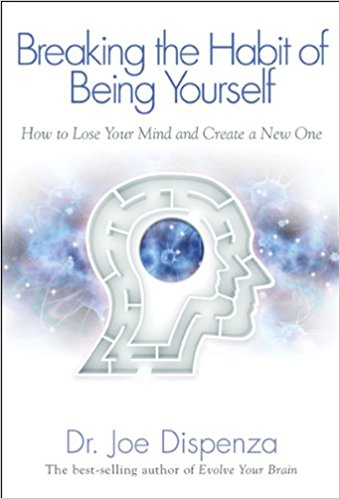
“Psychologists tell us that by the time we’re in our mid-30s, our identity or personality will be completely formed. This means that for those of us over 35, we have memorized a select set of behaviors, attitudes, beliefs, emotional reactions, habits, skills, associative memories, conditioned responses, and perceptions that are now subconsciously programmed within us. Those programs are running us, because the body has become the mind. This means that we will think the same thoughts, feel the same feelings, react in identical ways, behave in the same manner, believe the same dogmas, and perceive reality the same ways. About 95 percent of who we are by midlife1 is a series of subconscious programs that have become automatic—driving a car, brushing our teeth, overeating when we’re stressed, worrying about our future, judging our friends, complaining about our lives, blaming our parents, not believing in ourselves, and insisting on being chronically unhappy, just to name a few.”
― Joe Dispenza, Breaking the Habit of Being Yourself: How to Lose Your Mind and Create a New One
This is interesting, isn’t it? So is this.
“Reason this: When you think from your past memories, you can only create past experiences. As all of the “knowns” in your life cause your brain to think and feel in familiar ways, thus creating knowable outcomes, you continually reaffirm your life as you know it. And since your brain is equal to your environment, then each morning, your senses plug you into the same reality and initiate the same stream of consciousness.”
― Joe Dispenza, Breaking the Habit of Being Yourself: How to Lose Your Mind and Create a New One
I’ve said it before. The brain lives in the future based upon what it knows from the past. I am the poster child for this phenomenon. My family, my grandmother and grandfather, lived and died by this phenomenon. What can we do about this? Oh, so much.
“Change as a Choice, Instead of a Reaction”
I, therefore, carefully make one suggestion. What is one small thing that you could imagine changing? You don’t have to change it in real time. Just in your mind. You cannot make a meaningful change in your life, if you can’t imagine it first.
I’ll go first. I have a habit of letting my mind run away with me. It happens when I’ve done too much in a day or after I’ve had a migraine. Suddenly, the script starts. A film plays in my mind in which I’m all alone in my life. I feel lonely and overwhelmed but stoic and contrarian about the situation at the same time. Sort of like this:

It won’t last long. I’ll eventually end up crying alone in my room mumbling to myself:
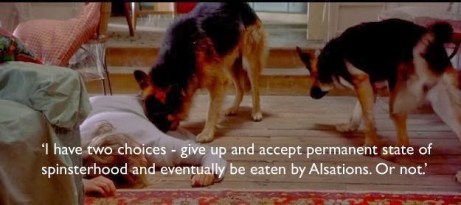
I was once caught crying in the kitchen by my daughter as I sniffled, “I’m going to die alone while trying to help refugees, but I’ll be eaten by wild dogs having helped no one…” I am not lying when I say that I have always had a larger-than-life flair for the dramatic, hence, my mother’s terrible nickname for me:

My mother called me ‘Sarah Bernhardt’ for the first 20 years of my life. I hated it although it was perhaps earned. Per my own suggestion, I am going to imagine responding to fatigue and stress differently by creating a narrative now–when I’m not stressed. Then, when I’m stressed I will have this narrative to call upon instead of my brain trampling over me like a herd of terrified bovines.
Will it work? We shall see, but I’m doing this in the spirit of making changes as a choice rather than from a reactionary place.
If you want to read something that has the potential to introduce you to a very different way of thinking, then I recommend this:
A Saturday Encouragment
I had such an unusual week. I’ll begin at the beginning.
My youngest daughter is open-enrolled in another school district because our home district is, well, incompetent and infamous for refusing to implement any kind of special education services. That’s fine if your child doesn’t require special education services, but my daughter does. So, I open-enrolled her into another district that came highly recommended, and it was a very good decision in terms of special education services. In terms of diversity, it has been an exercise in futility.
My state isn’t exactly known for its racial diversity. I live in the Midwest. My state is known for lakes, Scandinavians, lutefisk, hot dishes, icefishing, and the up and coming Super Bowl. There are good things about living here. I’ve lived here for two decades, and I think I must have been living in some sort of insulated box. What I encountered last week stunned me.
My daughter has faced not one, not two, but three counts of anti-Semitism in her Social Studies class including an incident of “soft-core” Holocaust denial over the past few weeks. It has been shocking. I reported the first incident to the school. Nothing was done. I explicitly reported the second and third incident to the school principal last week. My report was acknowledged. I am still waiting for action. In addition to anti-Semitism, there have been openly racist remarks from white students towards non-white students witnessed by teachers. The teachers have done nothing, and I suspect that their inaction was due to not recognizing the racism for what it was. One might think that this should just be allowed to pass. Middle school is a shark tank. It is terrible. Everyone is a target, right? No.
The problem here is that there might be perhaps one or two African-American students, one or two Asian-American students, and one Latin-American student in a sea of white students. 300 plus. 400 plus. 500 plus. No advocacy. No modeling. Enabling of bullying. Enabling of on-going racist interactions, aggression, and micro-aggression that has probably been nurtured since elementary school. I don’t necessarily expect kids to know for sure what is driving their inappropriate behaviors, but I do expect the adults observing them to know particularly when that behavior involves “otherizing”, sorting, and marginalizing which often leads to bullying and violence. This is completely unacceptable, and I’ve said so. You can imagine how much they love me over there.
It is even more important to address racism and anti-Semitism when the school district is largely white. It doesn’t matter what the culture of a student’s home is be it misogynistic, racist, anti-Semitic, conservative, liberal, or whatever. When a student participates in the public and civil forum, they and their parents tacitly agree to the rules governing that forum. Views and opinions that harm the well-being and rights of others and violate the rules governing that forum are left at home. One can be a white nationalist at home. One can be violent and misogynistic at home. One can hold fascist views at home. One can be homophobic at home. One can hate other people at home. One can deny the Holocaust at home. One can endorse the legislation of one’s own interpretation of morality and harshly judge other people for not believing exactly what they do at home. Not in a public school.
As I sat at home wondering how anyone could factually deny the Holocaust, I witnessed another injustice. I attended my 17 year-old daughter’s IEP meeting. She attends a school for students with special education needs. There are three members of the staff serving the needs of the students who hail from a West African nation with an almost 82% poverty rate. Of all the staff members at my daughter’s school, these three staff members are the kindest, most respectful, and most willing to go above and beyond for some of the most hard-to-reach students; and, it is hard for me to grasp at times because I know simply from the history of their country of origin that they have suffered inordinately. From what I know of two of these staff members’ personal stories, they have lost more personally than anyone I’ve ever met, and yet they show up every day to their workplace with optimism and a willingness to work hard and show kindness regardless of how they are treated.
And how are they treated? Poorly. Why? Because they are African. They are not white Americans. They are different. The staff and even students at my daughter’s school display racist attitudes and rhetoric towards these three people on a weekly if not daily basis, and I cannot fathom it. They are spoken down to. They are talked to as if they don’t understand English because they have accents even though their first language is English. They are excluded and mistreated.
So, what is new here? Should I really be surprised? This is the American legacy. I grew up in the South with an active KKK clan one town over from mine. Racism, prejudice, and bigotry run deep in the veins of our nation’s foundation. It was freely displayed in Texas. It’s just passively exhibited in the North whether we like to admit it or regard it.
So, what did I find surprising this week?
Well, my daughter has experienced unusual forms of bullying at her school, and I don’t say that to be dramatic. She was targeted by another student for months last year. This student attacked staff members with makeshift weapons. This student stalked my daughter during school and threatened to physically harm her. It was a severe situation. The school’s lawyer was involved. The superintendent was involved. My daughter required a “safely plan” meaning she had to be escorted wherever she went in case this student found her in the hallways or even the bathroom. This student is no longer at this school, but, when he was at this school, it was a serious situation.
I learned yesterday that one of the West African staff members was also experiencing multiple forms of mistreatment at school. The mistreatment is bad enough to bring charges. I also learned that this teacher will not leave until my daughter graduates. This teacher has determined to stay to make sure that my daughter is safe, protected, and cared for. This teacher is willing to tolerate abuse in the workplace for the sake of my daughter.
After weeks of battling my youngest daughter’s school district and their policies on racism and anti-Semitism and my own personal and emotional depletion, I felt something in my heart…crack…for lack of a better word.
How often have I felt alone in my efforts to set an injustice right? All the time. “Just let it go. It won’t make a difference,” I have heard. And, you know, I almost didn’t say anything after what my daughter’s Social Studies teacher said in her annoyance, “Let’s just pretend that those kids are Jews being packed onto train cars on their way to Auschwitz.” I almost didn’t say anything when she denied the Holocaust. I almost didn’t say anything when another anti-Jewish statement was made. But, if I don’t, then who will?
And, then I learned that there is someone else, behind the scenes, absorbing the inequities, suffering, for the sake of my daughter. Helping her feel safe. Helping her make it in a hard environment. Anonymously. And, the first thing that came to mind was, “How often do we experience this? We ask for help. We pray. And, we think that God doesn’t come through for us because we hurt. Because we are mistreated. Even abused. Because it’s so hard. Because we have to push really, really hard just to make it an inch up the road. But, what if we would have fallen a mile behind without their silent assistance?”
Pain is not the absence of God or human support.
So, today, I feel a profound, humble gratitude that I don’t know I’ve ever felt before. I feel it deep inside my core. Yes, the battles are real, and I will resume the fight tomorrow. Today, I can say that what we often hope for–maybe there is more to this than I can or ever will see–is true. There are truly good people in the world, and I might never know who they are.
Perhaps this will encourage you as you continue on.
That Which Does Make You Stronger
I had an interesting therapy experience yesterday. Jack is a very different therapist from my previous therapist. The gap is growing wider forming a gulf that is coming to represent their differences, and I’m missing my former therapist more and more. Alas, change is good. Perhaps I was growing too comfortable. I don’t know. I don’t know what kind of work is going to be done with Jack. I find myself feeling disdainful. Unusually rigid. Clinging to my own stubbornness.
He wants to discuss my sex life. He wants to discuss my “getting out there” and dating. I’ve got a lot to offer the world of men so he says.

Uh huuuuuuuuh. He wanted to emphasize that his office was a space for discussing difficult topics that may feel taboo. Like sex and all the nuances therein. Like…men and getting with them (my words not his). You know that I’m uncomfortable when I increase the sarcasm.
“It might be hard for you to even think of having sex. With everything that you’ve been through…but, we can talk about it. I’ve had clients come to me who can’t masturbate or even have sex at all. That’s okay. I want you to know that we can talk about that. I’m here for you. This is my job.”
I didn’t know how to tell him at that moment, when he was staring at me like I was sexually constipated and frigid, that I have a boyfriend.

I started trying to imagine walking in one day for a session with the intent to ask him about masturbation or a difficult nuance regarding having sex. I ended up here in my head.
I’ll tell you why. If I want to talk sex, then I either talk to a close girlfriend with whom I’ve been talking sex for years. Or, I’ll talk to the person with whom I’m having sex! It was a fair question for him to check in with me regarding sexuality particularly now that I’m not married. He doesn’t know that I’m in a relationship. I haven’t disclosed that to him, but he also hasn’t asked me if I feel competent sexually. He made an assumption about me. No, no, no, Jack. Never assume anything about your clients. It isn’t really fair to the one sitting in the Hot Seat. He assumes that because I have past sexual injuries and traumas that I’m presently fearful, incompetent or deficient. Whether he knows it or not, he was stereotyping me.
That being said, I will say that it is very important to discuss sex, but you have to do it with someone you like and with whom you have an established rapport. A person you trust. Someone who will have good insight. A good listener. And, a person who will not view you through the lens of past experiences because, if you’re anything like me, then you’re already doing that to yourself. You want to share this aspect of yourself with someone who has a healthy view of sexuality and brings something complete and relatively unmarred to the table. Someone who can see you in the present tense and imagine you in future tense, too. This encourages you to be open. Sex is one of the harder topics to discuss because there is so much shame and embarrassment tied up in it mixed with social pressures and judgment along with messages from our families of origin and religious upbringing. We never have sex without bringing a slew of people with us it seems. You want to talk to someone who likes themselves and likes sex. That really matters, too. And, you really want to talk to someone who wholeheartedly believes that recovery and healing from past trauma is possible for you. Particularly when you do not.
For roughly two and half years, I wrote a blog about sex. It wasn’t what one would call a “sex blog”. It was a blog about sexual development and healing in the context of PTSD and the recovery of one’s own sexual health in a long-term relationship. I really liked that blog and writing it. For what it was, it was a successful blog. It also marked the beginning of the end of my marriage. My ex-husband used to put me in double-bind situations–no win situations. He would complain about not having sex enough or my not seeming to enjoy sex. I took his observations to heart and decided that I was done with allowing past traumatic events determine my sexual health and enjoyment. I process quite well through the written word. So, I decided to blog about the experience anticipating that no one would find the blog. I was wrong.
Everything I learned, tried, failed at, succeeded at, and the effects it was having on my relationship I recorded. How I felt, how it was affecting me in terms of trauma recovery, whether or not I could be present, how post-modern culture and religion were affecting my experiences of my sexuality, all of it–I wrote about it. What I discovered was that I started to get better, and my ex-husband no longer wanted me. He changed his stance. He then complained that I was too demanding. I was showing up for sex, and he didn’t like it. He was angry that he was “required” to have sex with me. Perhaps we could schedule sex once a month. By the end of our marriage, we had had sex 18 times in two years, and it was all terrible. And painful. And somewhat violent. I didn’t know if I hated myself or him. After twenty years of marriage, I had never had one orgasm. He blamed me for that. I was tired of blaming anyone. I just wanted answers. I just wanted to be happy. I just wanted something better. And, I clung to a stubborn belief that I could get better regardless of what I had experienced in terms of sexual trauma–and, believe me, there was a boatload the size of the Titanic.
What I can say now is that all the time and effort I spent churning through resources on women’s health, sexual recovery, erotic intelligence, how-to guides on masturbation, reading the epic tomes of Dr. David Schnarch, and the hours I spent talking to the very few people willing to be open and honest about sexuality with me were not wasted. I did experience a recovery and healing in a kind of isolation. A very private and personal integration. And, it was challenged in every way when I met James, the man in my life.
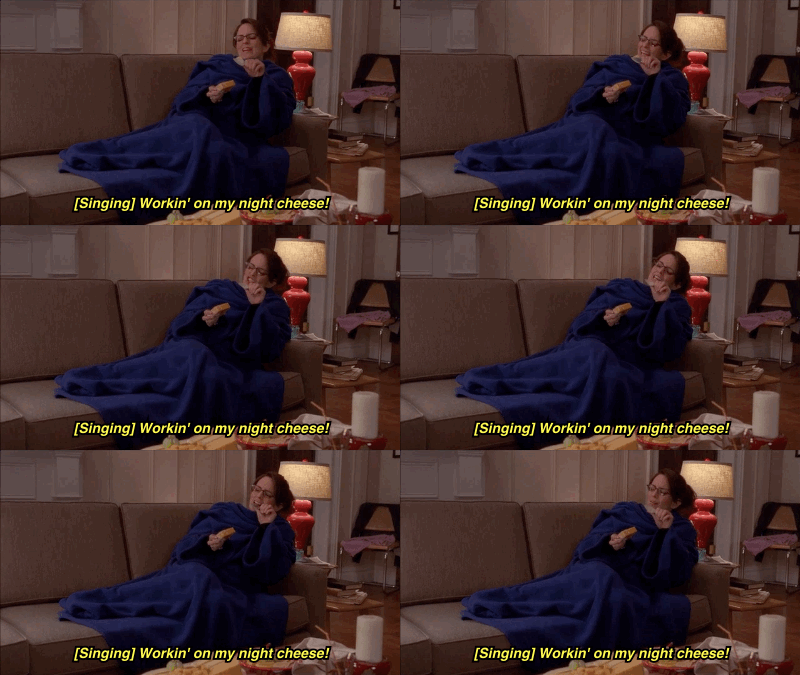
You don’t know just how solid you are until it goes live. Will your foundations hold? Will all the work support you? There was a lot of room for self-doubt and fear. My ex-husband’s voice was in my head, but James was in front of me. One was real. The other felt real enough, but was it? I learned that I had to choose. One small choice after one small choice. Consistently. Who would I believe? The past or the present? On paper, it sounds easy. The present, duh. In practice though? I can’t tell you how hard it was and continues to be on the bad days. Yes, there are bad days. Days when I just want to, as Liz Lemon sang, “work on my night cheese” and hide in a hole. That’s okay. The sun rises. You will always have another day to try again. And another. And another.
There is no substitute for the kind patience of a person who really likes you and finds you to be utterly fascinating and beautiful. When that kindness and admiration–nay attraction–grows into love, you have a foundation for something exhilarating, healing, and, yes, very scary.
And that is one of the secrets to healing from almost anything. To fully heal you must fully risk again. And, everything in us reels at that. That sounds counterintuitive. Why would we put ourselves into a situation in which we could be decimated…again? Are you familiar with that tired, old cliché “That which doesn’t kill us makes us stronger?” To be frank, I think it’s a stupid thing to say. There is no comfort in being told that you didn’t die at the hands of some evil thing, thereby, the evil instilling you with strength. Nope. I don’t buy it.
I think there is a different meaning here. I’m going to change it. “That (good love) which did not kill you makes you stronger.” Do you see it? “That which didn’t kill you makes you stronger.” Perhaps you survived a terrible reality like domestic violence or a really horrible family involving extremes that are not mentionable in “polite” society. Maybe you survived a stranger assault, war, tragic car accident, terrible grief, difficult and prolonged illness, mental illness that won’t give way–I could go on. It’s all trauma in one way or another. To me, it’s all “bad love”. Why? Because we end up loathing someone. Most likely, it’s ourselves that we blame or hate the most. I’m not making light or being pithy. Toxic love in all its forms drives some of the worst behaviors known to humankind. Even war. Love of country…Love of ideology…Love of God used to exterminate and Otherize.
It is integrous, kind, honest, true, patient, loyal, and consistent love that makes us stronger–“That (good love) which did not kill you will make you stronger.” A true and honest love only makes us stronger. And, for better or worse, to experience that, you must risk your heart. You must make yourself vulnerable to someone. You must try trusting someone, and if the thought of trusting someone makes your stomach turn, then you aren’t alone. It is one of the hardest things to do. I know all about that. I’ve spent the past two years feeling as if I’m living in a K Drama. Thrilling? Yes. Terrifying? Yes.
There are many paths to take should you desire more. None are fast. None are easy. There are no shortcuts, but if you keep going you just never know what’s around the corner. Your traumatized brain might think, “Something terrible probably,” but if you allow yourself to wonder beyond that for a moment maybe not. Maybe something better.
So, keep going.
The Neuroscience behind Feeling Stuck
I have recently been reading a lot of material on the endocrine system and neurology. Why? Anatomy and Physiology II. Brain, brain, brain, brain. What I’ve learned, aside from more than I ever expected to know about hormones, is that distress of all kinds is really bad for the body. Really bad. It is chemically bad. Our bodies secrete so many chemicals in response to real and perceived stressors, and prolonged exposure to those chemicals do damage to our vessels and surrounding tissues–to our brains. We are not meant to marinate in our adrenal gland’s hormones, but we do. More and more. What is one stressor that might cause said marination? Trauma. And, that trauma can be early childhood or yesterday’s car crash. Time isn’t a factor.
Outside of A&P II, I’ve been reading about trauma and the brain because I want to find some answers to my own questions. I came across a quote online somewhere a few days ago that said that trauma is an “unfinished event”. Initially, I did not like this interpretation of trauma. An unfinished event? What does that mean? It bugged me all week. Then, I heard it again this morning! I was watching an explanatory video on The Hakomi Method in which Ron Kurtz, founder of the method, was illustrating a point by discussing a session he had with a client. His client had an experience in session in which he recalled being hit by a car and waking up in the hospital with a priest performing something like a blessing or even the last rites over him. He was consequently filled with dread in the past and in the present as he recalled it. Kurtz explained that his client was experiencing an unfinished fear. He had never had the opportunity to fully process that experience–or finish it. So, the client’s wife, who had been present in session, held him in order to soothe and console him while Ron talked him through the rest of the experience. His client finished experiencing his trauma in order to finish experiencing his fear. He processed that trauma. I was intrigued and emotionally stirred.
Dr. Mark Brady describes the early phase of recalling traumatic memories as such:
“Extensive research suggests that early terrifying experiences take up residence in implicit (unconscious) memory networks primarily on the right side of the brain. These memories essentially compromise the flow of electro-chemical energy and information. In response to overwhelming experiences, our neural networks abruptly inhibit the firing of action potentials (nerve impulses) in the brain so as to cause the adrenal glands to stop flooding both brain and body with excessive amounts of adrenaline, noradrenaline and cortisol. In the amounts generated by life-threatening emergencies, without this safety shutoff, that quantity of stress hormones would do even worse damage than the trauma itself. The lived experience feels like going numb or being checked out – dissociated. But that’s not the end of it.” (“When Terror Strikes for No Reason”)
I am all too familiar with this experience. Does it resonate with you? When I recall past trauma that has not been processed, this is exactly what I feel like. I have, in the past, mistaken my numbness or emotional detachment for being completely fine. I used to think that it meant that I was presently okay with whatever happened way back when. Hardly. Dr. Brady is describing the “back end” of your emotional and affected experiences. The inner workings of your mind. Whether you know it or not, your brain is your friend. It is the modulator of your emotional experiences. It allows you to recall and cognitively experience a memory, but it’s not going to allow you to experience the emotional contents of said memory at the same time–unless you go mining and break into buried compartments. In other words, your brain is trying to titrate your emotional experiences so that you are not overwhelmed or overdosed by your own traumatic experiences.
Brady goes on to say:
“The brain knows when its functioning has been compromised by traumatic experience. As a consequence it seems to constantly attempt to identify or morph people, places and familiar environments into circumstances where its impoverished networks can be rekindled and activated, ideally for integrative re-connectivity. In both the incidents I’ve just described, that didn’t happen. Abdication (flight) is not integration.” (“When Terror Strikes for No Reason”)
The aforementioned remark is absolutely vital to me in terms of understanding ourselves and creating a roadmap out of our suffering. What do I mean by this? Take a moment to consider your uniquely personal Distortion Machine. What is the Distortion Machine? It is the name I’ve given to that harassing voice inside your mind that never shuts up. It is the Malicious Storyteller. It is the voice that always says, “What if…what if…what if…” followed by hundreds if not thousands of possible detailed scenarios usually involving your downfall.
- “What if you trust this person and they betray you just like everyone else you’ve trusted?”
- “What if you try your hardest and fail? Again.”
- “What if your house is struck by lightning and burns to the ground?”
- “What if you never meet anyone and you die all alone and they find your body all decayed and partially eaten by your cats?”
- “What if you really do look terrible in those pants and no one has the balls to tell you because everyone just feels sorry for you because they all know that you will never meet anyone and will most certainly die alone and will for sure be eaten by your cats?”
- “What if you’re just stupid?”
- “What if your parents were right about you all along?”
- “What if it was really all your fault?”
- “What if you really do have a snaggle tooth?”
- “What if no one really likes you at all?”
- “What if you choke and you’re by yourself and you can’t give yourself the Heimlich maneuver and you die…once again to be found partially eaten by the neighbor’s Great Dane. Or…just your cats?”
- “What if you get in a terrible car accident because someone is texting while driving?”
- “What if he decides he doesn’t want you anymore? Out of the blue? And you don’t see it coming? What if you can’t adapt to that? What if something terrible happens and it finally breaks you? What if…you just can’t get up again…?”
- “What did she mean about you when she said that? What if she is looking for a way out of this relationship?”
Do you notice the mix of absurdity, fear, and preoccupation with the past that paves the road into your future? The past is informing the present which kindles anxiety and fear about what might happen in the near or distant future? Some of this seems absolutely far-fetched. Lightning striking a house? Being eaten by cats? Choking to death? Car accidents? These are all examples of cognitive distortions that fall under the heading of catastrophizing, and I do this all the time. My brain is usually set off when I’m relaxed and happy. It’s as if it cannot stand to be at peace, and I cannot stand that my brain must kill off my serenity.
For example, if I get my hair done and it looks good, then I usually hear something like: “What if it all falls out? What if you get cancer and have to have chemotherapy and lose all your hair?” When I have a good coffee date with a friend, I might hear, “What if they get tired of you? What if they find out how weird you are?” I am left dragging my self-esteem and bedraggled brain home feeling like this:

Why does this happen? I have an answer (sort of), and it begins and ends in your brain. The first thing to understand is that our brains do not live in the past. I thought that mine did. I was wrong. Our brains live in the future. Our brains are continually looking for patterns based upon past experiences in order to predict outcomes so that we might have a sense of what to expect which allows us to plan a trajectory with a reasonable amount of certainty. Our brains do this all the time with very few data points without your conscious input. Also, our brains fill in the gaps between those data points with whatever is available be it past, present, or available data. In other words, our brains make shit up, and we are completely unaware of this. We are operating on false premises most of the time, but this is a necessary evil because we would not be functional or decisive if our brains failed to do this.
Think of all the unknowns that surround us second-to-second. Is that coffee too hot to drink? Did that barista really put almond milk in my latte? Was that really a car backfiring, or was someone shooting a gun? Should I cross the street, or will a car careen out of control from out of nowhere and run me down? Is that dog friendly? Are all these strangers safe? Is there E. coli in my spinach leaves? Should I drink this water? How do I know that someone in this movie theatre isn’t concealing a weapon? How do I know that someone didn’t lick that penny that I just picked up off the ground? We are faced with too many decisions to consider on a daily basis. Our unconscious brain must act for us all the time in order for us to maintain higher functionality–just to make it through the day.
Enter outlier events. When you have trauma in your past, your trauma becomes a data point for your brain, but traumatic events should be logged under “outlier events”. In other words, traumatic events should not be considered viable data points when your brain is constructing its premises and making its decisions. Think of statistics. How do we calculate an average? Before we calculate an average, we throw out the outliers: the highest number and the lowest number. Then, we calculate our average. Past traumatic events in our lives are part of the outlier numbers–the highest and lowest numbers. Outside the bell curve if you will. You cannot consider them as a possible data point for a future set of possibilities, and yet our brains do this all the time.
This is why my brain is the Malicious Storyteller. The majority of my past events are highly traumatic.
- “What if he turns out to be a liar and dupes you?”
- “What if he tries to kill you?”
- “What if you die in a terrible accident?”
- “What if everyone leaves you?”
- “What if it’s really true about you? What if you are disposable?”
- “What if you get eaten by a wild animal while you’re still alive?”
I know that all of these sound ridiculous, but all of the aforementioned “What ifs…” have happened to me. I have been duped. I have almost died in a car accident. I have been threatened with being eaten alive by wild animals while in the trafficking environment. I have been tortured. I have been abandoned and left to fight for my life. I was young, and these events happened years ago. These are all outlier events, but my brain does not know that. To my brain, these are all data points. These are legitimate possibilities that must be considered. Some of these old traumas became new again in my marriage during re-traumatization.
Enter the habenula. What is that? The habenula is part of the diencephalon and, together with the pineal gland, makes up a structure called the epithalamus. It is a tiny mass of cells about the size of half a pea. “The habenula tracks our experiences, responding more the worse something is expected to be,” said senior author Dr. Jonathan Roiser of the UCL Institute of Cognitive Neuroscience.” (Medical Daily) .
The habenula is involved in many, many of your brain’s activities, but it really gets involved when your brain starts storytelling and predicting.
“Previous neuroscience studies have shown how animals will exhibit avoidance behaviors following activity in their habenulas. Researchers watched as cells fired within animals’ habenula whenever bad things happened, or were simply anticipated to occur. Activity in this region is known to suppress dopamine, a neurotransmitter that helps regulate our brain’s reward and pleasure centers. Dopamine not only enables us to see rewards, but also to take action and move toward them. Significantly, the habenula has also been linked to depression.
For the current study, the researchers began by enrolling 23 healthy volunteers. First, participants were positioned inside a functional magnetic resonance imaging (fMRI) scanner, while the researchers collected brain images of high enough resolution to capture activity in the tiny habenula. Then, volunteers observed a random sequence of pictures, with each followed by figures depicting the chance of a good or bad outcome. Occasionally, volunteers pressed a button simply to show they were paying attention. Watching, the researchers discovered how habenula activation tracked the changing expectation of bad and good events. In particular, Roiser noted how the habenula didn’t just express whether something would lead to a negative event or not, it also signaled (with its increased activity) “how much bad outcomes are expected.” (Medical Daily)
Now, with that in mind, take a look at this study. Put on your thinking hat:
“Under repeated or continuous stress, animals and humans may show depression-like behaviour, as proposed by the ‘learned helplessness theory’64 and the ‘rank theory’112 of depression. In both schemes, depression is considered to be a form of behavioural adaptation to adverse conditions. More importantly, in the state of depression sensitization of the LHb-dopamine and LHb-serotonin circuits seems to occur (FIG. 2c). Indeed, in humans with depression and in animal models of depression the LHb (lateral habenula) becomes hyperactive12,83. This may cause the general motor suppression (through inhibition of dopamine neurons) as well as the mood changes (through changes in serotonin transmission) that are associated with depression.
Thus far, I have proposed that the habenula evolved as a general motor controller that was originally devoted to circadian control of behaviour. According to my hypothesis, at some point in evolution the brain areas that encode aversive signals acquired connections to the habenula. The habenula then became a suppressor of motor activities in response to, or in anticipation of, aversive events.” (The habenula: from stress evasion to value-based decision making)
What does all this mean?
“The researchers believe their study suggests how a hyperactive habenula might cause people to make disproportionately negative predictions, while also being involved whenever people feel pessimism and low motivation, or when they focus on negative experiences.” (Medical Daily)
What do I think this is? I suspect that this is a form of learned helplessness (LH) due to past exposure to trauma in which the victim of trauma had no control over the trauma and no means to escape the trauma. There are numerous studies available for review on LH (search PubMed). Clinicians are trying to assess how to help victims of trauma overcome LH as well as study the etiology of LH. LH perpetuates depression, and perceived re-traumatization exacerbates LH in those with PTSD even when there is a means of escape and control over the duration and exposure to the trauma. Based upon the animal studies, coping style and personality can often determine how one deals with later exposure to trauma or reminders of past trauma. In addition to this, the neurochemistry of the brain is changed sometimes for the worse after trauma exposure hindering recovery.
Okaaaaay, but how can I make this practical? I like knowing what is happening in my brain. It helps me feel better about myself for some reason. My brain is just doing what it was designed to do (or getting in my way). That being said, now what? What can I do to help myself?
- Shut it down. The Storyteller has nothing good to say. It’s like listening to a maniacally deluded weatherman predict the weather:

- “Run! Get inside! It will be raining fire and dragons! FIRE! DRAGONS! RUUUUUUN!”
- Find and activate your imagination by bringing forth colors, music, scenes, and images that you like whenever you begin to hear the Storyteller’s voice. For some reason, the imagery that you choose to conjure which springs forth from the right hemisphere of the brain can often overpower the words of the Storyteller, which you didn’t choose. This actually works.
- Change your language. Stop referring to what caused your PTSD as a trauma. Start using the word ‘injury’. You were injured after all. You do not have an illness. You have an injury, and you are engaged in a process to heal from that injury that you received by no fault of your own. You might be surprised at how effective this one linguistic change can be.
- Change your perspective. “One of the keys to Time Perspective Therapy is the realization that we always have the choice to change how we view the times of our lives. Over the course of Time Perspective Therapy, PTSD sufferers move away from a narrow focus on the traumatic past and a cynical present and the possibility of ever achieving a hopeful future. Instead they journey toward a balanced time perspective in which it seems possible once again to live a full and promising life.This concept is reflected in ordinary language that time perspective therapists use. Most people suffering from PTSD have already been labeled as anxious, depressed, or even mentally ill. When they hear these words, and identify with them, the possibility of ever emerging from such a state feels very distant. Reframing their ‘‘illness’’ as an ‘‘injury,’’ and recasting their depression and anxiety as a ‘‘negative past’’ that they can replace with a ‘‘positive present’’ and ‘‘brighter future’’—and ultimately with a balanced time perspective—may seem overly simplistic, especially to those trained in psychotherapy. But to PTSD sufferers, the idea of having a forward-leaning framework in which to understand and work on their issues most often comes as an enormous relief and a welcome ray of light in the darkness. The image below illustrates how in Time Perspective Therapy (TPT), we show people how to lift their back foot that is stuck in the muck and mire of the traumatic past while standing firmly on the ground of the solid present, and place it into a brighter future.” (Your Brain on Trauma)
 Source: Noah MilichSo, there it is. There is so much happening in our brains all the time, and we don’t even know it. We can, however, make small changes when we feel well or even relatively okay to create habits that will make all the difference when we don’t feel well. When the Storyteller comes for us. When it starts raining fire and dragons and Paradise is lost. Or, at least, when it feels that way. So, the next time you feel adrift, panicked, and awash in “What ifs”, remember your habenula. Remember to throw out your outliers before you let your Storyteller even try to calculate potential outcomes. And, don’t forget to activate your imagination and silence your verbal processing. Take in some beautiful images and music to silence that Inner Torquemada and overcome that sense of learned helplessness.
Is it a tall order? Maybe. But, every tiny effort is still an effort. Be proud.
Keep going.
MJ
Currently on the Nightstand
Share this blog

RSS


thrivingisthegoal.com
is licensed under a
Creative Commons Attribution-No Derivative Works 3.0 United States License.

 Out of the Mire