Understand Your Brain, Understand Yourself

To begin to get a solid grasp of where I’m headed in terms of changing your narrative and healing yourself in experiential ways so that you can change your trajectory in tangible ways, I highly recommend that you watch this documentary on the brain–“Automatic Brain: The Magic of the Unconscious Mind”.  It’s a little under an hour long.  It’s fascinating, and it will give you insight into how and why you function as you do on a daily basis.

You can also find it on Amazon Prime.

If you want to take it one step further, then watch this as well–“The Brain that Changes Itself” (also found on Amazon Prime in addition to YouTube).

Your Narrative Brain and Trauma Recovery

I’ve been thinking about the idea of catastrophizing and feeling suspicious.  Both of these fall under the larger heading of hypervigilance.  Bear with me as I explain this because it’s very important.

What is hypervigilance? It’s “an enhanced state of sensory sensitivity accompanied by an exaggerated intensity of behaviors whose purpose is to detect threats.  Hypervigilance is also accompanied by a state of increased anxiety which can cause exhaustion.”  (online source)  It is common for those who experience PTSD to also experience hypervigilance.  People with anxiety disorders are often hypervigilant.  People who suffer from chronic pain or chronic illness can also experience hypervigilance.

The two things that interest me here are the two states of mind that can often characterize, or add specific flavor, to a hypervigilant experience–existing in a suspicious state and/or consistently anticipating negative outcomes.  These two states of mind are often what make living with something like PTSD, for example, next to impossible because the suspicious, catastrophic free-flowing thoughts and tale-spinning seem impossible to manage.

I don’t know about you, but I don’t mind the startle response.  Feeling suspicious of others all the time and consistently anticipating a thoroughly negative outcome? I would rather be rid of those two altogether.

So, how do we do this?

I have and continue to study trauma and the latest research and clinical approaches to healing it.  My latest therapist, whom I chose based on his PhD in neuroscience, specializes in extreme trauma and trauma recovery.  I’ve put in years of work around recovery over the years, but I have never been able to shake this sort of hypervigilance.  None of the clinicians I’ve seen has addressed it adequately.  Frankly, that’s not good enough for me.  I don’t want to manage this.  I want to cure it.  So, how?

Let’s start with a premise.  I postulated that PTSD (and even C+PTSD) is an adaptation that enables survival.  It is not a disorder in terms of a mental illness diagnosis even though it exists in the DSM-V.  It is an expression of a human’s ability to adapt and survive even the most extreme circumstances.  After all, all people with PTSD have one thing in common–we all survived.  That is nothing to sneeze at.  That is actually a very big deal.  My therapist agreed with all of the above.  This is a point of view that is emerging in the clinical field.

There are people who can become very protective of the idea of hypervigilance and any other PTSD experiences as a pathology, and that is understandable.  Chronic PTSD can be disabling and create a strong feeling of “otherness”.  It can be the cause of extreme ontological alienation.  I’ve been there.  If it’s viewed as a pathology, however, which is what a disorder is, then it can’t be fully healed in a meaningful way.  We develop coping strategies in order to manage pathologies.  The Western Cartesian model of viewing and treating human beings and their pathologies doesn’t function from a “cure” paradigm.  I am, however, very tired of coping with hypervigilance.  I want a more elevated life experience.

I’m going to be blunt for a moment to prevent any accusatory emails.  This blog is almost seven-years old.  I can’t expect anyone to know what I mean by “trauma” in terms of my personal experiences because who has time to read all the contents and therein my background? At the same time, I don’t think that anyone should have to take out their Trauma and Suffering CV in order to gain credibility or gravitas, thus, permitting them to contribute to the larger discussion.  At the same time, I understand the urge to desire that.  People find it difficult to listen to another person’s opinions on something so personal as recovering from trauma without epistemic trust.  I thoroughly relate to this. I don’t like to be lectured on how to manage my fear by someone who has never been through anything terrible.  You need the epistemological connection.

So, for the record, I know trauma.  I’ve experienced incest, a childhood of systematic and ritualized sexual, verbal, emotional, spiritual, and physical abuse.  I was abducted and trafficked across the country.  I have lived most of my life in fear of someone.  Being found.  Being killed.  I have survived a highly unusual set of highly traumatic circumstances all of which represent extremes.  I should not be alive.  I know all about law enforcement. the realities of not getting justice, and keeping secrets.  So, when I write about recovering from trauma, what it looks like, how to do it, what’s hard about it, stalling out, and the next steps, I do not write about it from a removed, academic place.  I write about it from the arena.  I’m down there with you, taking ground and keeping it.  Sometimes I’m just trying to keep the ground I’ve got.

A few months ago, I set about to read about catastrophizing and suspicious thinking, and I haven’t found much.  It’s all very “Calm down to calm down.”  For real.  I was once told by a clinician that in order to calm down I simply needed to calm down.  Brilliant! Can I generalize that? “To stop bleeding simply stop bleeding.”  In other words, what currently exists in the therapeutic mainstream is the Band-Aid approach:

“Catastrophizing is a cognitive distortion.  Change your cognitive approach.”

The cognitive behavioral approach can be effective, but it does not address the cause.   Let’s look at the cause then, and to look at that we must look at the brain and its actions:

“Our minds form cohesive narratives out of disparate elements all the time: one of the things we are best at is telling ourselves just so stories about our own behavior and that of others. If we’re not sure, we make it up – or rather, our brain does, without so much as thinking about asking our permission to do so.” (Our Storytelling Minds)

This is a very true statement.  This is something that my therapist discusses with me.  The brain does not rest.  It is incessantly active, forming memories, making connections, and reinforcing neural connections while pruning others.  It doesn’t need your permission to do this.  This is simply what it is designed to do.  You will find yourself making connections based upon how your brain fills in the blanks for you, not based on facts or truth.

“Consider a famous problem-solving experiment, originally designed by Norman Maier in 1931: A participant was placed in a room where two strings were hanging from the ceiling. The participant’s job was to tie the two strings together. However, it was impossible to reach one string while holding the other. Several items were also available in the room, such as a pole, an extension cord, and a pair of pliers. What would you have done?

Most participants struggled with the pole, with an extension cord, trying their best to reach the end while holding on to the other string. It was tricky business.

The most elegant solution? Tie the pliers to the bottom of one string, then use it as a pendulum and catch it as it floats toward you while you hold the other string. Simple, insightful, quick.

But very few people could visualize the change in object use (here, imagining the pliers as something other than pliers, a weight that could be tied to a string) – unless, that is, the experimenter seemingly by accident brushed one of the strings to induce a swinging motion. Then, participants appeared to spontaneously think of the pliers solution. I say spontaneously because they did not actually remember the stimulus that prompted them to do so. It was a so-called unconscious cue. When subjects were then asked where their insight came from, they cited many causes. “It was the only thing left.” “I just realized the cord would swing if I fastened a weight to it.” “I thought of the situation of swinging across a river. I had imagery of monkeys swinging from trees.”

All plausible enough. None correct. No one mentioned the experimenter’s ploy—and even when told about it in a debrief session, over two-thirds continued to insist that they had not noted it and that it had had no impact at all on their own solutions – even though they had reached those solutions, on average, within 45 seconds of the hint. What’s more, even the third that admitted the possibility of influence proved susceptible to false explanation: when a decoy cue (twirling the weight on a cord) was presented, which had no impact on the solution—that is, no one solved the problem with its help; they were only able to do so after the real, swinging cue—they cited that cue, and not the actual one that helped them, as having prompted their behavior. Explanation is often a post-hoc process.

Our minds form cohesive narratives out of disparate elements all the time: one of the things we are best at is telling ourselves just so stories about our own behavior and that of others. If we’re not sure, we make it up – or rather, our brain does, without so much as thinking about asking our permission to do so….Split-brain patients provide some of the best evidence of our extreme proficiency at narrative self-deception, at creating explanations that make sense but are in reality far from the truth. But we don’t even need to have our corpus collosum severed to act that way. We do it all the time, as a matter of course.”  (Our Storytelling Minds)

Apply this paradigm to your catastrophic and suspicious inner experiences, and, suddenly, it starts to make sense.  The brain is filling in the unknowns in your life with what is known–making estimations for you.

We humans don’t live with uncertainty well.  in order to make plans, you must fill in the blanks with some kind of anticipated outcome.  In order to get up in the morning and cultivate willingness to approach life, you have to have a sense of what daily outcomes might look like.  This is exactly how human beings have survived for thousands of years.  How will your brain solve for your unknowns then?

Well, if your childhood was catastrophic and subsequent relationships have been full of betrayal and abuse, then your brain will solve that equation for you–the outcomes will be catastrophic.  It’s not a question of values per se.  The brain is acting as the actuary.  According to your life experiences, it creates the most plausible outcomes within a template unique to your life, presents it to you, and then lists out a series of potential outcomes.  For example, what if you’ve experienced few positive outcomes in your life? What if your most recent outcomes were damaging and painful? Your brain is seeing to it that you survive, but, take note of this:

“W.J. (a man who had his corpus callosum severed to treat his epilepsy) came into the Sperry lab from his home in Southern California to find Gazzaniga waiting with a tachistoscope, a device that could present visual stimuli for specific periods of time—and, crucially, could present a stimulus to the right side or the left side of each eye separately. The patient had no problems identifying objects in either hemisphere and could easily name items that he held in either hand when his hands were out of view. Gazzaniga was satisfied. W.J. went in for surgery, where both the corpus collosum and the anterior commissure (a thin tract of white matter that connects the olfactory areas of each hemisphere) were severed. One month later, he came back to the lab.

The results were striking. The same man who had sailed through his tests weeks earlier could no longer describe a single object that was presented to his left visual field. When Gazzaniga flashed an image of a spoon to the right field, W.J. named it easily, but when the same picture was presented to the left, the patient seemed to have, in essence, gone blind. His eyes were fully functional, but he could neither verbalize nor recall having seen a single thing.

But he could do something else: when Gazzaniga asked W.J. to point to the stimulus instead of speaking, he became able to complete the task. In other words, his hand knew what his head and mouth did not. His brain had effectively been split into two independently functioning halves. It was as if W.J. had become two individuals, one that was the sum of his left brain, and one, the sum of his right.

W.J. was Gazzaniga’s patient zero, the first in a long line of initials who all pointed in one direction: the two halves of our brain are not created equal. And here’s where things get really tricky. If you show a picture of, say, a chicken claw to just the left side of the eye (which means the picture will only be processed by the right hemisphere of the brain), and one of a snowy driveway to just the right side of the eye (which means it will only be processed by the left hemisphere), and then ask the individual to point at an image most closely related to what he’s seen, the two hands don’t agree: the right hand (tied to the left input) will point to a shovel, while the left hand (tied to the right input) will point to a chicken. Ask the person why he’s pointing to two objects, and instead of being confused, he’ll at once create an entirely plausible explanation: you need a shovel to clean out the chicken coop. His mind has created an entire story, a narrative that will make plausible sense of his hands’ discrepancy, when, in reality, it all goes back to those silent images.

Gazzaniga calls the left hemisphere our left-brain interpreter, driven to seek causes and explanations—even for things that may not have them, or at least not readily available to our minds—in a natural and instinctive fashion. The interpreter is responsible for deciding that a shovel is needed to clean out a chicken coop, that you’re laughing because the machine in front of you is funny (the explanation given by a female patient when a pinup girl was flashed to her right hemisphere, causing her to snicker even though she swore she saw nothing), that you’re thirsty because the air is dry and not because your right hemisphere has just been presented with a glass of water (another study in confabulation run by Gazzaniga and colleagues). But while the interpreter makes perfect sense, he is more often than not flat out wrong.” (Our Storytelling Minds)

What this evidence has demonstrated is that our brains are often wrong.  

Our brains are performing a task, but those stories that seem to intrude on us when we find ourselves engaging in our daily lives, relating to others, trying new things, or surmounting obstacles are seldom true.  They exist within the template that our brain put together based upon what it interpreted as correct at the time.  Those interpretations may all be wrong.

In order to take control of that, we have to change that template.  Is it hard? Yes.  Why? It’s hard because you don’t have the neural connections to support a new template.  Yet.  Your current traumatic template is well-developed and functioning on autopilot.

So, where do you start?

That’s the next post.  Knowing, however, that catastrophizing and suspiciousness are functions of your brain attempting to interpret your experiences and environment might be the glimmer of hope that you need to be willing to keep going.  It can and will get better.

Further Reading:

Our Storytelling Minds: Do We Ever Really Know What’s Going on Inside? by Maria Konnikova


CBD, Endocannabinoid System, and PTSD

My last post was about PTSD.  I tend to jump around topically a bit simply because I’ll wake up in the morning sometimes with an idea in my head and think, “Oh, that would be interesting to write about.”  The topic of PTSD, however, is germane to this blog because I have written so much about it not to mention I carry that diagnosis.  I’ve had PTSD since childhood.  In my case, it is a chronic experience in which the general PTSD experience ebbs and flows.  Under high stress, it returns.  When life eases up a bit, all systems slow down, and I feel much more at ease.  It is practically a way of life at this point.

Life experiences have reinforced the PTSD experience as is the case for many.  Childhood trauma can set it in motion.  A later trauma will not only reinforce the biology behind PTSD but add additional symptoms to the overall experience.  Abusive relationships or even one primary abusive relationship continue to reinforce post-traumatic stress responses that interfere with activities of daily living and quality of life and relationships.  There is nothing new here in terms of a narrative.  Many, many people experience this.  How do we get out of it?

I have spent the last year inundated with post-traumatic responses and an equal desire to stop them.  It has ruled my brain and body.  Knowing why it’s there (leaving an abusive marriage) has not buffered the blows.  I have still had to “ride the waves” of the extreme emotional experiences caused by PTSD.

What do we do?

Enter an adjunct therapy…

My state has recently legalized medical cannabis.  No, our program is nothing like California’s or Colorado’s.  Only pills and oil.  There will be no recreational usage here say our legislators! At this point in the process, I don’t care about recreational usage.  I care about treatment.  So, let’s discuss cannabidiol (CBD).  What is CBD?

Cannabidiol—CBD—is a cannabis compound that has significant medical benefits, but does not make people feel “stoned” and can actually counteract the psychoactivity of THC. The fact that CBD-rich cannabis is non-psychoactive or less psychoactive than THC-dominant strains makes it an appealing option for patients looking for relief from inflammation, pain, anxiety, psychosis, seizures, spasms, and other conditions without disconcerting feelings of lethargy or dysphoria.” (ProjectCBD)

So, it’s actually helpful then?

“CBD may have therapeutic benefits in the treatment of various conditions, including chronic pain,anxiety,nausea,rheumatoid arthritis, schizophrenia,diabetes,PTSD,alcoholism,strokes and cardiovascular disease,cancer,and other ailments.

CBD has been shown to suppress colon cancer tumors in mice and to kill breast cancer cells in lab studies by Dr. Sean McAllister at the California Pacific Medical Center. However, cancer specialists caution that the efficacy of CBD for cancer remains to be demonstrated in actual human studies.

CBD also has anti-inflammatory, neuro-protective, and antioxidant properties. Antioxidants are thought to fight degenerative diseases and aging. CBD has also been shown to stimulate bone fracture healing in laboratory animals.” (CANorml)

THC, the component of cannabis that causes the “high”, is therapeutic as well:

“Scientists at the Scripps Research Center in San Diego reported that THC inhibits an enzyme implicated in the formation of beta-amyloid plaque, the hallmark of Alzheimer’s-related dementia. The federal government recognizes single-molecule THC (Marinol) as an anti-nausea compound and appetite booster, deeming it a Schedule III drug, a category reserved for medicinal substances with little abuse potential.” (ProjectCBD)

I was recently certified for medicinal cannabis in my state.  I sat down with a doctor who went over all my symptoms, and he recommended two blends.  A THC dominant blend for pain and nausea and a THC:CBD blend for other health issues.

A happy accident occurred.  While I was tracking my symptoms I noticed that my PTSD-related anxiety was decreasing.  I found the most relief with the THC:CBD blend.

I’m fascinated by this and naturally want to understand it.

Enter the endogenous cannibinoid system aka endocannibinoid system (ECS).  What is that? Well, it’s this:

“The endocannibinoid system is perhaps the most important physiologic system involved in establishing and maintaining human health. Endocannabinoids and their receptors are found throughout the body: in the brain, organs, connective tissues, glands, and immune cells. In each tissue, the cannabinoid system performs different tasks, but the goal is always the same: homeostasis, the maintenance of a stable internal environment despite fluctuations in the external environment…

Endocannabinoids and cannabinoids are also found at the intersection of the body’s various systems, allowing communication and coordination between different cell types. At the site of an injury, for example, cannabinoids can be found decreasing the release of activators and sensitizers from the injured tissue, stabilizing the nerve cell to prevent excessive firing, and calming nearby immune cells to prevent release of pro-inflammatory substances. Three different mechanisms of action on three different cell types for a single purpose: minimize the pain and damage caused by the injury.

The endocannabinoid system, with its complex actions in our immune system, nervous system, and all of the body’s organs, is literally a bridge between body and mind. By understanding this system we begin to see a mechanism that explains how states of consciousness can promote health or disease.

In addition to regulating our internal and cellular homeostasis, cannabinoids influence a person’s relationship with the external environment. Socially, the administration of cannabinoids clearly alters human behavior, often promoting sharing, humor, and creativity. By mediating neurogenesis, neuronal plasticity, and learning, cannabinoids may directly influence a person’s open-mindedness and ability to move beyond limiting patterns of thought and behavior from past situations. Reformatting these old patterns is an essential part of health in our quickly changing environment.” (Introduction to the Endocannabinoid System)

Phytochemicals like CBD and THC, for example, are then known in the context of the endocannabinoid system (ECS) as phytocannibinoids because they are plant-based cannibinoids.  Our body already produces cannibinoids.  It has been postulated that homeostasis cannot be maintained when there is a lack of natural cannibinoids in the body, hence, disease processes begin and other syndromes like Fibromyalgia appear.  Other brain-based disorders like anxiety, for example, of which PTSD is one appear on the scene.  The brain cannot engage properly in neurogenesis and loses some of its neuroplasticity.  Reintroduce cannibinoids to the body in the form of phytocannibinoids like CBD and watch the body return to homeostasis.

Months ago, I wasn’t sure what I thought about medical marijuana.  To be honest, I didn’t think about cannabis at all.  A close friend of mine, however, had a daughter with intractable seizures who finally found relief in the form of CBD oil.  I had never heard of CBD.  I was then faced with my own biases around the idea of cannabis.  What did I even know about marijuana aside from having grown up watching Cheech and Chong films along with my not too recent viewing of “Pineapple Express”? Honestly, I only had second-hand knowledge at best.  I knew absolutely nothing about medical cannabis.  Surely, James Franco would not be the one certifying me for medical cannabis, right?

I have learned more about medical marijuana in the past year than I ever thought I would.  I have also learned that it is practically impossible to recover from certain conditions if the body lacks what it is naturally supposed to have.  I can do all the right things in the way of therapy (which I have done and continue to do).  I can follow the right diet (which I do), and I can take even drastic steps to make my life better (which I did).  But, if your body doesn’t have what it naturally requires to heal and maintain its ideal state of health, then those steps feel like walking through setting cement.

My conclusion? A 4:1 THC:CBD oil is highly therapeutic for neuralgia, nociceptive pain, migraines, and the symptoms of anxiety and perseveration that are comorbid to PTSD.  This is, however, not a legal alternative for many people as medical cannabis is not available in many states.  So, in the meantime, let me refer you to Dixie’s Botanicals CBD Hemp Oil Products.  It’s legal.  It’s CBD-based.  Check them out!

For further reading on PTSD and CBD, I recommend ProjectCBD‘s list of studies on CBD and PTSD: PTSD and CBD.  I also recommend ProjectCBD in general for further education on medical cannabis.

If you really feel like getting your feet wet, then I recommend this book:


cannabis.jpg
Click image for link

The world is changing, and I think that it’s changing for the better.  There are options for achieving relief, recovery, and, ultimately, healing.  We just need to expand our vision and take an honest look at our biases and their origins.

Further Reading:


Post-Traumatic Stress…Disorder?

Eric Maisel proposed a few years ago that post-traumatic stress disorder (PTSD) isn’t actually a disorder nor should it be labeled as such.  It should just be termed post-traumatic stress response or something similar.  Others are starting to agree with him.

Why?

Well, if we step back for a moment and take a look at why PTSD develops in people in the first place, then you might see that Maisel et al make an excellent point.  Let’s use the example of a war veteran.

After experiencing the inexplicable and nightmarish realities of war and its inherent violence and atrocities, how does one imagine a healthy individual to respond afterwards? One could anticipate flashbacks, avoidance, isolation, nightmares, and hyperarousal reactions including anger outbursts, tension and hypervigilance.  One would expect somatic symptoms as well like migraines, tension headaches, and other physical symptoms.  This isn’t unusual.  In fact, it was asserted that a healthy person would return from war with some kind of post-traumatic response in place, and this very response reflects their prior mental health.

What does that mean? Everyone has a different level of tolerance for trauma.  What one person can tolerate may vary wildly from what another person can tolerate.  Someone may be able to return from war and integrate into society and family life with greater ease than another person, and this is almost certainly to do with the resiliency factor.  Everyone has their own resiliency spectrum.  For those with a lower tolerance for trauma then,  it is completely normal and to be expected even that they would return from a war setting experiencing a post-traumatic response.

Labeling a completely normal human response to trauma a “disorder” stigmatizes trauma survivors.  Anyone who has been through trauma and admitted it to the wrong person knows all about this.  It also keeps people away from the very environments that would allow for healing.  Many trauma survivors already struggle with that uniquely depersonalized feeling that causes them to feel like they are on the outside of their lives looking in.  Adding stigma to the emotional experience amplifies that ontological isolation–the Outsider Experience–and perpetuates the anxiety that a good future is for other people.

PTSD is a brain-based experience.  Studies have shown that the size of the hippocampus is a factor in the development of PTSD.  This is why two people can go through the same trauma while only one develops PTSD.  Those with a smaller hippocampus may be genetically vulnerable to the development of PTSD after trauma.  The emotional experience of PTSD is an expression of an experience originating in the brain, and your brain believes that it is doing its job.  Even the post-traumatic response lies on a spectrum.  Some people experience it acutely while others endure a chronic experience.

Much of what has been labeled as “disorder”, in my opinion, isn’t that disordered at all.  It’s an expected response.  In fact, it’s the brain adapting to fit an extreme environment–even if that extreme environment is very short-lived.  The problem that exists is retraining the brain.  Telling the brain to stand down.  Adapt again.  The environment has changed yet again.  I think, hence, that PTSD is an adaptation, not a disorder.

The good news is that there is help for that.  We adapted to a situation in order to survive it.  We can adapt again in our lives in order to do more than survive.  In order to really live and regain a sense of control.  Discover our options.  Create happiness.

EMDR and doing therapeutic work with a qualified therapist will get you there, but, in case you can’t pursue that yet, this book will get you started:

414bfHFKxmL.jpg
click for link


Saying No is Good

Saying ‘no’ is good.  I seem to rarely do it, but I’ve heard other people tell me this.  I am kidding.  Sort of.

I really find out just how good saying ‘no’ is particularly when I said ‘yes’ but really wanted to say ‘no’.  Do you know what I mean?

If you are addicted to doing the “right” thing and making everyone happy, then I am certain that you know what I mean.

Case in point:

aspic-pe-blog.jpg
Aspic.

Someone made this on purpose! And some poor sod said ‘yes’ to eating it even though they would rather have endured a root canal without novacaine.  There they are, smiling at the creator of this disgusting delicious creation, mouth full of cool, gelatinous edibles, and all they can think to say as something slime-like oozes through their back molars is, “Wherever did you find this recipe?”

I agreed to having lunch with my ex-husband.  I should have said no.  I ate the metaphorical aspic.

He was not mean to me.  It was simply too triggering.  It took me a week to process a two-and-half hour lunch.  That’s not okay, but it’s informational.  After a year of post-separation therapy, it was an unexpected means of taking my own temperature in terms of post-traumatic healing.  I’m simply not there yet.

I thought I was.  I overestimated myself.  I don’t think it’s bad to overestimate oneself.  That’s what gets us out of bed in the morning sometimes, but, when it comes to having lunch with a former abuser, it might be good to be prepared.  Funnily enough, I thought I was.

What was my takeaway after the dust settled?

  1. Know your triggers.  I know his methods and wiles, but there is one thing that he does that triggers me.  His victim persona is a punch to the gut every time.  I didn’t realize it until we had lunch.  When he plays the victim, I want to take a sledgehammer to something; or, go into my room and cry for a week.
  2. Have at least one person in your corner who can remind you of what is true about your identity and your circumstances.  This will make it so much easier to come out from under those post-traumatic triggered responses particularly if a run-in with a formerly abusive partner is the cause.
  3. Take care of yourself.  Do what it takes to practice self-care and self-soothing.  The feelings will pass.  They will! I promise.  In the meantime, do what it takes to bring consolation and comfort to yourself.
  4. Look out for ANTs (automatic negative thoughts/thought distortions).  I got caught up in a slew of these last week, and it sucked.  Your brain will always tell stories.  That’s what it does, and, for whatever reason, it’s never an awesome story.  It’s always a catastrophic story involving abandonment, sharks, plane crashes, and some sort of plot from Law & Order:SVU.  Our job is to develop a mindfulness practice (I know, we are starting to get sick of that new buzz word) in order to stop the brain’s sordid and scary storytelling.  This is one of the primary points of mindfulness.  It is to learn to become aware of the brain’s latest plot twist, stop it, and then take control of it in the form of non-judgmental observations and containment.  With practice, this becomes a skill, and we are no longer held hostage to the Stephen King/John Grisham/James Patterson/Nicholas Sparks writing collective in our brains.
  5. Imagine saying no and then put that into practice.  If you are not up to doing something because you know that it will cause you to have a setback or cause a triggered response, then consider saying no.  I’m pondering this myself.  I say yes to a lot of things even though I know that I might be triggered.  I feel obligated, but, frankly, my distress tolerance might not yet match the occasion.  It doesn’t mean that I won’t one day be able to engage in the proposed situation.  It just means that I’m not there today.  And, that is okay.  After I had hip surgery, I couldn’t run for four months.  I couldn’t even walk for six weeks.  So, saying yes to a 5K two months after surgery would have definitely caused a setback in my healing process.  It’s not so different when we’re healing emotionally and psychologically.

That’s what I learned last week.  I sure hope it sticks because the idea of using aspic as a metaphor for anything again is…well…I’ll just say ‘no’ to that.

Further Reading:


Borderline Personality Disorder and Mirroring

I wrote this post, The Male Borderline Waif, a year ago, and it gets a lot of daily traffic.  For as much research that’s been accomplished over the decades around borderline personality disorder (BPD), there are still few answers to be had particularly for men who may be on the borderline spectrum.  Mental health and healing should not be pie in sky for any of us regardless of our diagnosis.

What do we do?

There is also a great deal of stigma for those who carry a personality disorder diagnosis particularly borderline.  The psychopath CEO or even pastor is let off far more easily than the borderline woman (TIME).

Let me be clear.  I’m not a personality disorder apologist.  I don’t, however, feel that anyone should withhold empathy from a population of people simply because there is little true understanding  around the etiology and ultimate course of their condition.  In the case of personality disorders, there are working theories.  That’s it.

Both my parents have personality disorders, and my father was extremely dangerous.  For years, I suspected something was going on with my ex-husband, but I could not pin it down.  Also, I didn’t want to believe that after growing up within a family dynamic so influenced by disordered personalities that I would then go on to choose a partner who would exercise a similar influence.  I, therefore, felt a great deal of denial for a long time which led to my staying in a very unhealthy relationship longer than I should have.

So, what pushed me out of my denial?

Firstly, I observed that my ex-husband was very resistant to any kind of treatment and became very defensive if I suggested it.  He refused to go to the doctor for anything.  He refused to seek mental health treatment as well–even when an ultimatum was on the table.  When I asked him why, he would tell me that he knew more than any doctor.  Was my ex-husband a physician? No.  Did he believe that he knew more? Yes, I think he did.  Is there a name for what he was expressing? Yes, there is.

Grandiosity.

Secondly, over the years I noticed that he had different “personalities” or ego states depending upon the situation, and sometimes they were wildly different.  He was a chameleon, and I wouldn’t even recognize him as the same person particularly at work functions.  What was most bothersome is that he had borrowed my self-image in terms of how he talked about life in general.  He used my language and knowledge base as if they were his own.  This is called mirroring.

What is mirroring?

Definition:

Mirroring – Imitating or copying another person’s characteristics, behaviors or traits.

Borrowing a Self-Image

Mirroring occurs when people with Personality Disorders have a vacant or distorted self-image, which can manifest itself as an imitation of another person’s speech, mannerisms, behaviors, dress style, purchase preferences or daily habits.

In more extreme manifestations of this behavior, the person doing the mirroring might begin to believe they actually are the other person, to the extent they might call themselves by their name, claim to be them or ‘borrow’ elements of the other person’s life such as relationships, past experiences, career or family history and claim these as their own.

Mirroring can be a form of Dissociation, where a person’s strong feelings create “facts” which are less than true.

A dramatic case of mirroring is portrayed in the movieSingle White Female, in which the character Hedra Carlson (played by Jennifer Jason Leigh) begins to imitate her new room-mate Allie in the way she looks, dresses and behaves, imitating her haircut, wearing her clothes and ultimately seducing Allie’s boyfriend. (Out of the Fog)

What it Looks Like

  • A man switches accents to mimic a colleague.
  • A woman wears identical clothing to her friend.
  • A mother wears her daughter’s clothing.
  • A teenager makes phone calls in which she pretends to be her sibling or parent.
  • A secretary wears her boss’s wife’s perfume in an attempt to seduce him.
  • A man writes letters in which he forges his boss’s signature. (Out of the Fog)

My mother mirrored me frequently.  It was obvious.  It wasn’t as obvious when my ex-husband was doing it until he attended an intake session with a therapist.

He came home after his intake appointment and told me that his new therapist saw no reason for him to be there.  I felt shocked, but I played along.

“Why does your therapist think that you don’t need therapy?” I casually asked.

“I told him that I was looking to create more ’emotional mindfulness’ in my life, and he was really impressed with that.  He had never heard that term before, and he really liked it.  Anyone who would even come into his office and use such a term probably didn’t need much therapy,” he said smugly.

STOP!!!!!! That’s MY term!! I used that term! That is what I was trying to create in MY life! 

He mirrored my therapeutic process in his first therapy session to get out of therapy! That was the moment when I knew something was wrong.

I kept this behavior in mind as I proceeded, and this weekend’s antics with my daughter settled it for me.

Between his mirroring, chameleon-like behavior, grandiosity, entitlement, apparent lack of a solid sense of self as well as his belief that others do not have a sense of self that requires fencing in (boundaries), protecting, and respecting, displays of rage and violence, and consistent need to be the victim in our relationship when he was actually participating in victimization, and his reported self-loathing, I finally understand that he is likely experiencing identity disturbance among other things.

I know that pathologizing people isn’t necessarily the way to go, but it helps me get a proper handle on how to adjust my expectations and behaviors.  It helps me think in terms of what I can expect from someone in terms of personal safety, too.  It also helps me organize a better narrative around our past interactions.  When I look back over our relationship, I can see that I wasn’t interacting with his true self but rather his disorder.

Mirroring behaviors are not discussed enough in the context of personality disorders particularly if you are in a relationship with someone who is engaging in them.  You may feel “creeped out” by them, and that’s legitimate.  It is a bit alarming.    Why is this even a thing? I found a very brave blog post written by a woman with borderline personality disorder who explains why she engages in mirroring behaviors:

“One of the biggest and most challenging aspects of Borderline Personality Disorder (BPD) is often ‘The Chameleon Effect’ – or ‘mirroring’. This is the constant, unconscious change in the person’s ‘self’, as they struggle to fit in with their environment, or the people around them. It is, essentially, a fluctuating identity. It is the manifestation of a basic inability or difficulty in establishing a stable sense of self.

The presence of The Chameleon is often one of the main obstacles to effective initial treatment and diagnosis of BPD, as it affects the interaction between patient and doctor, and can mask the disorder itself. It also effects and masks the way in which BPD intersects with other disorders that may have developed in connection with it – creating a complex web of behaviours that can be hard to untangle. The irony is that, without diagnosis and treatment, most are unaware of The Chameleon, and it is only through awareness that The Chameleon can be managed.” (Borderline Personality Disorder and the Chameleon Effect)

She goes on to explain very succinctly what the mirroring is all about:

“Now that I am acknowledging the presence of my Chameleon, I am beginning to wonder if this is actually the key to everything. The whole kit and caboodle. The crux of the issue. From what I can see, everything stems from this lack of a stable self. Borderlines instinctively ‘mirror’ to fit in, because without that behaviour, we have no idea what will happen. We have little or no sense of our own identity, so we can’t know if that will be acceptable to others. Without acceptance by others, we risk abandonment, which is often an intense fear for Borderlines. Why do we have this intense fear of abandonment? Because if we are abandoned, we have nobody to ‘mirror’. The fear of abandonment is a fear of being alone. It is terrifying to be left alone with yourself, when you don’t know who yourself is.” (Borderline Personality Disorder and the Chameleon Effect)

This is such a courageous thing to write, and it explains the inner movements of the emotional life of people who struggle with borderline personality disorder in a way that is very understandable.

My ex-husband and mother refused to confront themselves or their abusive behaviors.  There was no happy ending, but perhaps we can all gain better insight into the vast spectrum of human experience through the depth of our own.

Further Reading:

Borderline Personality Disorder and ‘The Chameleon Effect’

Entitlement and Domestic Abuse

I am going to record this for a very specific reason.

Sometimes people give something away in the moment, and that’s the moment that things crystalize.  That’s the insight that you needed to confirm your hypothesis.  That’s when you know that you were right.

That happened for me yesterday.

For readers new to my blog, I will explain that I am going through a divorce.  I have been separated for almost a year, and the process arriving at this point was very difficult.  I documented that process on this blog very intentionally so that men and women experiencing domestic violence could see what the therapeutic process looked like.  I just finished editing my entire blog, and I was a bit astounded at some of the raw content.  I really was in denial for a long time.  I made some of my posts private because I didn’t want them out there for public consumption any longer.  I stayed in the marriage too long.  I couldn’t wrap my head around what was happening to me.

When you are married to your abuser, it doesn’t feel real.  You keep hoping that s/he will change.  You knew them when they were different.  Why won’t they go back to how they used to be? It’s magical thinking.

I caught myself wondering if he was really that bad the other day.  Not in a nostalgic sort of way.  I don’t miss him at all, but I have a buffet of memories.  They aren’t 100% bad.  Two of my daughters still see him.  I just wondered if he would ever choose a better way for himself, and I don’t know why I even started down that road.  This is the man who raped me.  This is the man who hurt my hip so badly that I needed a labral repair surgery.  This is the man that caused a pelvic floor herniation so severe that I needed corrective surgery.  I haven’t even mentioned the emotional abuse that went along with the aforementioned physical abuse.

So, what happened yesterday?

My daughter spent the afternoon with him.  When she returned, she was angry.  She stomped into the house and declared loudly, “Well, that was horrible! We got into a fight!”

It should be noted that my ex-husband and I never fought.  He was very passive.  He was very covert in the expression of his hostility.  It isn’t easy to explain.  He would lash out quickly and then calm down.  You wouldn’t know what hit you.  And then he would deny everything.  Literally!

“I never did that.  That did not happen.”

It was gaslighting all the time.

“Then why am I having surgery? Why have I been limping for three months?”

“I don’t know.  I didn’t do that.  That never happened.”

Reality did not line up with his self-assessment so reality had to be denied.

My daughter told me that her father, my ex, insisted on taking her picture yesterday while they were out.  This is something he has been trying to do for months.  She asks him to stop, but, when he thinks that she is not looking, he tries to do it clandestinely.  She always reiterates her wish, and he makes a point to openly sulk.  Yesterday, she finally stood her ground more assertively:

“You need to stop this.  I have told you many times to stop trying to take my picture.  I don’t like it.  I don’t like having my picture taken.  Please respect my boundaries.”

“My parental position supersedes your boundaries and right to say no.”

Did you catch that? He actually told her that he didn’t have to respect her as a person with rights or respect her consent because he is her parent.  I was shocked and livid.

This is a very nefarious form of entitlement in action, and I’m very familiar with it.  I saw glimpses of it during my marriage, but I could never pin it down.  Now? He actually said it out loud:

“I have a right to do what I want to you because of my position over you.”

I don’t know that any therapist or program can fix or heal someone who actually believes this or lives according to this belief.

The following information was taken from New York State’s Office for the Prevention of Domestic Violence:

Understanding Domestic Abusers

Why Would Anyone Abuse Their Partner?

Coercive control gives abusers many unearned benefits, large and small, at the expense of their partner and children.16,17  Gaining access to those benefits is abusers’ goal.18   Those benefits include:

  • Being able to do as they please.
  • Getting their partner to comply with their demands, cater to them, and let them have their way.
  • Gaining unlimited access to partner’s money, time, attention, caretaking, labor and sexuality.
  • Stopping their partner from:
    • Hurting, betraying, or cheating on them.
    • Arguing with them; trying to have a voice in decisions, or expecting them to compromise.
    • Making demands on them (e.g., to do household chores).
    • Disclosing their abuse to others.
  • Keeping their partner’s life centered around them.
  • Having a safe outlet for anger and other feelings.

People often speak of domestic abuse  as “a choice” but, in reality, abusers make many choices over a long period of time – choices that stem from the belief that abusive behavior is a legitimate way to create and maintain their “rightful” position of power and privilege within their family19 – i.e., that they are entitled to act as they do.  (Domestic abusers who have non-domestic criminal histories also often think using violence is legitimate in other contexts.) At its root, domestic abuse  is motivated by the desire to gain and keep control,20 and the individual makes hundreds of small choices about how to continue controlling his/her partner. (One reason more men than women abuse their partners may be that men more often have power over a partner that they see as worth defending, but the feeling of entitlement is also influenced by other attitudes, values, perceptions and feelings, and by what the individual learned while growing up.)

Implications for intervention

Because domestic abuse is largely driven by attitudes and social inequality, therapeutic efforts to stop it are largely unsuccessful.  Mental health and substance abuse treatment cannot effectively address either abusers’ belief that they have the right to use violence to get what they want or the social inequality that supports those beliefs.  Yet abusers, especially those who also have mental health problems, are often sent to some sort of mental health treatment, either individually or in a batterer program.

In addition, the subjects that mental health treatment is likely to address often have little or no relationship to domestic abuse:

  • Factors the abuser can’t control that “cause” the abusive behavior.
  • The individual’s feelings and needs.
  • Conflict in the relationship.
  • The victim’s partner’s faults, problems or provocative behavior.
  • Incidents of physical violence – rather than the pattern of control.
  • Coping skills and communication.

Many of the social underpinnings of domestic abuse, such as male dominance, can’t be “treated” at all, as they are not the sort of individual problems that clinicians work on. For instance, you can’t “treat:”

  • A man’s belief that he owns his partner and is entitled to run her life.
  • The fact that someone sees their partner as an object.
  • A man’s belief that his partner is “less than” he is.

Entitlement attitudes are very hard to change – especially ones that are longstanding and culturally supported, and that benefit the individual who holds them. Treatment providers can, and should, challenge these beliefs, but they are not just matters of individual motivation or pathology. (OPDV)

Entitlement attitudes are very hard to change.  Did you read that?

Yes.  They are.  I tried.  For 19 years.  Nothing changed but me.  If you are in a relationship with an entitled person, think about why you are in that relationship.  What are you getting out of it? Do you believe that it’s possible to experience something better?

Lundy Bancroft, author of Should I Stay or Should I Go, wrote this:

We believe there are basics that all relationships need to have, indispensable elements such as:

  • love, affection, and kindness
  • mutual respect
  • freedom of both partners to express their true opinions and feelings
  • safe, loving physical intimacy
  • equality
  • making each other a high priority (though not necessarily the only priority)
  • accepting responsibility for one’s own actions
  • each partner caring about how his or her actions affect the other person

Nothing on this list is pie-in-the-sky. If your relationship is missing any of these elements, you have good reason to want that gap to be attended to— and to insist on it.

Entitlement is not on this list.  Funnily enough, neither is abuse.  Of any kind.

I was really upset yesterday about what my ex said to my daughter, but, at the same time, I was validated.  We are divorcing for many reasons.  All the right ones apparently.

Aim high.  Don’t settle for lesser loves.  You deserve the life you’ve always hoped for.

Further reading:

Should I Stay or Should I Go?

The Persona Paradigm

I’ve been editing old posts.  It’s been a much bigger process than I expected what with over 200 posts and six years worth of material.  I came across this post written in 2014, and it dovetailed so nicely with my latest post.  

Why is therapy an endeavor worth taking? This.  This is exactly why we seek out the therapeutic process.  I hope you find it helpful:

Breaking The Mold


I have never contacted an author for any reason.  Never because I’ve liked their material.  Never to complain.  Never because I was fan-girling over their latest novel or having a fit over how they wrote a character out of a storyline.  I am an introvert and, admittedly, a lurker.  Lurkers skulk around on the Internet.  I don’t contact authors.  Ever.  That changed for me recently, however, when I was reading the material of a certain writer.  He’s a non-fiction writer and speaker.  I’ve heard him speak numerous times.  I really like his material.  I’ve recommended it to many people who are looking for a different take on God, faith, and the problem of suffering.  His material is very empowering.  I recall sitting at my dining room table reading one of his shorter books.  I came across a statement that confused me.  I reread it.  It was still confusing.  I read it yet again.  Nope.  It made no sense to me.  It made no sense because of a certain word.  The word was ‘persona’.  The author said that God will only interact with our persona.  Huh.  I stopped and thought about it.  That didn’t make any sense to me.  That couldn’t be correct.

I have to explain something about myself.  I’m a word nerd.  I’ve always been like this.  I studied Latin for four years.  I went on to study Russian in college.  I grew bored with it so I decided to study French.  I devoted eight years of my life to that language and even moved to France to attend university there.  I got sick of French whilst living there so I started studying German just to shake things up a bit.  I can only order a beer and a piece of cake in German now, but my French really improved thanks to attempting to learn German while only speaking French.  On top of it, I’m a synesthete.  Certain spoken words cause me to feel a physical sensation.  Synesthesia is actually a sign of faulty wiring in the brain.  I know someone who tastes ear wax when she hears a certain word spoken aloud.  My primary form of synesthesia is seeing words as they are spoken.  When people speak, I see a stream of words pass before my eyes much like an LED stock ticker displaying the latest stock information.  My synesthesia combined with my logophilia are probably what contributed to my stumbling over the improper use of the word ‘persona’ in the book I was reading.  I can be quite rigid about words and their use.  I know this about myself.  I work hard to be flexible and non-judgmental when it comes to others and their journey with grammar, language, and writing.  This author and his use of the word ‘persona’ in his chosen context, however, got under my skin! So, I emailed his publishing house.  I really respect this author so I felt some fear in doing this, but I wanted some clarification.  My logophilia and need for clarification in his writing overrode my need to be liked. I never thought I would get a response, but I did.

The author himself emailed me and explained his word choice.  He stood his ground, linguistically speaking, and he was very kind and gracious about it.  I was surprised and grateful for the response although I stubbornly held my own view.  I still disagree with him.  ‘Persona’ is the wrong word.  I have to stop here and explain what a persona is.  The word ‘persona’ comes from the Latin for ‘theatre mask’.  In fact, the word itself has not evolved at all.  ‘Persona’ is itself a Latin word.  In Latin, ‘persona’ means ‘mask’ or ‘character played by an actor’.  We derive the word ‘personality’ from it.  Why does this matter? It matters because of this author’s statement that God only interacts with our persona.  What he intended to say, I think, is that God only interacts with our identity.  NOT our many personae.  BIG DIFFERENCE.

What happened next is altogether strange and wonderful.  For three days after I received his email response, I saw my life pass before me as if I were watching a movie.  It was as if all the events and experiences both inner and outer were reorganizing according to a new paradigm–persona vs. identity.  This is something I’ve been exploring for years except that I never called it a persona.  I always called it a ‘false self’.  M. Basil Pennington, a Trappist monk, wrote a book called True Self/False Self: Unmasking The Spirit Within, and I read that book cover to cover years ago hoping to make some connections I intuitively knew existed..  What are these so-called connections?

I’ll explain it by asking another question.  Why do we go to therapy? Why do we read self-help books? Why do we seek out the truth regarding our life experiences? We do these things because we are looking to define ourselves in terms of what is really true about us vs. what is not true.  Let me break it down into something very familiar–social roles.

When I go to book club, I behave differently amongst the women there than I would were I going to see my gynecologist.  When I am spending time with my husband I behave differently with him than I do when I’m with him at one of his work functions.  I speak to my cousins differently than I speak to a close friend.  We all wear masks that serve us because we have to move along a social register.  It’s an expectation.  What’s more, we’ve probably all encountered someone who doesn’t know that they are required to wear a mask, or persona, that suits the occasion.  I’ve been at social functions wherein a man has spoken to me in an overly familiar manner that caused me to feel very uncomfortable.  He crossed boundaries through physical touch and language.  He spoke to me as if I were his girlfriend when, in fact, I was a complete stranger to him! We had only just met.  In part, I could explain this by saying that he was not wearing an appropriate persona.  He was disinhibited most likely due to alcohol consumption.  People take off their masks for all sorts of reasons, but alcohol is often a primary reason.

Our many personae, however, do not necessarily define us in whole or even in part.  Sometimes we put on a persona that feels like it isn’t us at all.  It’s just habitual because it’s expected.  We put on the persona to get through an experience.  When we leave the experience we feel exhausted, drained, and almost confused.  We ask ourselves why we even bother getting together with those individuals if we always leave feeling so psychically exsanguinated.  In my opinion, these are all rather normal experiences.  As we grow, we find that we’ve outgrown certain roles.  We outgrow certain relationships and can’t be ourselves within certain groups.  The more exhausted we are when we leave a gathering, the more we realize that there is a lack of congruency between our persona and our identity within that group.  Are we free to be ourselves? Are we spending more time hiding our true selves and overcompensating? Why? To me, this is all very fascinating and even healthy.  This, however, is not the most interesting part of what I saw during the three days of watching my life experiences play before me.

There are personae that we carry and choose to put on and take off.  We go to work, parent, have friendships and romantic attachments.  We don’t make love wearing a parent persona.  That would never work unless you have a certain fetish, but I’m going to stay within the bell curve for the sake of discussion.  There are, however, many personae, I would argue, that we carry that we did not choose.  They are applied to us by others, and we wear them perhaps often or even all the time–maybe even unknowingly.  These applied personae affect everything that we do and even how we think about ourselves.  The tragic consequence about these outwardly applied personae is that we often internalized these personae as our identities, and, when we do this, our lives change.

Why? Our behavior and choices follow what we believe about ourselves.  It’s really that simple.  If you believe yourself to be completely worthwhile, intelligent, capable, and lovable, then you will make good decisions.  You will choose healthy people as friends and potential mates.  You will have good boundaries.  You will have a sense that you have a good future ahead of you so you will make plans.  You will not fear failure so you will learn from your mistakes rather than practice avoidance behavior.  What if you don’t value yourself? What if you are functioning in life with toxic internalized personae that are masquerading as identity statements? How did they get there, and what might that look like?

Frankly, I could write a novel about this, but here is an example.  I’ve written about theNo-Good Child in another post.  The No-Good Child is a term given to children raised by a caregiver with Borderline Personality Disorder.  The child is personified in the family as 100% evil.  No matter what the child does to earn the parent’s love, affection, and acceptance, they are rejected, abused, and typically outcast because the parent only perceives them as bad.  This is the definition of a persona.  A borderline parent perceives a child through a filter.  This filter causes the parent to see a particular child as bad in every way.  Due to this perception, the borderline parent then feels justified in their abusive behavior.  The child has two choices before them.  They can reject the beliefs of the borderline parent; this belief that they are all bad is the applied persona.  Or, they can believe that they are, in fact, all bad and, thusly, deserving of all the abuse.  Why would their own parent abuse and hate them if they didn’t deserve it? This belief that they are all bad is the internalizing of the applied persona.  Essentially, they are exchanging their own identity for their parent’s belief.

They are making a persona their identity.

They are taking on their parent’s hatred and making it their own.  Their identity becomes one founded upon self-loathing which was originally the loathing of a parent, and a new borderline is created.  It all began with an exchange.  The child gave up their identity, which was still forming, for a persona that didn’t even belong to them.  It was a persona that was forced upon them by a very influential adult.

I have come to believe that this is often what happens to us in life as we are developing and growing into adulthood.  It’s usually not as extreme as the aforementioned situation, but it’s common nonetheless.  What are the roles of our mothers and fathers? They are present in our lives for so many obvious reasons.  One role that they play is in the area of self-actualization.  Parents see who we are and who we are becoming.  They are there to call forth the beauty, strength, and gifts that are merely kernels within us when we are children.  They are there to connect us with resources and mentors so that these kernels are fertilized and cultivated.  They are also there to protect us from those that would seek to cut us off from experiences that would expand us.  Parents are in our lives to help us make sense of the experiences we go through as we grow up so that we do not internalize any falsely applied personae.

Think about things that were said to you in middle school and high school? Those statements that you just can’t forget? For example, I’m 6 feet tall.  I was teased relentlessly for years.  My mother commented on my height.  My father teased me.  I left high school feeling like an unfeminine oaf due to all the comments I heard.  It took me over ten years to be comfortable in my own skin, and there are days I still remember the words of my best friend in ninth grade–“Who would ever want to date a string bean?” I went home and cried.  “I’m a string bean.”  That persona statement became my identity.  “I’m too tall.  I’m unattractive.  No one would ever want to date me.”  But, those were not my words.  Those were the words of other people, and no one ever told me that I didn’t have to accept them.  I just did.

What about the words of abusive parents or even cruel teachers who were using shame to force compliance? What about religious teachers or pastors who were trying to motivate congregants?

  • “You’re so lazy! Why don’t you clean your room! What makes you think you’ll ever get a good job or amount to anything? You won’t even make your bed!”
  • “You are so worthless.”
  • “You didn’t turn in your confirmation homework again? God helps those who help themselves.  Clearly, you won’t help yourself.  Don’t expect to get any of your prayers answered.  Sloth is not rewarded.”
  • “How’s the weather up there? By the way, nice tits…”
  • “You are stupid.  You will never get anywhere without me.  No one would ever want you.  Who could put up with you and your sniveling? Do you see what I have to deal with? Crying again? Again? You are so selfish.”

Many people grow up in environments, familial, educational, and religious, wherein statements like these are declared.  Individuals with more resiliency tend to fare better than those who lack resiliency.  Studies have shown that resiliency originates in a conviction that one is lovable, worthy of love, or already loved.  If an individual has experienced love from just one person, then they will be more resilient even if they are subjected to long-term abuse.  So, what kind of persona might be formed from statements such as this?

“I am a lazy, worthless person.  God will not help me if I’m not productive all the time.  No one is interested in my feelings.  Never show anyone weakness.  They will leave you.  I’m an object.  Needing anything means that I’m selfish.  Being tired and needing to rest means that I’m lazy and slothful.  Never ask for help.  I can’t ever need help.”

This statement used to be a part of my identity statement, and I know many people who have tied their identity and worth to a persona that was applied to them through a religious organization, an academic institution, or their family of origin.  They change their behavior like a chameleon by wearing different personae depending upon the context.  If you were to ask them who they really are, they don’t know.  What they do know for certain is that they hate who they are when they are with certain people.  They do know that it’s just not them.  They know that, for example, their family is wrong about them, but they don’t know another way to behave.  It’s been this way for too long.  How do they break out of the mold?

How indeed?

In my experience, the best way to begin separating personae from identity is by building a true identity.  Some false persona statements are so integrated and internalized that they honestly feel like truth.  Life experiences have only ratified and reinforced what has been declared by influential people.  When a person is abused as a child and then raped as an adolescent only to be assaulted in a relationship later on, for example, the thought that one truly is worthless feels absolutely true.  Hasn’t life experience proved that?

What are our options then? After reorganizing my life experiences according to this paradigm, I think that no matter who you are or what you’ve been through, we have a lot of options.  Stepping back and looking at this from a persona paradigm is one way to untangle this and get traction to move forward.

Preparing to Transform

I have been attending therapy faithfully.  I look forward to the day when I don’t require it any longer.  At the same time, I encourage people to go.  For some people, therapy is like an engine overhaul.  For others, it’s like going in for a tune-up and alignment.  After you live life for a while, you need, at a minimum, an oil change.  Most of us take better care of our cars than our psyches.

I’ve heard many arguments around why therapy isn’t necessary, but I bring one valid reason to the table on why it is–you need new data to overwrite old, obsolete, bad data.  Sure, you can walk the self-help road for a while, but there comes a time when even the best of us need to be challenged directly by someone who simply knows more or who is better trained at spotting false beliefs and poorly developed premises.  We require accountability by someone who won’t become offended by our being offended when we are “seen”.  What do I mean by that?

Well, do you know that feeling when you’ve been caught? Caught doing something not right or good for you? Really good therapists are good at catching us doing things that don’t benefit us.  The people closest to us probably see us do these things, too, but they lack the third-party credibility that gives a therapist the necessary gravitas to push a point home.  Plus, we are paying a therapist which means that we are somewhat invested in the time we spend in The Chair, or, at least, we should be.  We don’t pay partners and friends to observe and comment on our habits, thoughts, and patterns of behaviors.  In fact, that might feel really weird if a friend, for example, psychoanalyzed your emotional eating or double standards.  Would you feel safe in the relationship after being exposed in such a way?

But, in your therapist’s office? It’s a safe space to explore the darker side of yourself.  In fact, that’s why you’re there.  To shine a light on your personal darkness so that your darkness diminishes.

If you’ve never been to therapy, then I encourage you to think about it.  It’s not scary at all.  If you haven’t been for a while, then ask yourself if it’s time for a tune-up.  Are you feeling stuck in your life? Are there issues that you’ve been trying to tackle on your own that just don’t want to go away? Why not do it with someone? You’ll gain momentum and move through this season faster with the company of another person than by yourself.

It’s something to think about as you develop enthusiasm over your personal transformation.

Living in Color…Again

I wrote this post six years ago on this very blog.  I woke up this morning and thought that it might be worth re-posting just in case someone needed to read it:

It is no secret that the past few weeks have been difficult.  Moving forward seems to require looking back sometimes, even going back.  Unresolved memories of past trauma surfaced recently, and I have been required to revisit old places.  It feels like touring an old battleground or an ancient ruin.  There was blood shed to be sure, and there was ruin.  There was a great fight, and something died there.  Good and evil were at work, and a life was at stake.  I’m not, however, visiting the site of another’s battle or ruin; I’m visiting mine.  I have, therefore, felt vulnerable, shaky, and a little needy as I have set forth on the healing journey once again.

I do not like to feel vulnerable and needy.  I do have some trusted allies; nonetheless, I prefer self-reliance even though that opposes my own creed and approach to community and friendship.  How can I process what I am going through with a trusted friend if I lock myself in my house? So, I ventured forth in spite of my own fears, and I had two distinct experiences.  My first experience thwarted me by only reaffirming my fears of vulnerability.  I allowed myself to be transparent with someone and came away feeling distinctly “broken”.  I cannot think of another word to describe my deep feelings of shame and regret.  Nothing was said overtly, but sometimes it isn’t what is said–it is what is not said.  It’s body language, a small criticism, an attitude, a look, a lack of empathy, a sigh.  At the end of the day, I regretted leaving the house.  I remember driving home, and I was talking to myself as I made my way home.  Actually, I was talking to God.  I said, “You know, I’m sick of feeling this way.  Broken.  Damaged.  I’m so tired of being “that woman”.  That woman with the problem.”  It isn’t often that God talks back to me.  Oh, I’m a big believer in God speaking to us through nature, other people, even bumper stickers, but when you hear that still, small voice so distinctly answer back in your mind (and you know undoubtedly that it’s not you answering back), it is very important to stop talking and listen.  This is what I heard–“You are not broken.  You are awesomely and wonderfully made.  I made you.  How could you break?”

Let me back up here for a moment.  I took a hiatus from the American church experience about five years ago for myriad reasons.  I left the church, but I did not leave my belief behind.  At the time of my exit, the use of the word “broken” was very popular among Christian Evangelicals.  To speak Christianese fluently, one had to use “broken” often.  It might look something like this: “Oh God, we want to be broken before you.” or “We bring our brokenness to you as an offering.” or “We are broken and weary people.”  You get the idea.  At times it seemed that the more “broken” a person felt, the holier and more sanctified he was.  What does it mean to be “broken”? Google.com has searched many online dictionaries for me, and this is a list of definitions for the adjective “broken”:

  • physically and forcibly separated into pieces or cracked or split
  • subdued or brought low in condition or status
  • (especially of promises or contracts) having been violated or disregarded
  • Sundered by divorce, separation, or desertion of a parent or parents
  • Intermittently stopping and starting; discontinuous
  • Incomplete
  • Weakened and infirm
  • Crushed by grief
  • Financially ruined; bankrupt
  • Not functioning; out of order

Obviously, there are a few definitions that apply to the spiritual life of a human being.  The church at large does not necessarily have it wrong.  We certainly want to bring crushing grief, financial ruin, spiritual lowliness, infirmities, broken promises, and physical brokenness to God.  We do not, however, want to wallow or label ourselves or others as “broken”.  When I said I felt “broken”, however, I meant the last definition on the list.  After all my life experiences, sometimes I just feel like I don’t work anymore.  Like I’m kaput.  What’s more, sometimes I have a feeling that other people think the same thing.  I feel this way when well-meaning people say things like, “How can you have been through so much and still be so normal?” To me, they are really saying, “You must be really screwed-up underneath your veneer of normalcy.”  Should I just have ‘Out of Order” tattooed on my forehead and call it a day? Can a person just go throughtoo much? So, when I heard that still, small voice tell me that I am awesomely and wonderfully made, I was forced to reconsider my own opinions.

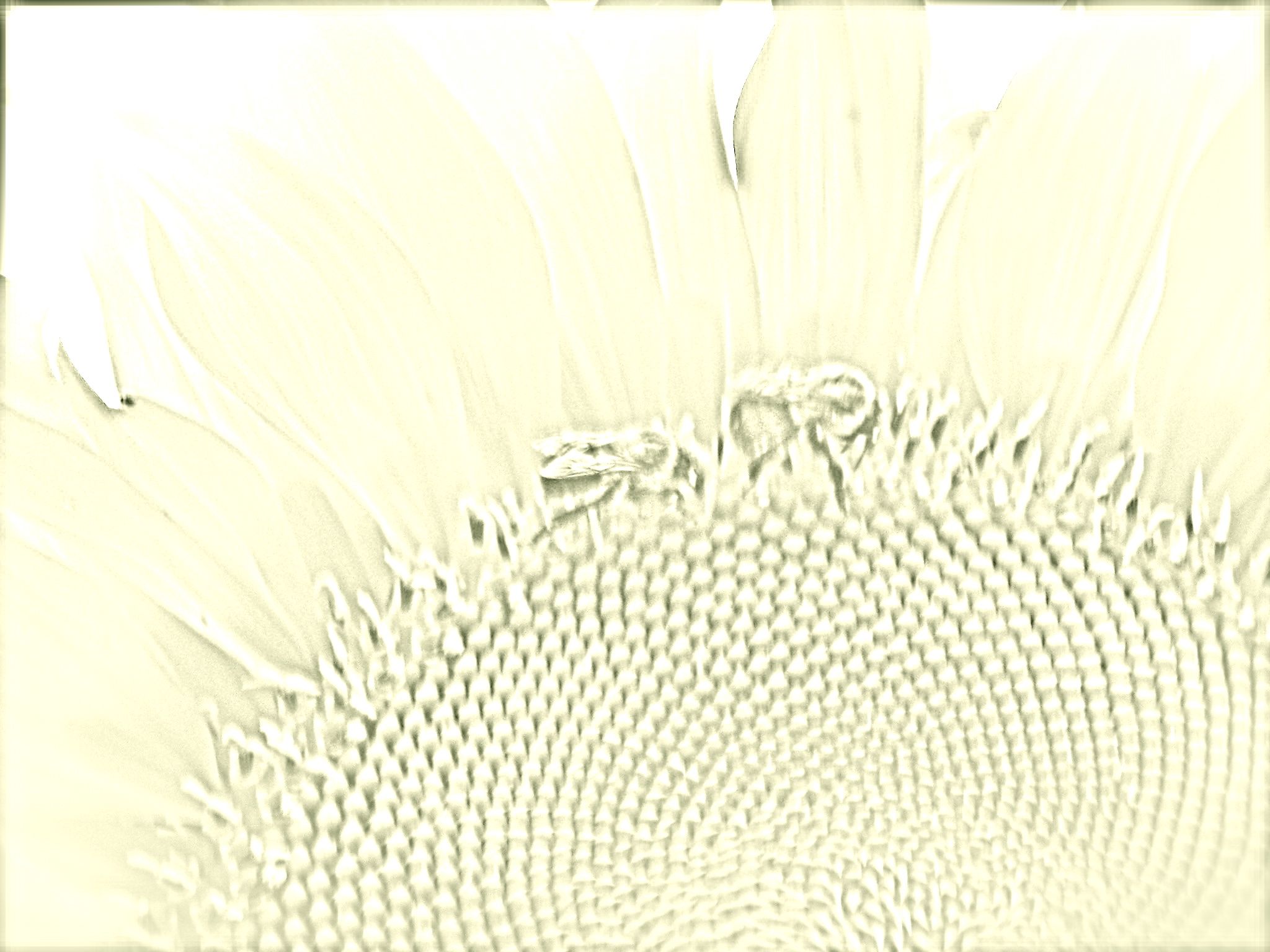
Psalm 139:14 tells us that we are awesomely and wonderfully made.  I did not just fabricate that.  As I meditated on this new idea that I was not a broken person, but I was, on the contrary, a whole and working person, I began to wonder what that might mean.  This is what I’ve come up with, and I’m going to use images to explain it.

Look at the image above.  You can probably discern the subject.  Can you find the two bees? Can you see the complexity of patterns? Can you discern color? I have filtered this image, removed color, altered exposure, saturation, temperature, and contrast.  I have faded the image on the edges.  This image is a metaphor for how we view ourselves.  Our life experiences act as filters for how we view ourselves.  What might a stinging remark from your mother before prom night alter in your self-image? What about an absent father? What about a rape or an incestuous relationship? Think about my abduction experience? Think about any kind of sexual violence or trauma? Could they remove all color from your self-image leaving you with only a black and white picture of yourself? It’s very possible.  If we have been exposed to terrible events or events that left us feeling out of control and terrible about ourselves, then how might we “look” to ourselves? Overexposed, colorless, shadowed, and faded? It explains why I feel broken sometimes.  Even being in a fallen world has activated our filters.  We are surrounded by all forms of death, destruction, poverty, illness, and suffering.  If we are able to live in the world without deactivating our empathy, then we will no doubt have learned to view the world through filters.  We must if we are to survive.  It is often too painful otherwise.

This is the same image filtered differently.  I’ve filtered out the color red.  This image looks very different from the other.  The bees stand out, but the petals do not.  The complexity of the seeds have become more visible, and the play of the shadows is more interesting.  Your life with more color, more pattern, less filtering.  Some trauma has been resolved.  Forgiveness has been at work here.  Forward progress.  There is more balance between light and dark.  Less extremes.  More vulnerability means more safety.  Better boundaries and more peace.

This is the image in full color with very little filtering.  I took this photograph yesterday evening in my backyard.  This is the flower of the Russian Mammoth Sunflower.  Look at the complexity of the seeds in the fruiting body and their colors.  Do you see all the details and the shadows in the petals? Do you see how the light reflects off the bees’ wings? These details were impossible to see in the other images due to the effects of the filters.  It does not mean that these details were not there.  The nature of the flower existed.  The bees were doing their work.  They existed.  This flower is standing majestically at about 12 feet in my backyard at this very moment tracking the sun as it moves across the sky, but you could not know this because of how I filtered the two previous images.  You knew that you were looking at a flower.  You did not know the color.  You may not have known the genus or species.  You noted the bees, but you could not notice their gossamer wings or their black and yellow thoraces.  You only knew what was allowed to pass through the filters.

In the unseen or invisible world, the eternal world which will never pass away but surrounds us yet, in God’s heart and mind, we are much like this sunflower.  We exist in full color in rich complexity.  Remember–Thank you for making me so wonderfully complex! Your workmanship is marvelous—how well I know it. (Psalm 139:14) We are not broken, out of order, lowly, violated, emotionally bankrupt, incomplete, separated, or crushed.  Our journey in the physical or visible world is to learn to bring forth, if you will, bit by bit the invisible reality of who we really are into the visible.  Essentially, step by step, we learn to see ourselves in full color and complexity rather than black and white, overexposed, and shadowy because that is who we really are regardless of what has happened to us or how we feel about ourselves. This process takes time, the help from very trustworthy allies, and an unwavering belief that you are so much more that what you currently see.  You are strong, beautiful, powerful, gifted, majestic, capable, talented, complex, and so valuable.

At the end of the famous 1 Corinthians 13 there is this verse:

For now we are looking in a mirror that gives only a dim (blurred) reflection [of reality as in a riddle or enigma], but then [when perfection comes] we shall see in reality and face to face! Now I know in part (imperfectly), but then I shall know and understand fully and clearly, even in the same manner as I have been fully and clearly known and understood [by God].

This verse comes at the end of a chapter entirely devoted to the nature of God’s love.  That is the perspective you must take when you read 1 Corinthians 13.  This chapter is often read at weddings because we want to be able to love each other with the love that is described in this beloved chapter of the New Testament.  What is profound is that God loves us like this.  This chapter could end in any number of ways, but it comes to a close with the announcement that what we see is only a blurry and dim reflection, a cracked and tarnished image, of what exists in the perfect reality.  What’s more, as we are today, sometimes lost in the haze of an imperfect self-image often rooted in deep psychic pain, we are “fully and clearly known and understood by God”.  This statement was made after an entire chapter devoted to the nature of God’s ability to love us.  Human beings are never asked to do something which God Himself does not.  This chapter is all about the nature of God’s love towards us.  So, you see, we may not see ourselves clearly, but God does, and He loves us completely, entirely, thoroughly regardless of everything and with everything.  And, He understands you.  You are understood.  That means that you are not alone.

That is what I learned last week.  When I feel the temptation to feel “broken” or ashamed, I must think again.  This is not an easy choice, but the question comes down to ‘who am I going to believe?’  Am I going to believe my father, my mother, my perpetrator, or even my wounded self? Well, I’m not going to believe my father, my mother, or my perpetrator.  Hell, no.  And, my wounded self is…well, wounded.

It’s something worth pondering as we continue to heal.